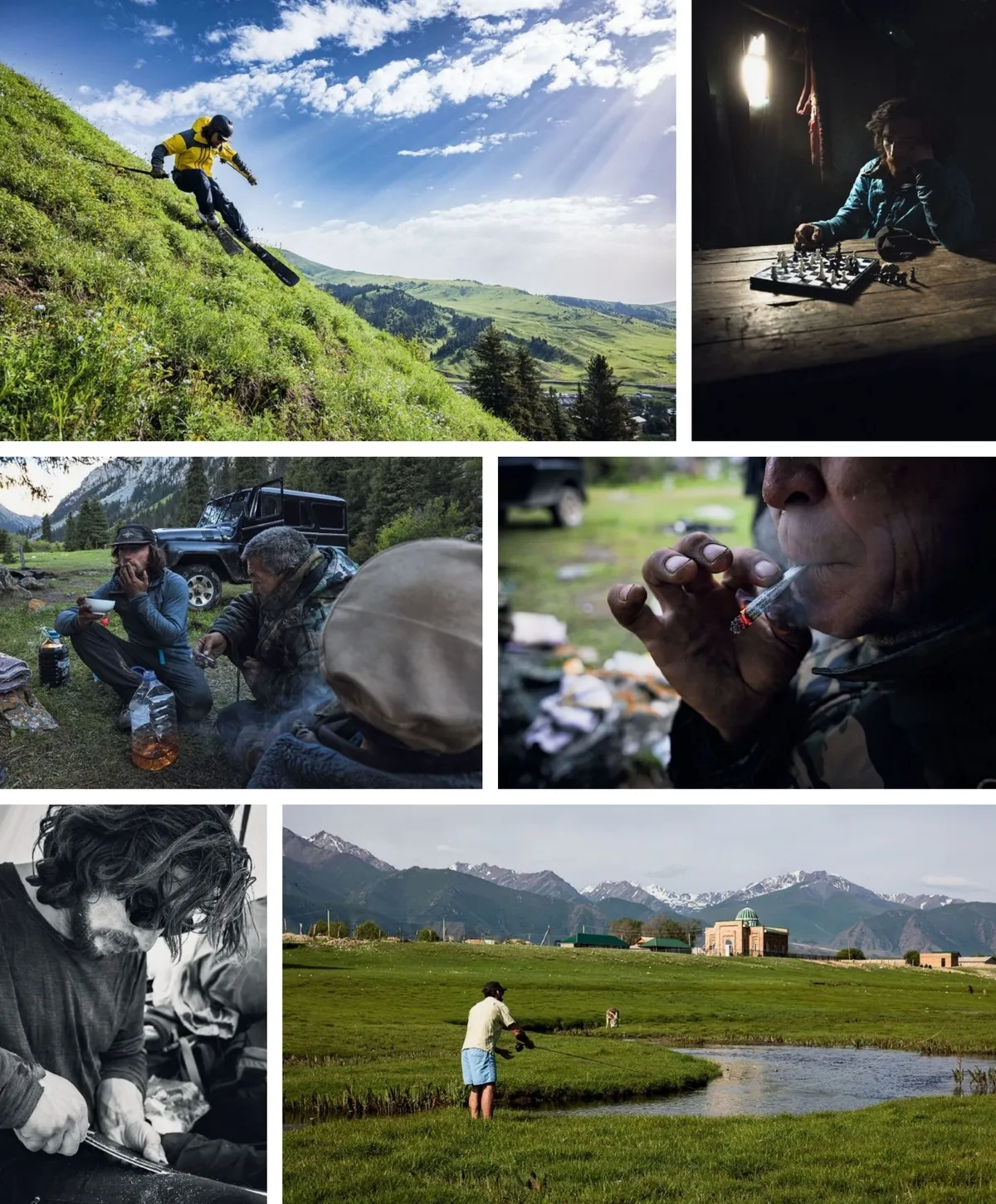
LEFT TO RIGHT, TOP TO BOTTOM Ultimately, snow conditions couldn’t dictate whether Adrien found qual-ity turns. In a remote corner of the country above a dilapidated mining town, Adrien launches into the green and brown pow. Adrien ponders his next move while trying not to get distracted by the resident mice chewing through his pack. Tea, baked potatoes and hand-rolled cigarettes made up most of the trail-building crew’s diet. We quickly learned capitalistic incentive, efficiency and workplace safety standards weren’t high on the priority list, and a day of work with the trail-building cohort stretched to five in a blur of vodka and tobacco rolled in newspaper. Adrien makes some last-second tuning modifications to his skis in high camp. Adrien was equally enthused about the prospect of flyfishing in Central Asia as he was about skiing there. Here he tries his luck in a quiet valley on the other side of the hills from bustling Issyk Kul. My mind drifted that final night, as it had for many nights, back to the line, the decisions that led us there and the ones that got us out. A world of rock and snow, so far from binary. We worked with our new friends for five days in a blur of vodka and newspaper-rolled tobacco. The next couple of weeks passed in a haze of gravel switchbacks, corner store ice creams and a lack of road signs. We skied on grass, drove across playas, and waded through muddy riverbeds looking for trout. Outside a small village in the foothills of the Tien Shan, Adrien cast his fly rod with meditative consistency. A lifelong student, he studies the water, matches the hatch, and makes calculated choices about a fluid environment. He ties his own flies. But when it comes to movement, he goes by feel. He casts unconsciously. There’s a momentary pause, subtle and required, between his back and forward casts. It’s not unlike the moment he clicks into his skis atop a consequential line. I observed with my camera. We were both in our elements. After an hour or so, I asked if I could try—I’d never cast a fly rod before. He borrowed the camera and we taught each other what we knew. We spoke about doing a fishing trip somewhere exotic. I’ll need to practice before then. We’d been out of the alpine for a week at that point. We had nowhere to be and everything to learn. Our days filled with chal-lenging philosophical conversations about value, time, comparison and upbringing. Our bellies filled with dozens of new foods. I watched Adrien choke down the sourest of fermented milks. Adrien watched me digest some ideas I’d never considered. Both were hard to stomach at times. Both were better shared. We needed that time. We let go of skiing aspirations and leaned into the liminal pause in-between. HALF-FINISHED new hotels adjacent abandoned Soviet ce-ment stood in sharp contrast against the evening haze settling over Bishkek. We sat on the back of our rental car (and home for the past month) on our final night and emptied a bottle of vodka that’d seen more of the country than most locals. We cheered to good health (den-soolukka!), one for the road (pososhok!), Kyrgyzstan, friendship and a few things that blurred together by the time we’d gotten that far. We pulled out the chess board a final time—31 pieces and a black rock that subbed for a missing rook. We were tipsy and tired. Still, Adrien asked questions as we played, acknowledged strategy, and ran scenarios out loud. I won again, but it was close. We played with intention and both learned—the student and the teacher, the analytic and the intuitive. My mind drifted that final night, as it had for many nights, back to the line, the decisions that led us there, and the ones that got us out. A world of snow and rock, so far from binary. It’s estimated that an unfathomable 10 to the 120 th power unique games exist in chess. And yet, even that number is finite. The game ultimately unfolds within a fixed container of rational moves. The high alpine requires you to engage in games of logic as well as chance. Seracs and cornices, graupel and the Greater Ranges—they exist in something more ephemeral, a space beyond black and white squares. Roulette, perhaps. When we met in the airport, the plan was to write a profile on Adrien—his talent and humility, his methodical approach and instinctual performance. After our close call, I thought it was a story about a slide in Kyrgyzstan. But thousands of avalanches come down in the Tien Shan every year. It’s less our chance presence than our reflection that gives it significance. The story has become one of reconciliation with the decisions, the events, the aftermath. I’ve been through seven drafts with my editor. Each revision yields a temporary catharsis—a feeling it’s settled. Each version back ties a knot in my stomach—a reminder it’s not. During our exit, Adrien and I passed an ancient gnarled pine twisting through talus—exposed roots revealed the simultaneous strength and fragility of its position. Our partnership felt similarly exposed by the slide. The path ahead was still convoluted. Mature conifers take decades to make a healthy return. The first growth after an avalanche is often a thicket of alder. Kyrgyzstan 065
The Ski Journal Volume 16, Issue 2: Page 65