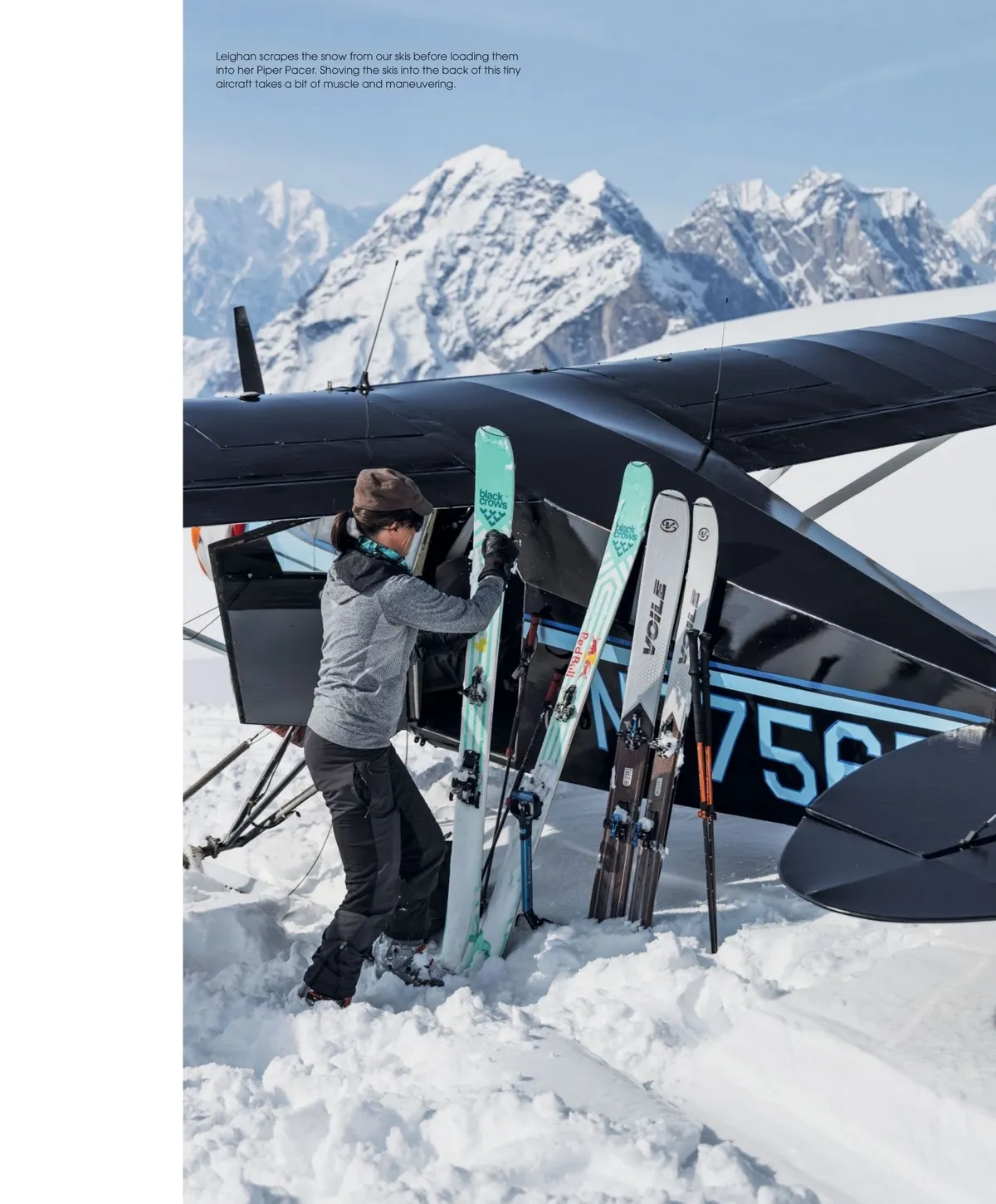
ONE SUMMER IN HER EARLY 20S , a climbing expedi-tion in the Alaska Range drove Leighan to finally pursue the power of flight. After a long week spent exploring the Ruth Gorge, her team helped their air taxi pilot dig his plane out of the snow—a slow, grueling task. As a token of gratitude, he gave the climbers a long tour of the range on their flight back to Talkeetna. The detour left Leighan glued to the window. “I decided right then and there that I had to become a glacier pilot,” she says. Later that summer, Leighan suffered a foot injury that ended her guiding season early. She decided to spend every penny she had on flight school, training for her private pilot’s license with an instructor in Talkeetna. Driven by the possibilities of far-flung adventures in the mountains, she expedited the process, complet-ing ground school and the required 40-plus hours of instructor flight time in just two months. “I wanted to have my own free will to access the range to go skiing or climbing,” she says. “I’ve been obsessed with the Alaska Range since I was little and combining that love with the ability to fly around within it—I had to make it a larger part of my life.” Leighan eventually settled in Talkeetna and started a fam-ily with her husband Tucker Chenoweth, a former ski patroller she’d met while “skiing too fast” during her stint as a liftie at Eldora Mountain. The town in the shadow of the Alaska Range would become a fantastic place to raise two girls while pursu-ing rugged ski adventures and mountain careers (Tucker now serves as the south district ranger for Denali National Park). While developing her skills as a mountain pilot in the early 2000s, Leighan’s background as a ski patroller, avalanche educa-tor and mountain guide gave her a unique advantage. Glacier flying comes with distinct challenges—newer glacier pilots often get stuck in difficult snow and have to spend the night out, or get heli-evacuated in extreme circumstances. You need to know a lot about snow to fly a ski plane. “It’s very, very tricky to judge from the air,” she says. “The Inuit have 36 words for snow…and I feel like I’ve seen every single one in one day of ski flying.” Following the lead of local backcountry ski pilots like Talkeetna’s Paul Roderick, Leighan became the lone female pilot among a small group who regularly accessed the Alaska Range for ski tours after work. While Talkeetna has very little ski terrain within driving distance, a short flight to the range holds endless possibilities—from steep, loaded chutes to mellow, scenic glacier runs. Many of the glaciers are unnamed and most of the terrain is unknown to the general public—a perfect haven for skiers seeking solitude. Recreational ski flying has gained popularity recently among Alaskans, and more and more skiers are using scrappy personal planes to avoid crowds and expand available terrain. “People used to mainly use bush planes to transport goods from point A to point B. Very few pilots were using their planes to access the backcountry,” Leighan explains. While she was among some of the earlier recreational ski pilots, she says an expanding group of young, athletic pilots is now approaching flying from a backcountry skier’s perspective. “It’s really fun to see how outdoor athletes take on the art of flying from the other side,” she says. She describes the growth as a “backcountry ski renaissance,” broadening the realm of possibility for backcountry skiers in Alaska. Many of these emerging ski pilots are women, a sign of a shifting culture in backcountry aviation. Once the lone woman in a field of men, Leighan now feels like “there’s an army at [her] back.” Meg Smith, who started flying just over three years ago, looked up to Leighan as an accomplished backcountry skier upon moving to Alaska in 2011. Since obtaining her pilot’s license, Meg has flown and skied remote corners of the Chugach where few have laid tracks. While she’d dreamed of flying since childhood, recreational pilots in Alaska opened her eyes to what she could accomplish with her own bush plane. “Leighan was doing such cool things with her plane,” Meg says. “I thought, ‘That’s what I want to do. Talk about writing your own story.’” As Leighan juggles her demanding career with being a mother to her two daughters, Scout and Skye, her personal plane serves as a line to the activities she loves most. Alaska Range pilots often work 14-hour days during the busy season, with unpredictable schedules dictated by weather and constantly changing conditions. Annual pilot-recurrent training coincides with spring climbing season, meaning workdays are jam-packed from April into the summer. But Talkeetna Air Taxi ensures two days off a week for their pilots, allowing important respite from the demands of work. During summer weekends, Leighan often flies her 4-and 9-year-old girls out for remote camping trips, and in the winter she sneaks away for solo ski missions as often as she can. Days spent touring alone in the mountains serve as a mental reset for Leighan. While she still seeks plenty of steep skiing, many of her solo days are spent on mellower terrain. “Being a big mountain skier was my entire identity before I had children,” she explains. “I don’t have to ski off Meteorite anymore—I love gardening with my children, flying around in the jagged mountains, and getting out to ski when I can. I feel like I’ve lived a dozen people’s lifetimes.” 078 The Ski Journal
The Ski Journal Volume 16, Issue 2: Page 78