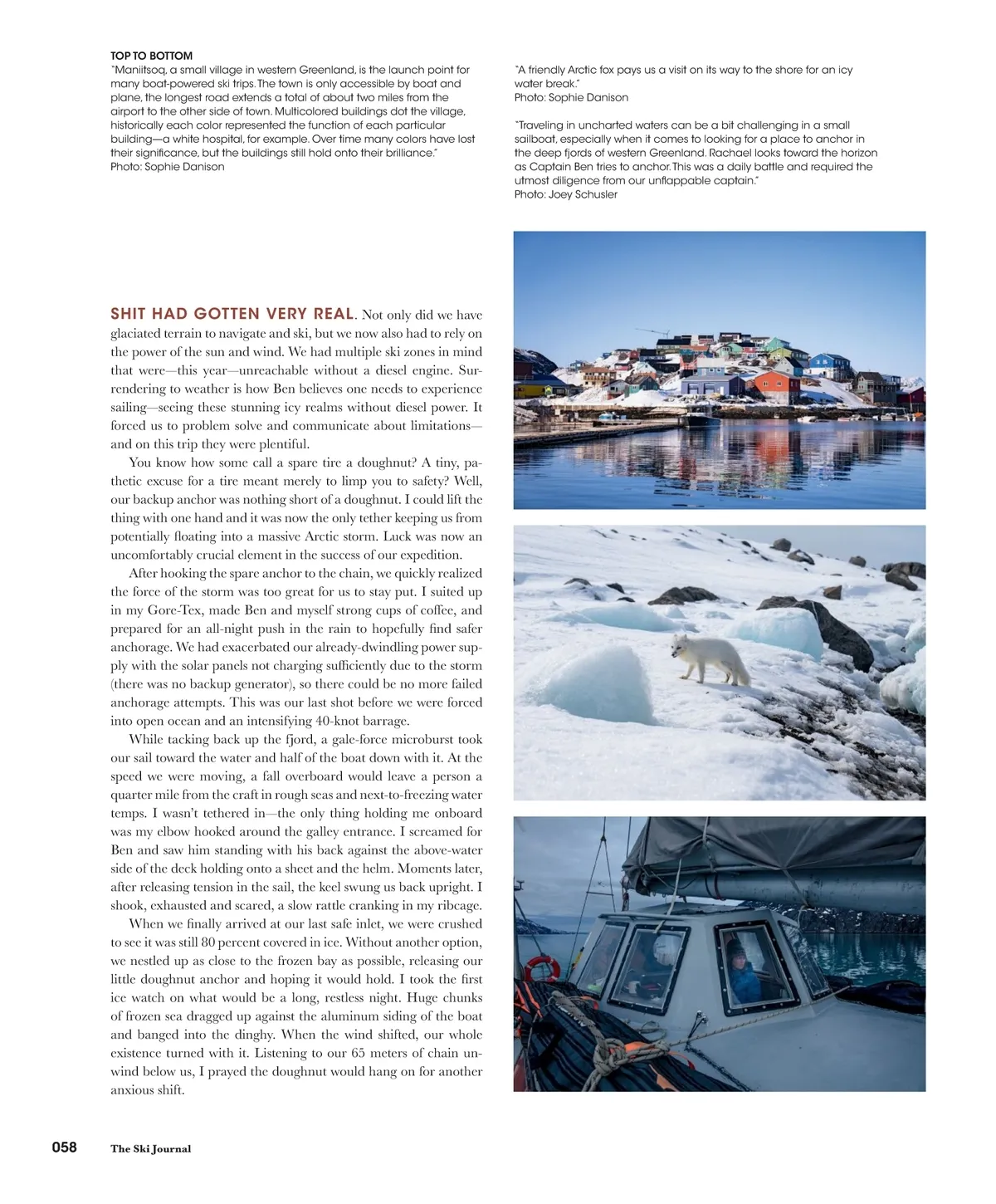
TOP TO BOTTOM “Maniitsoq, a small village in western Greenland, is the launch point for many boat-powered ski trips. The town is only accessible by boat and plane, the longest road extends a total of about two miles from the airport to the other side of town. Multicolored buildings dot the village, historically each color represented the function of each particular building—a white hospital, for example. Over time many colors have lost their significance, but the buildings still hold onto their brilliance.” Photo: Sophie Danison “A friendly Arctic fox pays us a visit on its way to the shore for an icy water break.” Photo: Sophie Danison “Traveling in uncharted waters can be a bit challenging in a small sailboat, especially when it comes to looking for a place to anchor in the deep fjords of western Greenland. Rachael looks toward the horizon as Captain Ben tries to anchor. This was a daily battle and required the utmost diligence from our unflappable captain.” Photo: Joey Schusler SHIT HAD GOTTEN VERY REAL . Not only did we have glaciated terrain to navigate and ski, but we now also had to rely on the power of the sun and wind. We had multiple ski zones in mind that were—this year—unreachable without a diesel engine. Sur-rendering to weather is how Ben believes one needs to experience sailing—seeing these stunning icy realms without diesel power. It forced us to problem solve and communicate about limitations— and on this trip they were plentiful. You know how some call a spare tire a doughnut? A tiny, pa-thetic excuse for a tire meant merely to limp you to safety? Well, our backup anchor was nothing short of a doughnut. I could lift the thing with one hand and it was now the only tether keeping us from potentially floating into a massive Arctic storm. Luck was now an uncomfortably crucial element in the success of our expedition. After hooking the spare anchor to the chain, we quickly realized the force of the storm was too great for us to stay put. I suited up in my Gore-Tex, made Ben and myself strong cups of coffee, and prepared for an all-night push in the rain to hopefully find safer anchorage. We had exacerbated our already-dwindling power sup-ply with the solar panels not charging sufficiently due to the storm (there was no backup generator), so there could be no more failed anchorage attempts. This was our last shot before we were forced into open ocean and an intensifying 40-knot barrage. While tacking back up the fjord, a gale-force microburst took our sail toward the water and half of the boat down with it. At the speed we were moving, a fall overboard would leave a person a quarter mile from the craft in rough seas and next-to-freezing water temps. I wasn’t tethered in—the only thing holding me onboard was my elbow hooked around the galley entrance. I screamed for Ben and saw him standing with his back against the above-water side of the deck holding onto a sheet and the helm. Moments later, after releasing tension in the sail, the keel swung us back upright. I shook, exhausted and scared, a slow rattle cranking in my ribcage. When we finally arrived at our last safe inlet, we were crushed to see it was still 80 percent covered in ice. Without another option, we nestled up as close to the frozen bay as possible, releasing our little doughnut anchor and hoping it would hold. I took the first ice watch on what would be a long, restless night. Huge chunks of frozen sea dragged up against the aluminum siding of the boat and banged into the dinghy. When the wind shifted, our whole existence turned with it. Listening to our 65 meters of chain un-wind below us, I prayed the doughnut would hang on for another anxious shift. 058 The Ski Journal
The Ski Journal Volume 16, Issue 3: Page 58