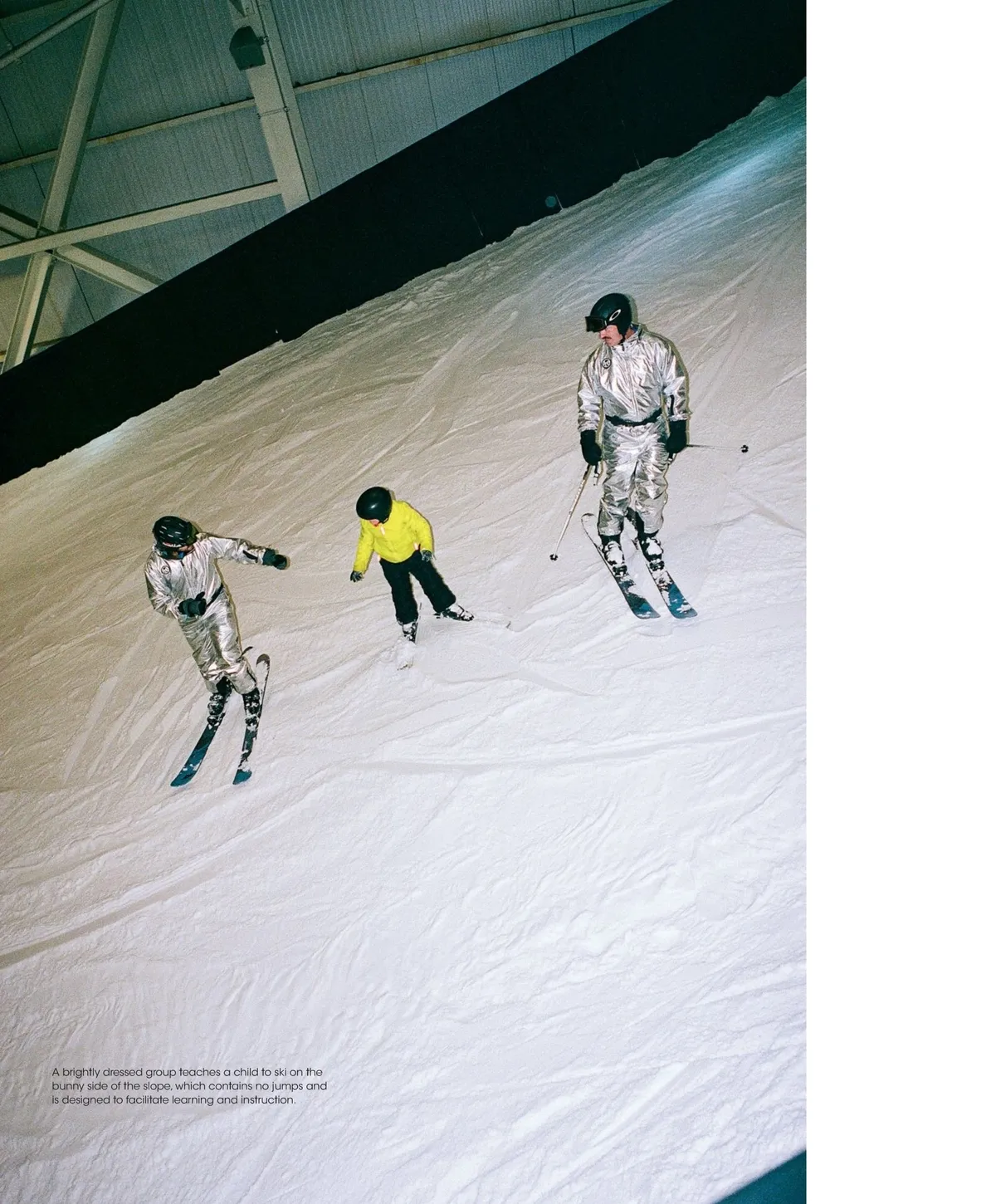
Words KADE KRICHKO Photos and Captions OK MCCAUSLAND PASS through the sliding doors at the end of the concrete parking garage. Ignore the construction signs for the Mrs. Fields cookie store and drop into the human current as it ebbs from one ghastly lit shop to the next. Avoid the fuzzy mechanical animals (and the line at Starbucks) and make your way across the cavernous pavilion. Just beyond the stage, take the escalator up to the second floor. There, somewhere between Zara and Sweet Factory you’ll find it: Big Snow—skiing’s missing link. made skiing feel a world away. When Big Snow opened its doors in December of 2019, that changed. In addition to being a 30-minute bus ride from Manhattan’s Port Authority, the ski center offered full-service equipment rental—from skis and boots to jackets, pants and helmets—and affordable lift tickets (as cheap as $69 for full rentals and two hours on the hill). In its first year alone (cut short because of the pandemic), the center saw over 90,000 first-time snowsports participants, nearly 1 percent of all new skiers and snowboarders during that period. For the first time, New York City had a ski hill to call its own. “[Big Snow] is actively bringing people to the sport,” says McCausland after a September visit to the center. A Seattleite now based in Brooklyn, she grew up near the Cascades and had her own ideas of what a ski hill should look like, “At first glance, you’re like ‘For real? A ski resort in a mall?’” she says. “But people are stoked that this exists. I don’t think the irony is lost on anyone, but no one gives a shit because they’re having a great time.” A pair of skiers in shiny Devo-esque one-pieces, a New Jersey octogenarian picking up skiing again after decades, a Utah park rat traveling the country and living out of his van—all coexisting in one temperature-regulated icebox. Set to 28 degrees Fahr-enheit year-round, Big Snow gives skiers and snowboarders a chance to score turns almost 365 days a year. In addition to two beginner slopes and a pair of surface lifts, the facility also has an intermediate run and a terrain park jammed with jumps and rails. At only 160 feet of vertical drop and spread across just four acres, Big Snow is one of the smallest resorts in North America—and also probably the only ski hill where you can listen to Christmas music and order a peppermint mocha in tank tops and cutoff jeans, according to McCausland. But she also thinks the tight quarters have an unex-pected upside in that they force patrons to interact and ultimately build community. The first indoor ski center in North America, Big Snow is carved out from what New York-based photographer OK McCausland calls, “an American nightmare.” American Dream, in East Rutherford, NJ, is the second-largest mall in the United States. It’s less than 10 miles from Times Square. A testament to our bizarre obsession with entertainment and commerce, the complex also features a Nickelodeon-themed amusement park, an aquarium and a surf wave. But it’s the 180,000-square-foot snow refrigerator that provides something beyond the excess of consumerism, a rare and overdue oppor-tunity in the snowsports realm: Big Snow has brought the mountains to the people. Nearly 20 million people live in the New York City metro area, over 6 percent of the U.S. population. Yet even with ski area Mountain Creek, NJ, just an hour and a half from city limits, for many, limited transportation options, lack of equipment and high-priced entry fees have New Jersey 067
The Ski Journal Volume 16, Issue 3: Page 67