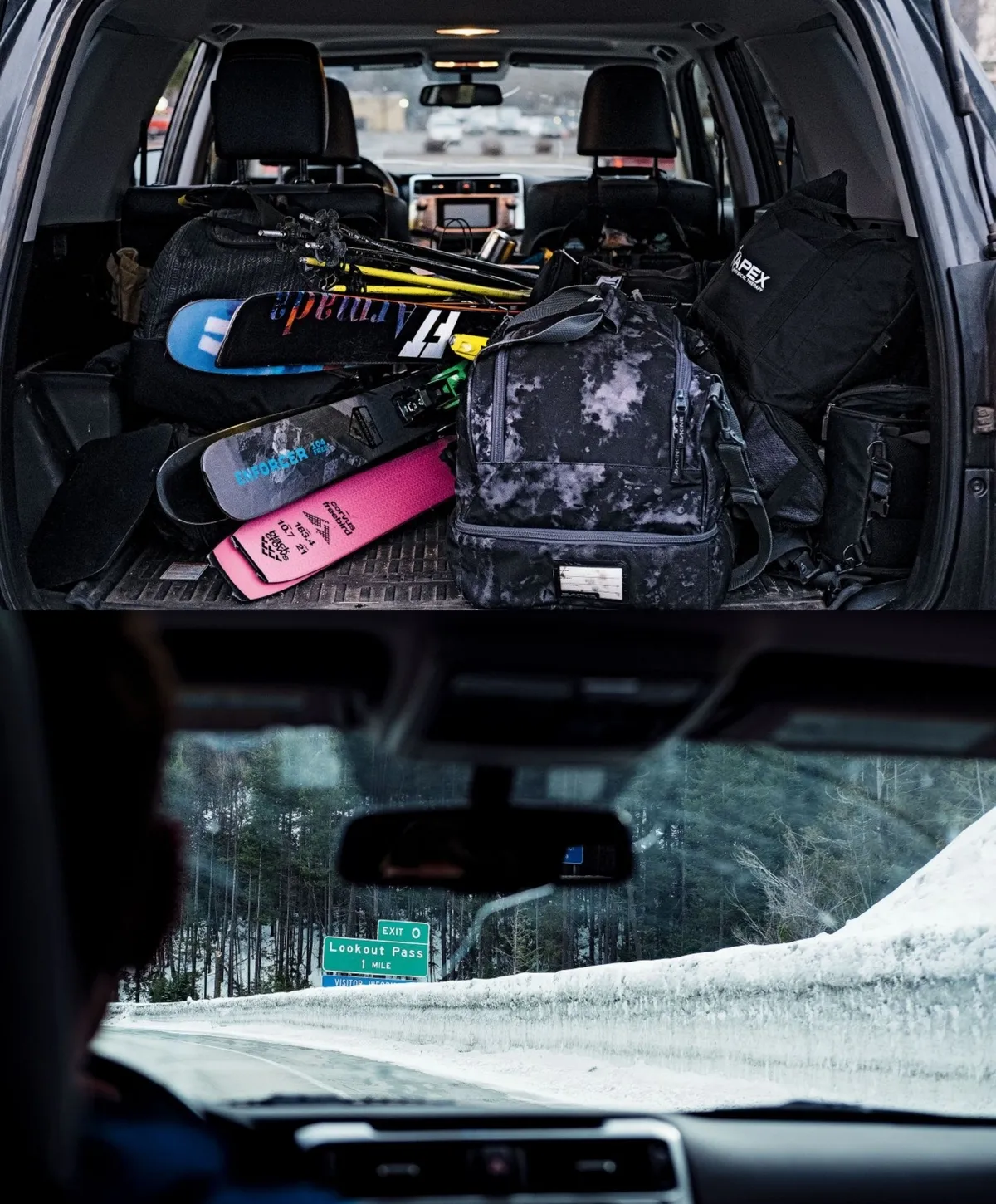
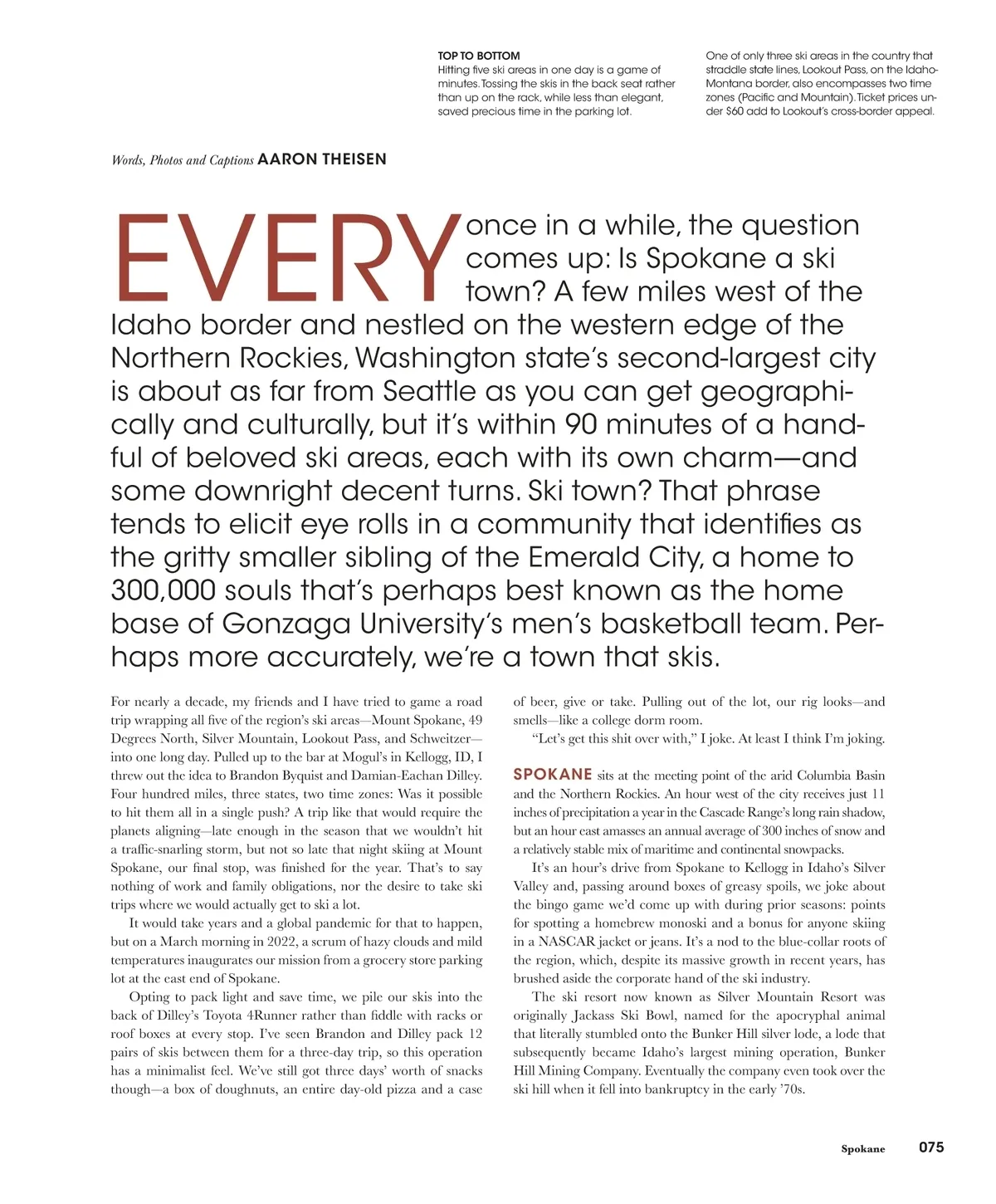
TOP TO BOTTOM Hitting five ski areas in one day is a game of minutes. Tossing the skis in the back seat rather than up on the rack, while less than elegant, saved precious time in the parking lot. One of only three ski areas in the country that straddle state lines, Lookout Pass, on the Idaho-Montana border, also encompasses two time zones (Pacific and Mountain). Ticket prices un-der $60 add to Lookout’s cross-border appeal. Words, Photos and Captions AARON THEISEN once in a while, the question comes up: Is Spokane a ski town? A few miles west of the Idaho border and nestled on the western edge of the Northern Rockies, Washington state’s second-largest city is about as far from Seattle as you can get geographi-cally and culturally, but it’s within 90 minutes of a hand-ful of beloved ski areas, each with its own charm—and some downright decent turns. Ski town? That phrase tends to elicit eye rolls in a community that identifies as the gritty smaller sibling of the Emerald City, a home to 300,000 souls that’s perhaps best known as the home base of Gonzaga University’s men’s basketball team. Per-haps more accurately, we’re a town that skis. For nearly a decade, my friends and I have tried to game a road trip wrapping all five of the region’s ski areas—Mount Spokane, 49 Degrees North, Silver Mountain, Lookout Pass, and Schweitzer— into one long day. Pulled up to the bar at Mogul’s in Kellogg, ID, I threw out the idea to Brandon Byquist and Damian-Eachan Dilley. Four hundred miles, three states, two time zones: Was it possible to hit them all in a single push? A trip like that would require the planets aligning—late enough in the season that we wouldn’t hit a traffic-snarling storm, but not so late that night skiing at Mount Spokane, our final stop, was finished for the year. That’s to say nothing of work and family obligations, nor the desire to take ski trips where we would actually get to ski a lot. It would take years and a global pandemic for that to happen, but on a March morning in 2022, a scrum of hazy clouds and mild temperatures inaugurates our mission from a grocery store parking lot at the east end of Spokane. Opting to pack light and save time, we pile our skis into the back of Dilley’s Toyota 4Runner rather than fiddle with racks or roof boxes at every stop. I’ve seen Brandon and Dilley pack 12 pairs of skis between them for a three-day trip, so this operation has a minimalist feel. We’ve still got three days’ worth of snacks though—a box of doughnuts, an entire day-old pizza and a case of beer, give or take. Pulling out of the lot, our rig looks—and smells—like a college dorm room. “Let’s get this shit over with,” I joke. At least I think I’m joking. EVERY SPOKANE sits at the meeting point of the arid Columbia Basin and the Northern Rockies. An hour west of the city receives just 11 inches of precipitation a year in the Cascade Range’s long rain shadow, but an hour east amasses an annual average of 300 inches of snow and a relatively stable mix of maritime and continental snowpacks. It’s an hour’s drive from Spokane to Kellogg in Idaho’s Silver Valley and, passing around boxes of greasy spoils, we joke about the bingo game we’d come up with during prior seasons: points for spotting a homebrew monoski and a bonus for anyone skiing in a NASCAR jacket or jeans. It’s a nod to the blue-collar roots of the region, which, despite its massive growth in recent years, has brushed aside the corporate hand of the ski industry. The ski resort now known as Silver Mountain Resort was originally Jackass Ski Bowl, named for the apocryphal animal that literally stumbled onto the Bunker Hill silver lode, a lode that subsequently became Idaho’s largest mining operation, Bunker Hill Mining Company. Eventually the company even took over the ski hill when it fell into bankruptcy in the early ’70s. Spokane 075
The Ski Journal Volume 16, Issue 3: Page 75