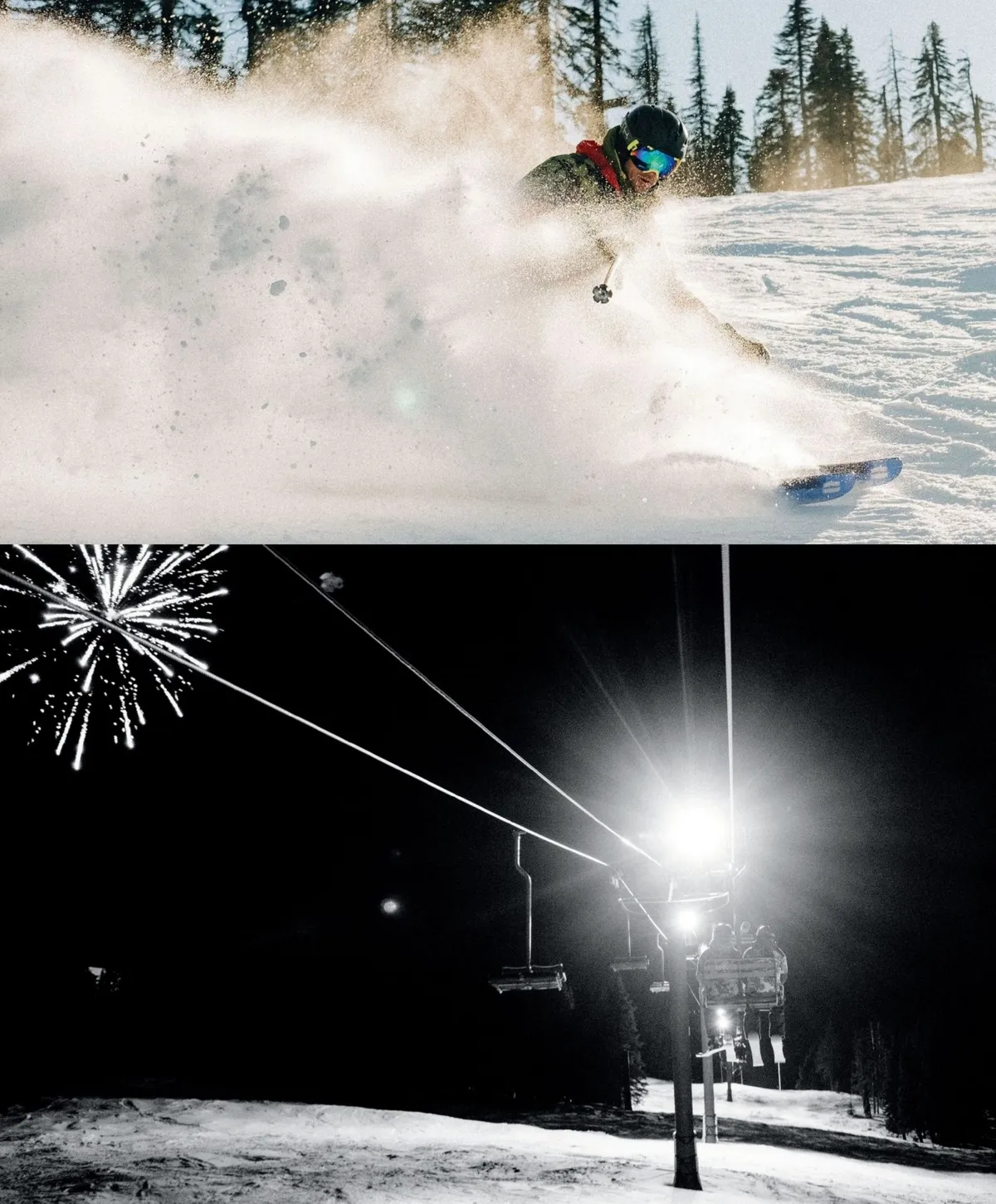
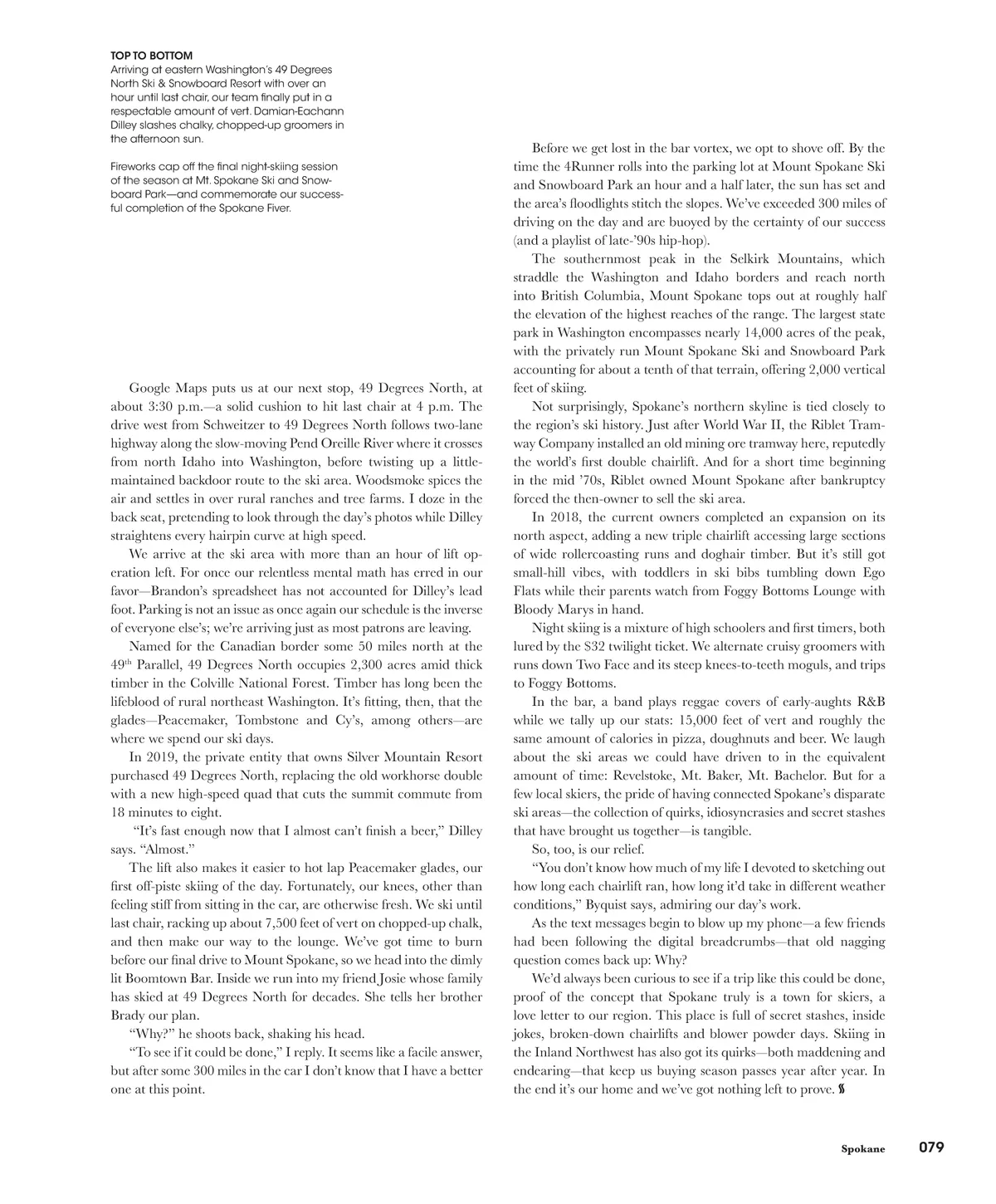
TOP TO BOTTOM Arriving at eastern Washington’s 49 Degrees North Ski & Snowboard Resort with over an hour until last chair, our team finally put in a respectable amount of vert. Damian-Eachann Dilley slashes chalky, chopped-up groomers in the afternoon sun. Fireworks cap off the final night-skiing session of the season at Mt. Spokane Ski and Snow-board Park—and commemorate our success-ful completion of the Spokane Fiver. Google Maps puts us at our next stop, 49 Degrees North, at about 3:30 p.m.—a solid cushion to hit last chair at 4 p.m. The drive west from Schweitzer to 49 Degrees North follows two-lane highway along the slow-moving Pend Oreille River where it crosses from north Idaho into Washington, before twisting up a little-maintained backdoor route to the ski area. Woodsmoke spices the air and settles in over rural ranches and tree farms. I doze in the back seat, pretending to look through the day’s photos while Dilley straightens every hairpin curve at high speed. We arrive at the ski area with more than an hour of lift op-eration left. For once our relentless mental math has erred in our favor—Brandon’s spreadsheet has not accounted for Dilley’s lead foot. Parking is not an issue as once again our schedule is the inverse of everyone else’s; we’re arriving just as most patrons are leaving. Named for the Canadian border some 50 miles north at the 49 th Parallel, 49 Degrees North occupies 2,300 acres amid thick timber in the Colville National Forest. Timber has long been the lifeblood of rural northeast Washington. It’s fitting, then, that the glades—Peacemaker, Tombstone and Cy’s, among others—are where we spend our ski days. In 2019, the private entity that owns Silver Mountain Resort purchased 49 Degrees North, replacing the old workhorse double with a new high-speed quad that cuts the summit commute from 18 minutes to eight. “It’s fast enough now that I almost can’t finish a beer,” Dilley says. “Almost.” The lift also makes it easier to hot lap Peacemaker glades, our first off-piste skiing of the day. Fortunately, our knees, other than feeling stiff from sitting in the car, are otherwise fresh. We ski until last chair, racking up about 7,500 feet of vert on chopped-up chalk, and then make our way to the lounge. We’ve got time to burn before our final drive to Mount Spokane, so we head into the dimly lit Boomtown Bar. Inside we run into my friend Josie whose family has skied at 49 Degrees North for decades. She tells her brother Brady our plan. “Why?” he shoots back, shaking his head. “To see if it could be done,” I reply. It seems like a facile answer, but after some 300 miles in the car I don’t know that I have a better one at this point. Before we get lost in the bar vortex, we opt to shove off. By the time the 4Runner rolls into the parking lot at Mount Spokane Ski and Snowboard Park an hour and a half later, the sun has set and the area’s floodlights stitch the slopes. We’ve exceeded 300 miles of driving on the day and are buoyed by the certainty of our success (and a playlist of late-’90s hip-hop). The southernmost peak in the Selkirk Mountains, which straddle the Washington and Idaho borders and reach north into British Columbia, Mount Spokane tops out at roughly half the elevation of the highest reaches of the range. The largest state park in Washington encompasses nearly 14,000 acres of the peak, with the privately run Mount Spokane Ski and Snowboard Park accounting for about a tenth of that terrain, offering 2,000 vertical feet of skiing. Not surprisingly, Spokane’s northern skyline is tied closely to the region’s ski history. Just after World War II, the Riblet Tram-way Company installed an old mining ore tramway here, reputedly the world’s first double chairlift. And for a short time beginning in the mid ’70s, Riblet owned Mount Spokane after bankruptcy forced the then-owner to sell the ski area. In 2018, the current owners completed an expansion on its north aspect, adding a new triple chairlift accessing large sections of wide rollercoasting runs and doghair timber. But it’s still got small-hill vibes, with toddlers in ski bibs tumbling down Ego Flats while their parents watch from Foggy Bottoms Lounge with Bloody Marys in hand. Night skiing is a mixture of high schoolers and first timers, both lured by the $32 twilight ticket. We alternate cruisy groomers with runs down Two Face and its steep knees-to-teeth moguls, and trips to Foggy Bottoms. In the bar, a band plays reggae covers of early-aughts R&B while we tally up our stats: 15,000 feet of vert and roughly the same amount of calories in pizza, doughnuts and beer. We laugh about the ski areas we could have driven to in the equivalent amount of time: Revelstoke, Mt. Baker, Mt. Bachelor. But for a few local skiers, the pride of having connected Spokane’s disparate ski areas—the collection of quirks, idiosyncrasies and secret stashes that have brought us together—is tangible. So, too, is our relief. “You don’t know how much of my life I devoted to sketching out how long each chairlift ran, how long it’d take in different weather conditions,” Byquist says, admiring our day’s work. As the text messages begin to blow up my phone—a few friends had been following the digital breadcrumbs—that old nagging question comes back up: Why? We’d always been curious to see if a trip like this could be done, proof of the concept that Spokane truly is a town for skiers, a love letter to our region. This place is full of secret stashes, inside jokes, broken-down chairlifts and blower powder days. Skiing in the Inland Northwest has also got its quirks—both maddening and endearing—that keep us buying season passes year after year. In the end it’s our home and we’ve got nothing left to prove. Spokane 079
The Ski Journal Volume 16, Issue 3: Page 79