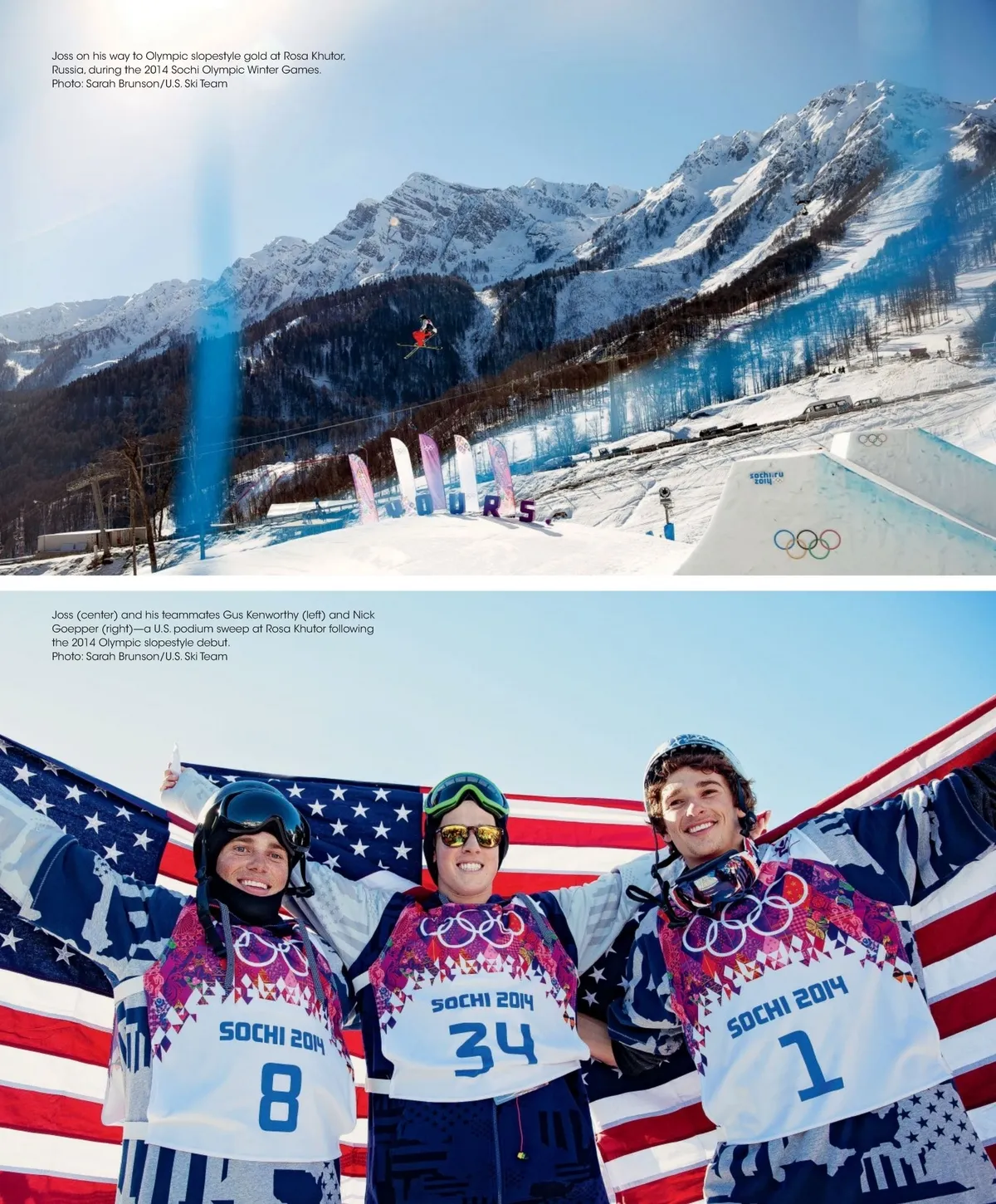
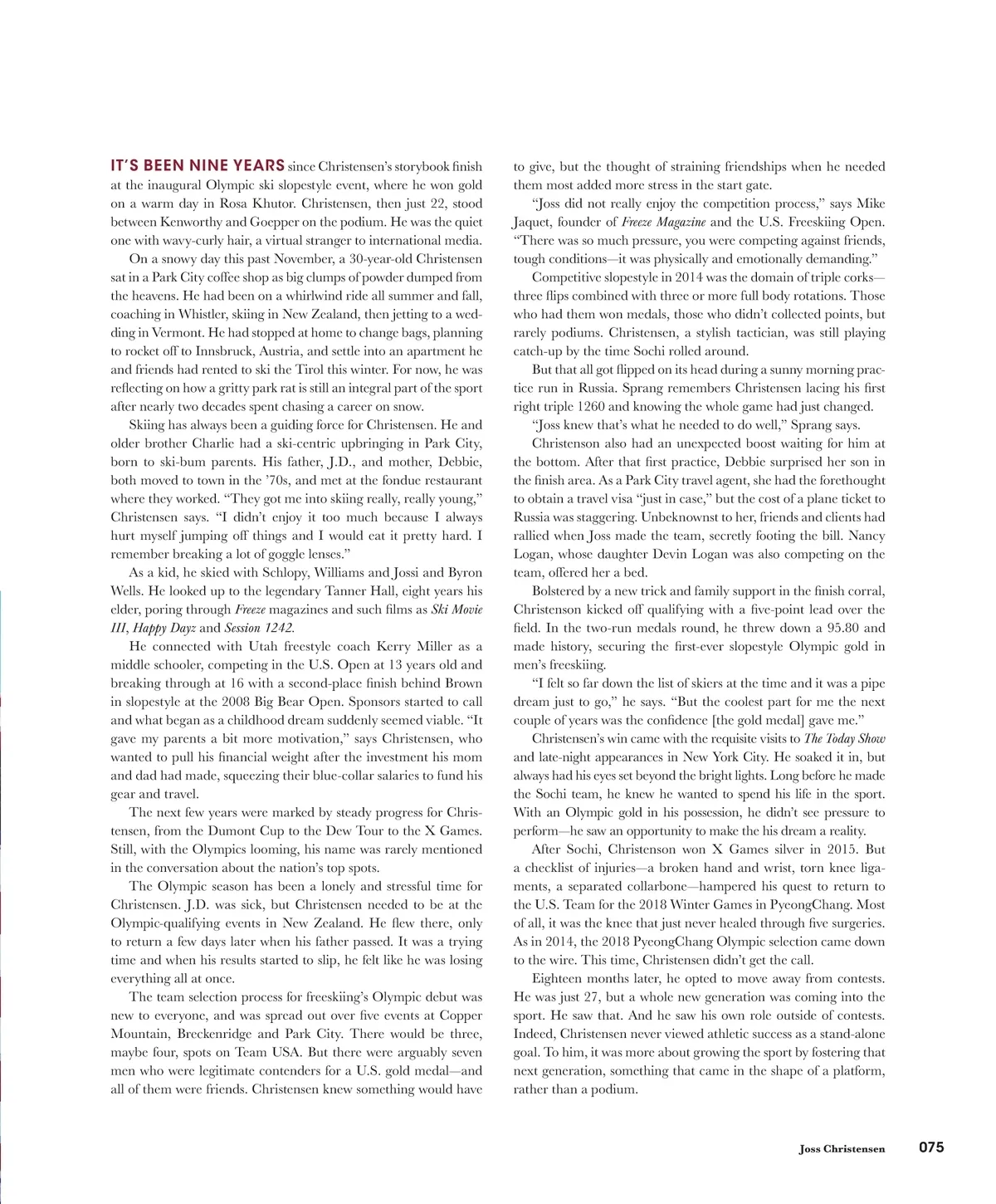
IT’S BEEN NINE YEARS since Christensen’s storybook finish at the inaugural Olympic ski slopestyle event, where he won gold on a warm day in Rosa Khutor. Christensen, then just 22, stood between Kenworthy and Goepper on the podium. He was the quiet one with wavy-curly hair, a virtual stranger to international media. On a snowy day this past November, a 30-year-old Christensen sat in a Park City coffee shop as big clumps of powder dumped from the heavens. He had been on a whirlwind ride all summer and fall, coaching in Whistler, skiing in New Zealand, then jetting to a wed-ding in Vermont. He had stopped at home to change bags, planning to rocket off to Innsbruck, Austria, and settle into an apartment he and friends had rented to ski the Tirol this winter. For now, he was reflecting on how a gritty park rat is still an integral part of the sport after nearly two decades spent chasing a career on snow. Skiing has always been a guiding force for Christensen. He and older brother Charlie had a ski-centric upbringing in Park City, born to ski-bum parents. His father, J.D., and mother, Debbie, both moved to town in the ’70s, and met at the fondue restaurant where they worked. “They got me into skiing really, really young,” Christensen says. “I didn’t enjoy it too much because I always hurt myself jumping off things and I would eat it pretty hard. I remember breaking a lot of goggle lenses.” As a kid, he skied with Schlopy, Williams and Jossi and Byron Wells. He looked up to the legendary Tanner Hall, eight years his elder, poring through Freeze magazines and such films as Ski Movie III , Happy Dayz and Session 1242. He connected with Utah freestyle coach Kerry Miller as a middle schooler, competing in the U.S. Open at 13 years old and breaking through at 16 with a second-place finish behind Brown in slopestyle at the 2008 Big Bear Open. Sponsors started to call and what began as a childhood dream suddenly seemed viable. “It gave my parents a bit more motivation,” says Christensen, who wanted to pull his financial weight after the investment his mom and dad had made, squeezing their blue-collar salaries to fund his gear and travel. The next few years were marked by steady progress for Chris-tensen, from the Dumont Cup to the Dew Tour to the X Games. Still, with the Olympics looming, his name was rarely mentioned in the conversation about the nation’s top spots. The Olympic season has been a lonely and stressful time for Christensen. J.D. was sick, but Christensen needed to be at the Olympic-qualifying events in New Zealand. He flew there, only to return a few days later when his father passed. It was a trying time and when his results started to slip, he felt like he was losing everything all at once. The team selection process for freeskiing’s Olympic debut was new to everyone, and was spread out over five events at Copper Mountain, Breckenridge and Park City. There would be three, maybe four, spots on Team USA. But there were arguably seven men who were legitimate contenders for a U.S. gold medal—and all of them were friends. Christensen knew something would have to give, but the thought of straining friendships when he needed them most added more stress in the start gate. “Joss did not really enjoy the competition process,” says Mike Jaquet, founder of Freeze Magazine and the U.S. Freeskiing Open. “There was so much pressure, you were competing against friends, tough conditions—it was physically and emotionally demanding.” Competitive slopestyle in 2014 was the domain of triple corks— three flips combined with three or more full body rotations. Those who had them won medals, those who didn’t collected points, but rarely podiums. Christensen, a stylish tactician, was still playing catch-up by the time Sochi rolled around. But that all got flipped on its head during a sunny morning prac-tice run in Russia. Sprang remembers Christensen lacing his first right triple 1260 and knowing the whole game had just changed. “Joss knew that’s what he needed to do well,” Sprang says. Christenson also had an unexpected boost waiting for him at the bottom. After that first practice, Debbie surprised her son in the finish area. As a Park City travel agent, she had the forethought to obtain a travel visa “just in case,” but the cost of a plane ticket to Russia was staggering. Unbeknownst to her, friends and clients had rallied when Joss made the team, secretly footing the bill. Nancy Logan, whose daughter Devin Logan was also competing on the team, offered her a bed. Bolstered by a new trick and family support in the finish corral, Christenson kicked off qualifying with a five-point lead over the field. In the two-run medals round, he threw down a 95.80 and made history, securing the first-ever slopestyle Olympic gold in men’s freeskiing. “I felt so far down the list of skiers at the time and it was a pipe dream just to go,” he says. “But the coolest part for me the next couple of years was the confidence [the gold medal] gave me.” Christensen’s win came with the requisite visits to The Today Show and late-night appearances in New York City. He soaked it in, but always had his eyes set beyond the bright lights. Long before he made the Sochi team, he knew he wanted to spend his life in the sport. With an Olympic gold in his possession, he didn’t see pressure to perform—he saw an opportunity to make the his dream a reality. After Sochi, Christenson won X Games silver in 2015. But a checklist of injuries—a broken hand and wrist, torn knee liga-ments, a separated collarbone—hampered his quest to return to the U.S. Team for the 2018 Winter Games in PyeongChang. Most of all, it was the knee that just never healed through five surgeries. As in 2014, the 2018 PyeongChang Olympic selection came down to the wire. This time, Christensen didn’t get the call. Eighteen months later, he opted to move away from contests. He was just 27, but a whole new generation was coming into the sport. He saw that. And he saw his own role outside of contests. Indeed, Christensen never viewed athletic success as a stand-alone goal. To him, it was more about growing the sport by fostering that next generation, something that came in the shape of a platform, rather than a podium. Joss Christensen 075
The Ski Journal Volume 16, Issue 4: Page 75