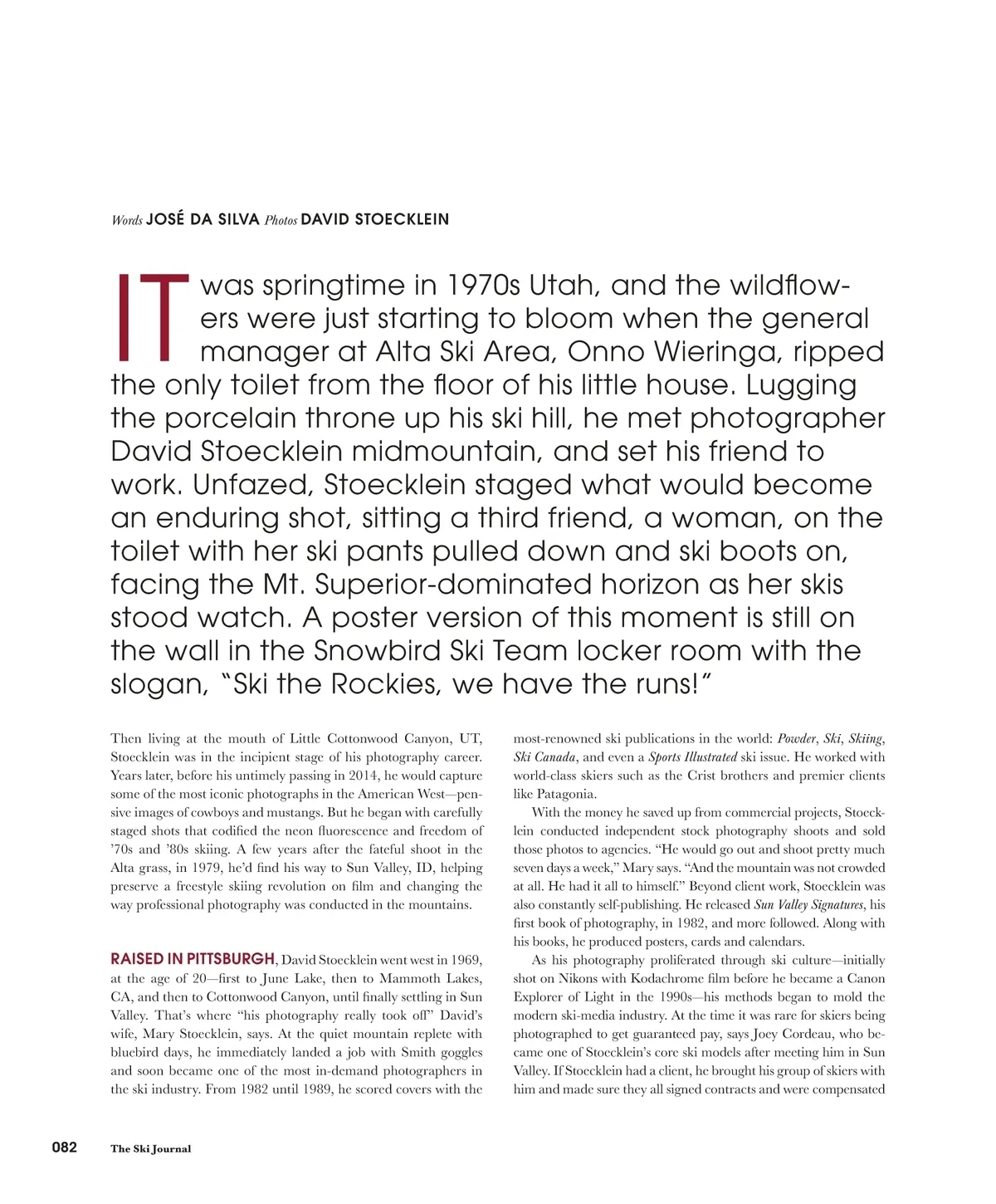
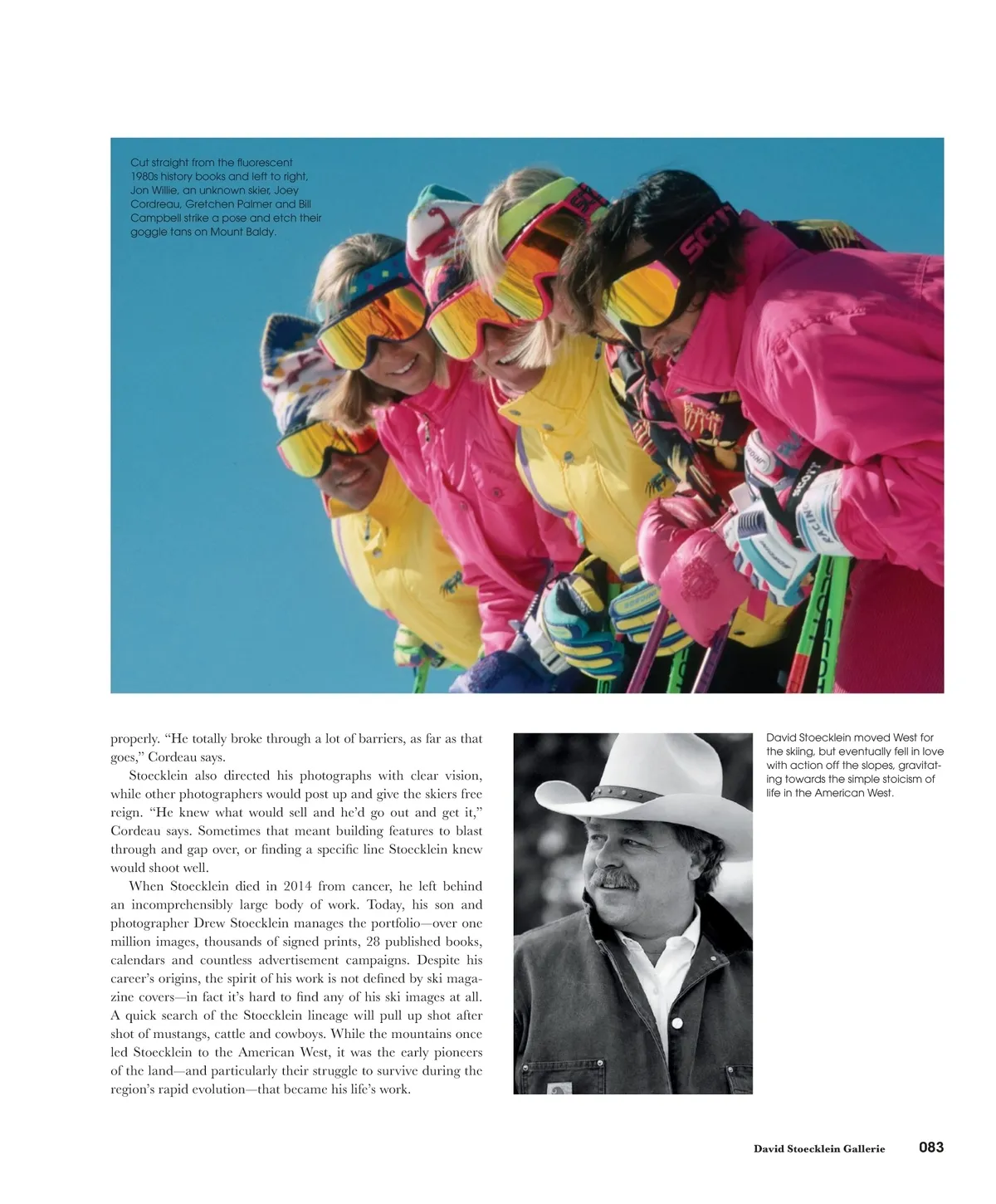
Words JOSÉ DA SILVA Photos DAVID STOECKLEIN IT was springtime in 1970s Utah, and the wildflow-ers were just starting to bloom when the general manager at Alta Ski Area, Onno Wieringa, ripped the only toilet from the floor of his little house. Lugging the porcelain throne up his ski hill, he met photographer David Stoecklein midmountain, and set his friend to work. Unfazed, Stoecklein staged what would become an enduring shot, sitting a third friend, a woman, on the toilet with her ski pants pulled down and ski boots on, facing the Mt. Superior-dominated horizon as her skis stood watch. A poster version of this moment is still on the wall in the Snowbird Ski Team locker room with the slogan, “Ski the Rockies, we have the runs!” most-renowned ski publications in the world: Powder , Ski , Skiing , Ski Canada , and even a Sports Illustrated ski issue. He worked with world-class skiers such as the Crist brothers and premier clients like Patagonia. With the money he saved up from commercial projects, Stoeck-lein conducted independent stock photography shoots and sold those photos to agencies. “He would go out and shoot pretty much seven days a week,” Mary says. “And the mountain was not crowded at all. He had it all to himself.” Beyond client work, Stoecklein was also constantly self-publishing. He released Sun Valley Signatures , his first book of photography, in 1982, and more followed. Along with his books, he produced posters, cards and calendars. As his photography proliferated through ski culture—initially shot on Nikons with Kodachrome film before he became a Canon Explorer of Light in the 1990s—his methods began to mold the modern ski-media industry. At the time it was rare for skiers being photographed to get guaranteed pay, says Joey Cordeau, who be-came one of Stoecklein’s core ski models after meeting him in Sun Valley. If Stoecklein had a client, he brought his group of skiers with him and made sure they all signed contracts and were compensated Then living at the mouth of Little Cottonwood Canyon, UT, Stoecklein was in the incipient stage of his photography career. Years later, before his untimely passing in 2014, he would capture some of the most iconic photographs in the American West—pen-sive images of cowboys and mustangs. But he began with carefully staged shots that codified the neon fluorescence and freedom of ’70s and ’80s skiing. A few years after the fateful shoot in the Alta grass, in 1979, he’d find his way to Sun Valley, ID, helping preserve a freestyle skiing revolution on film and changing the way professional photography was conducted in the mountains. RAISED IN PITTSBURGH , David Stoecklein went west in 1969, at the age of 20—first to June Lake, then to Mammoth Lakes, CA, and then to Cottonwood Canyon, until finally settling in Sun Valley. That’s where “his photography really took off” David’s wife, Mary Stoecklein, says. At the quiet mountain replete with bluebird days, he immediately landed a job with Smith goggles and soon became one of the most in-demand photographers in the ski industry. From 1982 until 1989, he scored covers with the 082 The Ski Journal
The Ski Journal Volume 16, Issue 4: Page 82