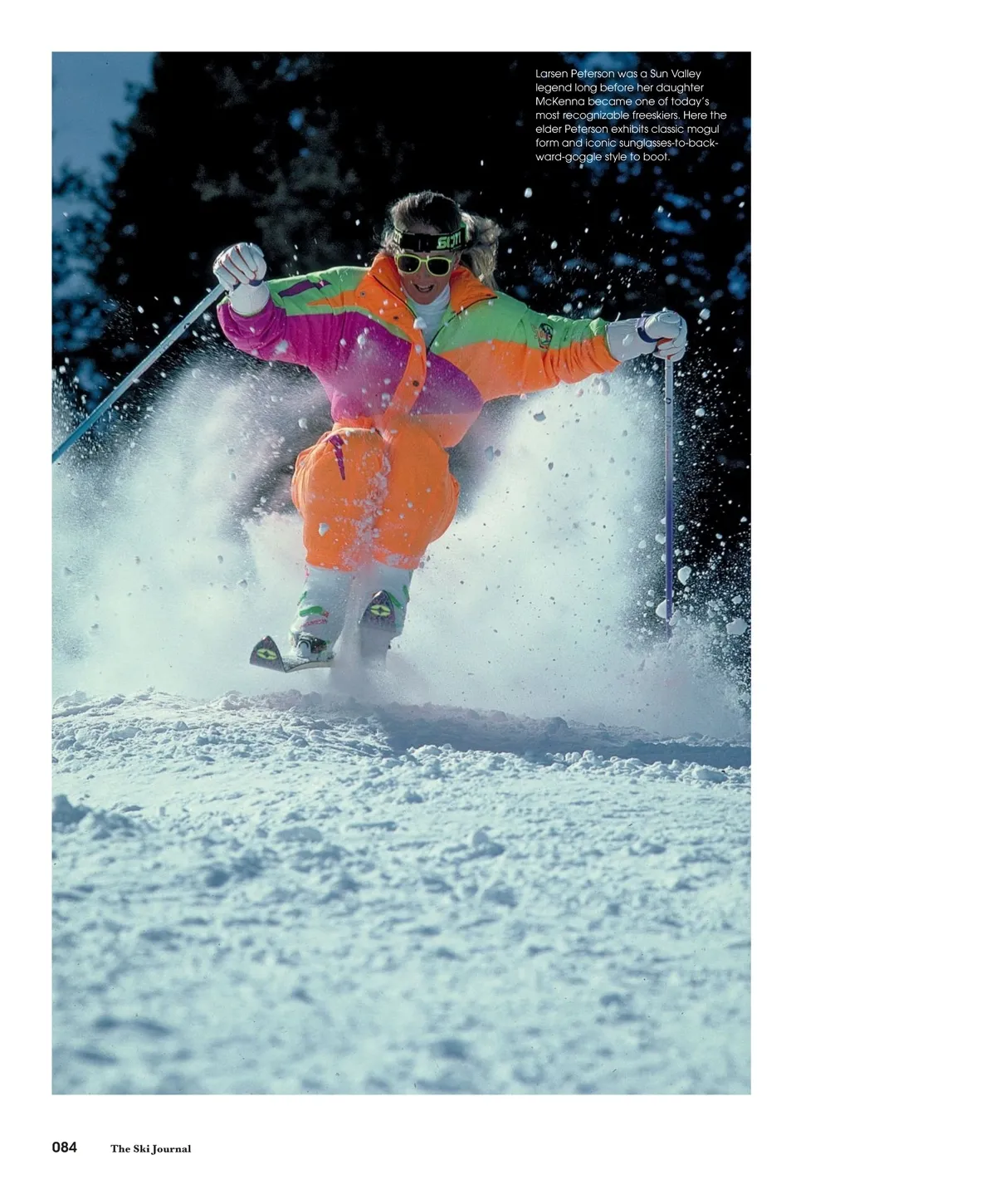
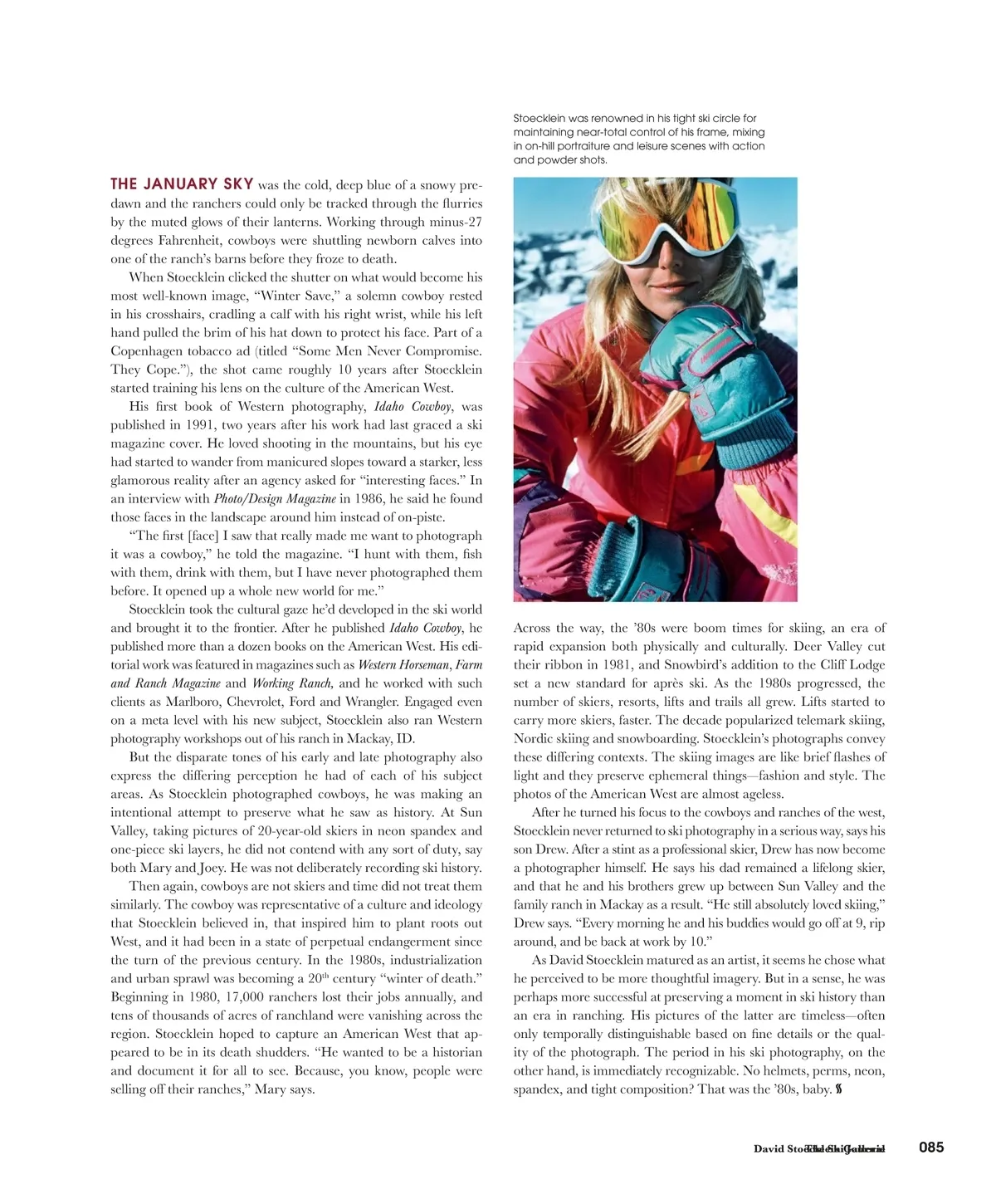
Stoecklein was renowned in his tight ski circle for maintaining near-total control of his frame, mixing in on-hill portraiture and leisure scenes with action and powder shots. THE JANUARY SKY was the cold, deep blue of a snowy pre-dawn and the ranchers could only be tracked through the flurries by the muted glows of their lanterns. Working through minus-27 degrees Fahrenheit, cowboys were shuttling newborn calves into one of the ranch’s barns before they froze to death. When Stoecklein clicked the shutter on what would become his most well-known image, “Winter Save,” a solemn cowboy rested in his crosshairs, cradling a calf with his right wrist, while his left hand pulled the brim of his hat down to protect his face. Part of a Copenhagen tobacco ad (titled “Some Men Never Compromise. They Cope.”), the shot came roughly 10 years after Stoecklein started training his lens on the culture of the American West. His first book of Western photography, Idaho Cowboy , was published in 1991, two years after his work had last graced a ski magazine cover. He loved shooting in the mountains, but his eye had started to wander from manicured slopes toward a starker, less glamorous reality after an agency asked for “interesting faces.” In an interview with Photo/Design Magazine in 1986, he said he found those faces in the landscape around him instead of on-piste. “The first [face] I saw that really made me want to photograph it was a cowboy,” he told the magazine. “I hunt with them, fish with them, drink with them, but I have never photographed them before. It opened up a whole new world for me.” Stoecklein took the cultural gaze he’d developed in the ski world and brought it to the frontier. After he published Idaho Cowboy , he published more than a dozen books on the American West. His edi-torial work was featured in magazines such as Western Horseman , Farm and Ranch Magazine and Working Ranch, and he worked with such clients as Marlboro, Chevrolet, Ford and Wrangler. Engaged even on a meta level with his new subject, Stoecklein also ran Western photography workshops out of his ranch in Mackay, ID. But the disparate tones of his early and late photography also express the differing perception he had of each of his subject areas. As Stoecklein photographed cowboys, he was making an intentional attempt to preserve what he saw as history. At Sun Valley, taking pictures of 20-year-old skiers in neon spandex and one-piece ski layers, he did not contend with any sort of duty, say both Mary and Joey. He was not deliberately recording ski history. Then again, cowboys are not skiers and time did not treat them similarly. The cowboy was representative of a culture and ideology that Stoecklein believed in, that inspired him to plant roots out West, and it had been in a state of perpetual endangerment since the turn of the previous century. In the 1980s, industrialization and urban sprawl was becoming a 20 th century “winter of death.” Beginning in 1980, 17,000 ranchers lost their jobs annually, and tens of thousands of acres of ranchland were vanishing across the region. Stoecklein hoped to capture an American West that ap-peared to be in its death shudders. “He wanted to be a historian and document it for all to see. Because, you know, people were selling off their ranches,” Mary says. Across the way, the ’80s were boom times for skiing, an era of rapid expansion both physically and culturally. Deer Valley cut their ribbon in 1981, and Snowbird’s addition to the Cliff Lodge set a new standard for après ski. As the 1980s progressed, the number of skiers, resorts, lifts and trails all grew. Lifts started to carry more skiers, faster. The decade popularized telemark skiing, Nordic skiing and snowboarding. Stoecklein’s photographs convey these differing contexts. The skiing images are like brief flashes of light and they preserve ephemeral things—fashion and style. The photos of the American West are almost ageless. After he turned his focus to the cowboys and ranches of the west, Stoecklein never returned to ski photography in a serious way, says his son Drew. After a stint as a professional skier, Drew has now become a photographer himself. He says his dad remained a lifelong skier, and that he and his brothers grew up between Sun Valley and the family ranch in Mackay as a result. “He still absolutely loved skiing,” Drew says. “Every morning he and his buddies would go off at 9, rip around, and be back at work by 10.” As David Stoecklein matured as an artist, it seems he chose what he perceived to be more thoughtful imagery. But in a sense, he was perhaps more successful at preserving a moment in ski history than an era in ranching. His pictures of the latter are timeless—often only temporally distinguishable based on fine details or the qual-ity of the photograph. The period in his ski photography, on the other hand, is immediately recognizable. No helmets, perms, neon, spandex, and tight composition? That was the ’80s, baby. David Stoecklein The Ski Gallerie Journal 085
The Ski Journal Volume 16, Issue 4: Page 85