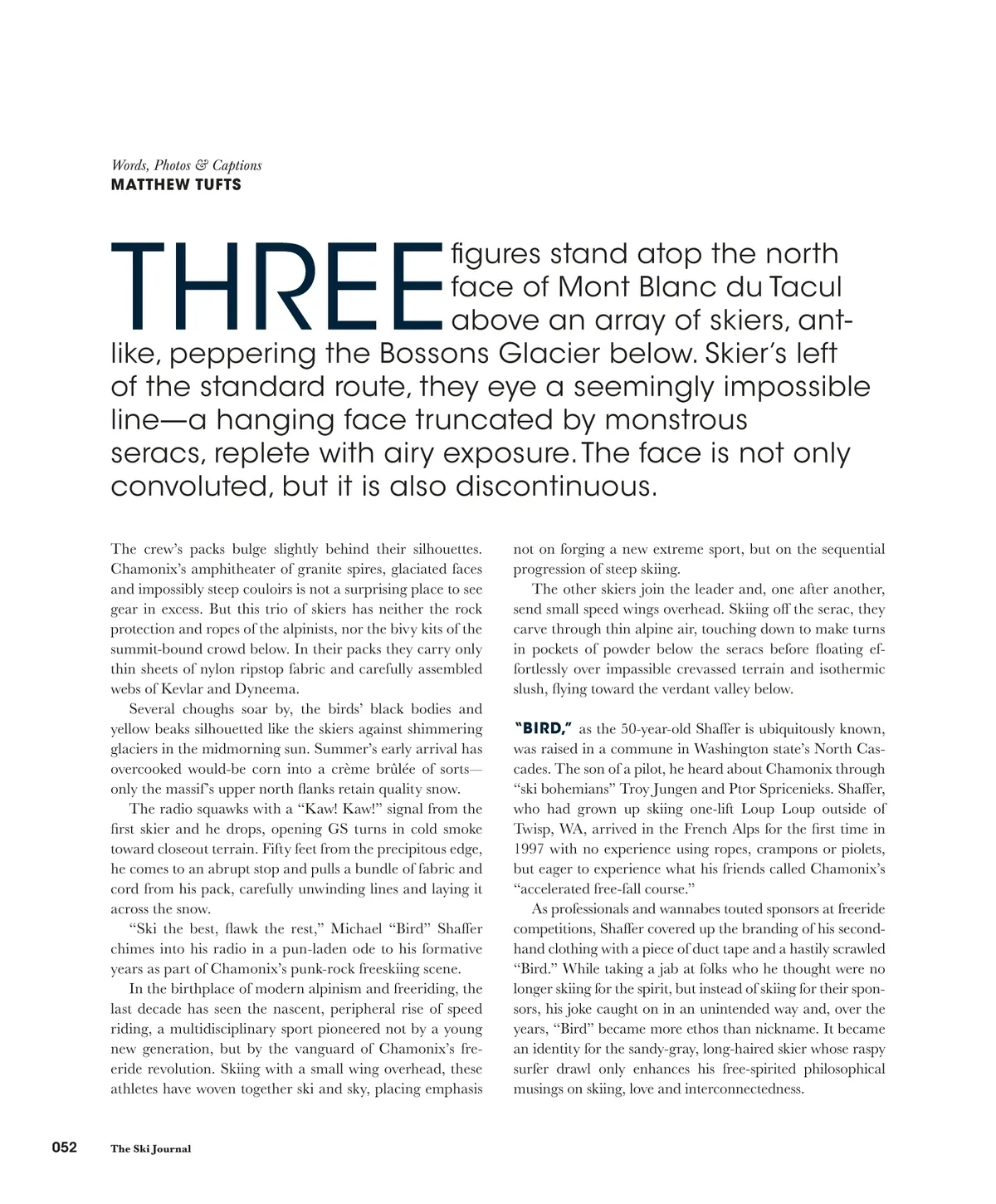
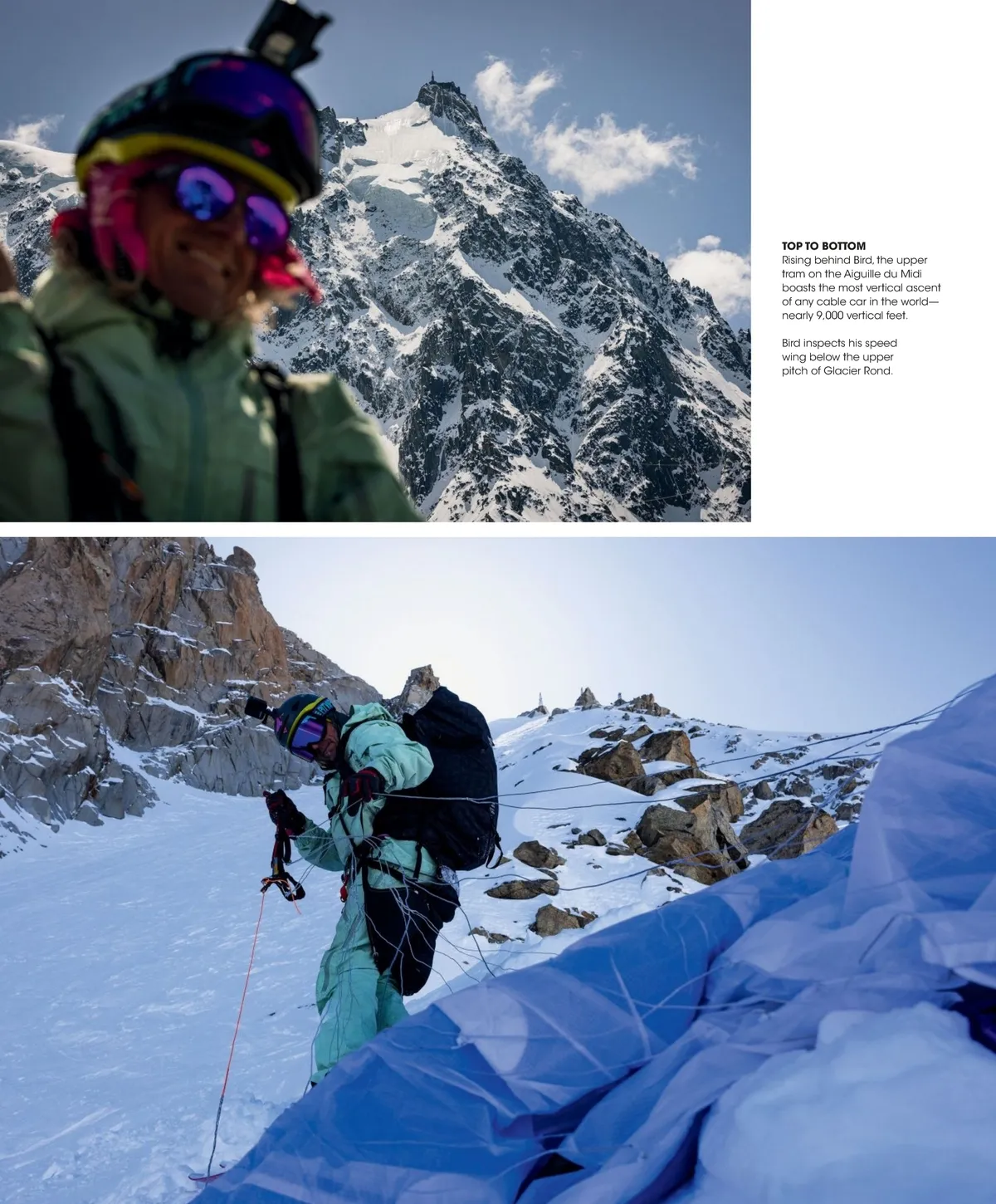
Words, Photos & Captions MATTHEW TUFTS THREE figures stand atop the north face of Mont Blanc du Tacul above an array of skiers, ant-like, peppering the Bossons Glacier below. Skier’s left of the standard route, they eye a seemingly impossible line—a hanging face truncated by monstrous seracs, replete with airy exposure. The face is not only convoluted, but it is also discontinuous. not on forging a new extreme sport, but on the sequential progression of steep skiing. The other skiers join the leader and, one after another, send small speed wings overhead. Skiing off the serac, they carve through thin alpine air, touching down to make turns in pockets of powder below the seracs before floating ef-fortlessly over impassible crevassed terrain and isothermic slush, flying toward the verdant valley below. “BIRD,” as the 50-year-old Shaffer is ubiquitously known, was raised in a commune in Washington state’s North Cas-cades. The son of a pilot, he heard about Chamonix through “ski bohemians” Troy Jungen and Ptor Spricenieks. Shaffer, who had grown up skiing one-lift Loup Loup outside of Twisp, WA, arrived in the French Alps for the first time in 1997 with no experience using ropes, crampons or piolets, but eager to experience what his friends called Chamonix’s “accelerated free-fall course.” As professionals and wannabes touted sponsors at freeride competitions, Shaffer covered up the branding of his second-hand clothing with a piece of duct tape and a hastily scrawled “Bird.” While taking a jab at folks who he thought were no longer skiing for the spirit, but instead of skiing for their spon-sors, his joke caught on in an unintended way and, over the years, “Bird” became more ethos than nickname. It became an identity for the sandy-gray, long-haired skier whose raspy surfer drawl only enhances his free-spirited philosophical musings on skiing, love and interconnectedness. The crew’s packs bulge slightly behind their silhouettes. Chamonix’s amphitheater of granite spires, glaciated faces and impossibly steep couloirs is not a surprising place to see gear in excess. But this trio of skiers has neither the rock protection and ropes of the alpinists, nor the bivy kits of the summit-bound crowd below. In their packs they carry only thin sheets of nylon ripstop fabric and carefully assembled webs of Kevlar and Dyneema. Several choughs soar by, the birds’ black bodies and yellow beaks silhouetted like the skiers against shimmering glaciers in the midmorning sun. Summer’s early arrival has overcooked would-be corn into a crème brûlée of sorts— only the massif’s upper north flanks retain quality snow. The radio squawks with a “Kaw! Kaw!” signal from the first skier and he drops, opening GS turns in cold smoke toward closeout terrain. Fifty feet from the precipitous edge, he comes to an abrupt stop and pulls a bundle of fabric and cord from his pack, carefully unwinding lines and laying it across the snow. “Ski the best, flawk the rest,” Michael “Bird” Shaffer chimes into his radio in a pun-laden ode to his formative years as part of Chamonix’s punk-rock freeskiing scene. In the birthplace of modern alpinism and freeriding, the last decade has seen the nascent, peripheral rise of speed riding, a multidisciplinary sport pioneered not by a young new generation, but by the vanguard of Chamonix’s fre-eride revolution. Skiing with a small wing overhead, these athletes have woven together ski and sky, placing emphasis 052 The Ski Journal
The Ski Journal Volume 17, Issue 1: Page 52