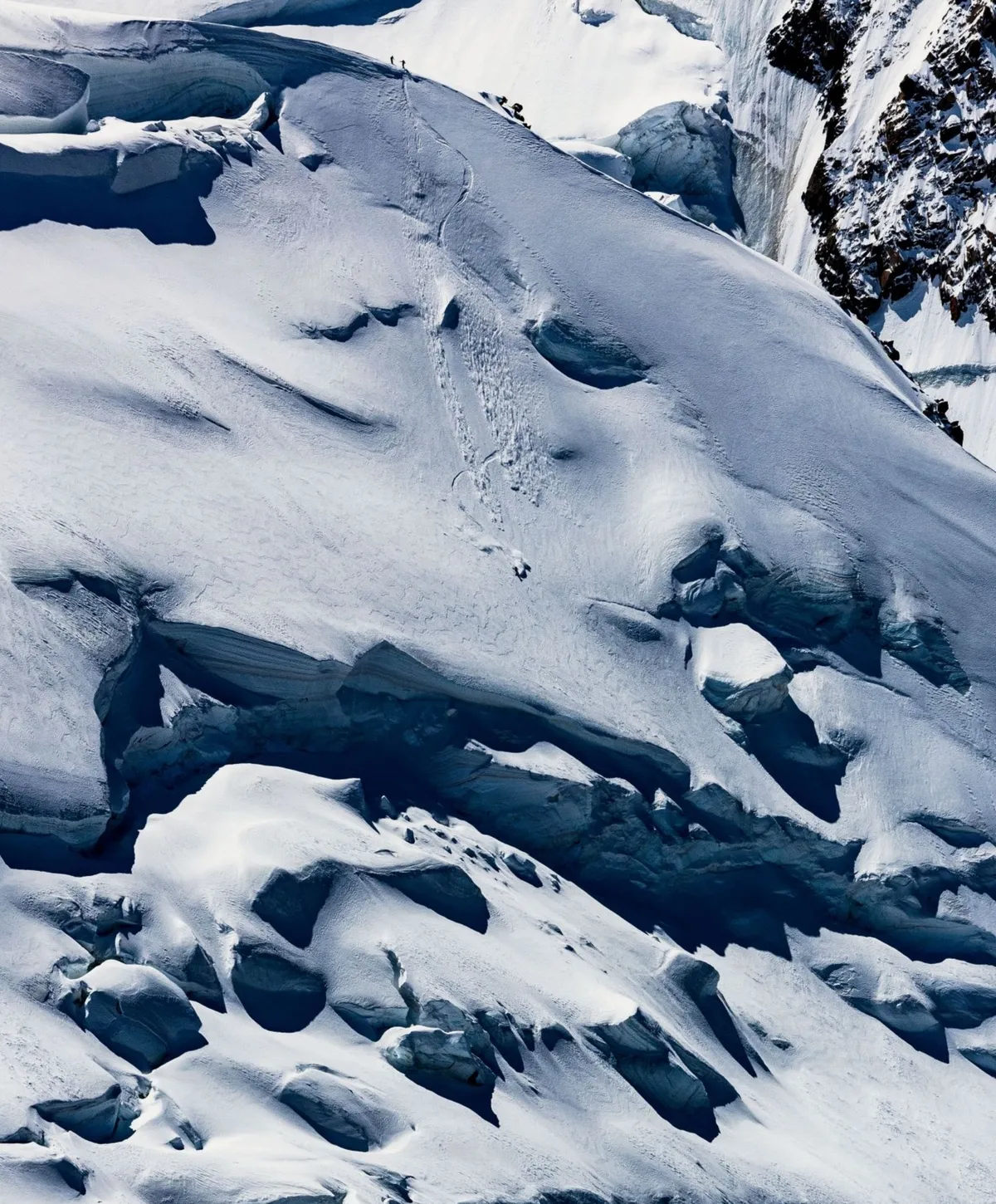
Bird opens up steep freeride pow turns on the exposed north face of Mont Blanc du Tacul. For every extra rappel a crumbling line requires, the stance for the wing as a progressive adaptation of steep ski-ing solidifies. And as speed riding technology and technique continue to evolve, the valley’s freeskiers are seeing the benefit of following a winged avant-garde. A half-decade ago, Bird accompanied Paul-Edouard “Papy” Millet, a born-and-raised Chamoniard freeskier, on one of Papy’s first speed riding descents off the Aiguille du Midi. (At the time, Papy was stuffing his wing inside a recy-cled grocery bag in his pack.) He had learned speed riding at an even more accelerated trajectory than Bird—straight into small wings, skis on, sans paragliding prerequisites. He was among the first generation to enroll in courses taught by an accomplished local female pilot, Cyrilde Pic, on the mellow slopes of Le Tour and Grands Montets. He and other local friends later trained on the Italian Helbronner side of Mont Blanc, where lines are steep but more continu-ous than the truncated ramps of the Midi’s top station. Today, Papy is one of the stalwarts of the tram line— often found on the first and last cabin up, he can log more than 28,000 vertical meters in 10 descents on a good day. He employs a unique approach to the sport, using a 10-meter wing designed less for speed performance and more for staying aloft at lower speeds, providing the precision and deft control to carve turns into the upper slopes while maintaining the wing overhead. The result is a complete melding of sports, one Papy now employs to ski cut ava-lanches and large sloughs on steep lines, testing slopes like Col du Plan and Mallory that can later be followed by eager wingless steep skiing friends. BIRD’S 2022 SEASON came to an unfortunate early close—a season-ending knee injury on a landing he’d made countless times when the midday sun had long-since dried the dew off the grass. He speculates that he should’ve been content to fly without skis that day—being in the air is the safe part, he says. The 51-year-old isn’t numb to the risks of pushing pro-gression; he’s seen his share of friends at the sharp end of the sport pass the other way—Siffredi, McLeod, Montant (though none died pursuing speed riding). Papy recently had a close call with slough on the Frendo Spur. Many folks in the sport can point to a time or two they got lucky. In a sport where milliseconds and intuition determine the ultimate price to be paid, being able to recall a mistake is fortunate. The court of public opinion is quick to offer a blanket, “Why risk it?” dismissal of the delicate nuances of injuries, deaths and near-misses on the cutting edge of speed riding. Tales of navigating the increasingly labyrinthine icefalls and seracs of the high alpine are often laced with mentions of Icarus and cautions of hubris. But progression always devel-ops at the periphery. Only the vanguard knows the limit. The downfall of Icarus was not flying, but flying too high. Speed riders prefer to soar just a few centimeters off the snow. 060 The Ski Journal
The Ski Journal Volume 17, Issue 1: Page 60