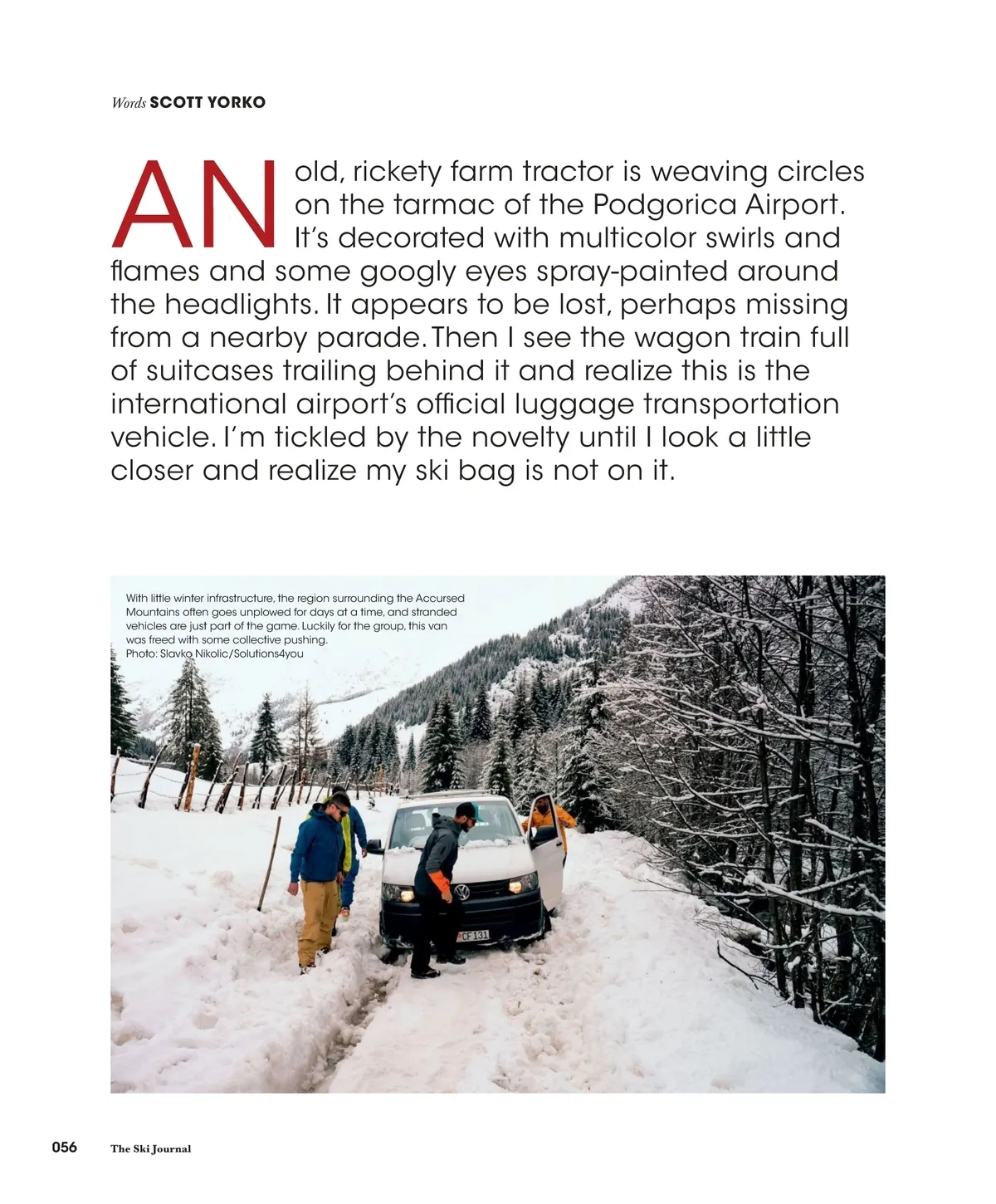
Irma, the airport lost and found attendant with a wide gap-toothed smile and ridgeline of eyebrows under dark curly hair, fills out some paperwork for my lost “sledding devices” and hands it to me before getting up from her tiny desk in baggage claim to walk out for lunch. “Do you think it will arrive in the next few days?” I ask. “I’m heading pretty far out into the mountains.” “Yes,” she says with an even wider smile beneath a devi-ous eyebrow dip. “This is Montenegro.” I nod, pretending to know what she means. STILL WITHOUT MY SKIS or gear, the drive from the capital city to the dreary outskirts doesn’t start out scenic. Regional roads pass billboards advertising cured meats. Some blocky, dirt-stained buildings are only a bit higher than adjacent trash mounds. But then the newly built high-way, barely three years old, traces the frosty blue Cijevna River into the belly of the Accursed Mountains (also known as the Albanian Alps). Dark granite rock faces plastered with snow shoot to the sky, encasing the road in a vertical-walled canyon. After passing some medieval castle-like buildings, the range opens up to prominent 6,000-foot peaks in expan-sive terrain—most of it has never been skied. Two hours farther on, the town of Plav is waiting at the-foothills of the Bogićevica mountain area with peaks rising to 8,310 feet. This is the meeting point for the fourth annual Ski Tour Fest of the Balkans. Skiers and splitboarders from nine different countries have descended upon the moun-tainous, war-torn region of Southeastern Europe to build a ski-touring community from scratch in a land known more for its political turmoil than its backcountry pursuits. Small cars are parked in a gravel lot next to a guesthouse and people in brightly colored Gore-Tex stand around chat-ting, smoking, their Skittles array of color contrasting the gloomy clouds overhead. One of them is Miljko “Gigo” Bula-jic, a bald 34-year-old professor of philosophy, environmental activist and the festival’s Montenegrin founder and ringleader. Weeks earlier, he’d spoken over the phone about the Bal-kan region’s complicated history, the long list of wars and the impact of the Ottoman Empire’s conflict with Western Europe. “Our family’s history is always connected with war in every previous generation and that’s all people know this area for,” he said. “We want to connect them instead with beautiful mountains and skiing.” Gigo sees the untapped potential of this region as an attraction that can bridge gaps across borders, finding common ground with skiers from the area, while also lay-ing the foundations for future ski-touring visitors and de-velopment. While this area is commonly referred to as the Balkans, a cloud hangs over the term, the aftereffect of the Yugoslav Wars in the 1990s that split apart families and left more than 140,000 people dead. Over two decades since the end of the war and the split of Yugoslavia in the 1990s into six independent entities—Slovenia, Croatia, Bosnia and Herzegovina, Montenegro, Serbia, and North Mace-donia—Gigo and friends are trying to emerge from that shadow. Unfortunately, since Montenegro’s independence in 2006, people have been hearing promises of foreign consortiums coming to the region to develop large-scale ski resorts, but widespread corruption, political inefficiency and social disengagement have kept some of the best skiing in Europe outside of the Alps untouched until now. But first we have to make it there. Just as losing a ski bag with all your gear is a rite of passage, no ski trip to the Accursed Mountains is complete without getting a vehicle stuck in snow. We spend two hours heaving on the back of several leapfrogging two-wheel-drive vans with slush spraying us in the face. After a few thousand feet of high-centering, fishtailing on bald tires and rocking and rolling, we finally make it to Maslo, a hamlet of half-finished guesthouses normally reserved for summer use. The plow pulls up to clear the road minutes after, but no one seems annoyed. It’s just how it goes around here. The next day’s rain is another unwelcome surprise, espe-cially since I’ll be skiing in my jeans, the cotton T-shirt and underwear I’ve been wearing for four days, a trench coat I found in a closet, wool mittens knitted by a Slovenian grand-mother and borrowed skis. But people show up, beacons beeping, ready to ski, even in the occasional trash bag. “We had the best snow I’ve ever skied in my life last year,” says a slender guy named Boris, a lifelong ski racer. “Those two-story houses over there were completely buried.” He points as we glop past a grouping of shepherd huts on our way toward Three Border Mountain, where one can ski through Montenegro, Albania and Kosovo in a single afternoon. Thousands of bunkers exist in these hills, testament to the violent history of their strategic location. Controlling the mountains once meant controlling entry points to entire countries. The same terrain that made the area so coveted when it was a war zone is also what makes it so appealing to skiers—long, north-facing ridges with relentless fall lines that once acted as sniper sightlines also funnel snow into the valley. Accursed Mountains 057
The Ski Journal Volume 17, Issue 2: Page 57