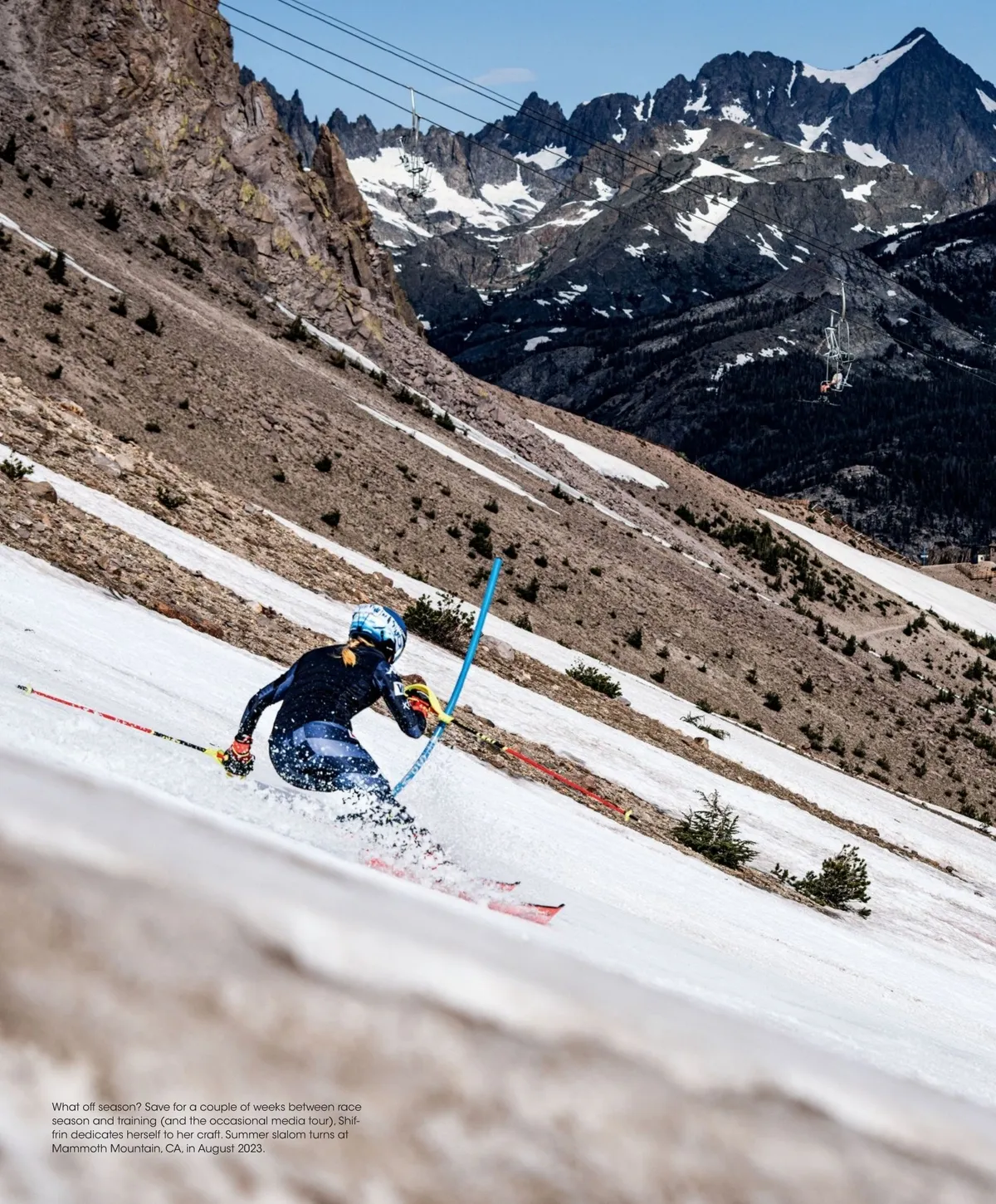
“YOU COULD TELL SHE UNDERSTOOD MORE THAN A NORMAL TEENAGER WHAT TO LOOK FOR IN A COURSE. I WAS SO IMPRESSED THAT I PREDICTED BACK THEN: SHE’S GOING TO BE THE BEST SKI RACER OF ALL TIME.” —GORDY MEGROZ AS A JOURNALIST who covers the world of skiing, I’ve been following Shiffrin’s career from her early days as a teenage ski racing sensation. She started racing on the World Cup a day before her 16th birthday, when she was turning heads for her raw talent and racking up impressive results for her age. Gordy Megroz, a freelance journalist and former ski racer, wrote what was arguably the first mainstream story on Shiffrin, back in 2011 in a short profile for Outside. She was just making her World Cup debut then and nobody outside of ski racing knew her name. Megroz’s brother-in-law had been Shiffrin’s coach at Vermont’s Burke Mountain Academy, and he told Megroz to look out for this young upstart, a smiley teenager with unprecedented promise. “I’d heard she was winning junior races by many seconds, but I was still skeptical,” Megroz recalls. “Then I watched her train, and it was obvious even to an untrained eye how solid her technique was. You could tell she understood more than a normal teenager what to look for in a course. I was so impressed that I predicted back then: She’s going to be the best ski racer of all time.” Megroz’s clairvoyance was spot on, but it would take a decade for her to get there. Over those years, I interviewed Shiffrin a handful of times for various media outlets. During my first interview with her, she was candid and open, and we chatted for an hour. That was 2016. She’d recently won her 18th World Cup race and made her Olympic debut at the Sochi Games two years before, where, at age 18, she became the youngest slalom gold medalist in Olympic his-tory. “I always put a lot of importance on being young and doing groundbreaking things,” she told me back then. We spoke again a few years later, and Shiffrin was as kind and effusive as before. At the end of our interview, I asked if she’d be willing to record a short greeting for two young ski racer girls I know, who are big fans. She obliged my request, reciting an inspiring message to these two youngsters. “Hi Addie and Juniper. I just wanted to say hello, I heard you love skiing,” she said. “Keep ripping on the mountain. Maybe sometime, I’ll meet you. Until then, ski fast and have fun.” The girls were ecstatic. Shiffrin’s star power has grown a lot since then. It’s under-standable—she’s nabbed every prize possible in the sport of ski racing: six consecutive World Championship titles, 88 World Cup wins (and counting), the record for most World Cup victories in a single season. She’s also the only person to have won a World Cup race in ski racing’s six disciplines (downhill, super-G, slalom, giant slalom, combined and parallel). This past winter, she had a 35 percent victory rate at each World Cup race she entered. That’s unheard of. The Olympics don’t matter as much to ski racers, but she’s nabbed a couple of golds there over the course of her career, too. These days, getting an interview with Shiffrin is like securing a time slot with the Pope. When I reached out to her publicist, Megan Harrod, who formerly worked as the press officer with the U.S. Ski Team before taking the job as Shiffrin’s personal PR manager, to request an in-person interview for this article, Harrod very kindly told me she didn’t have any time in her schedule for the next two months, and what time she did have was reserved for spon-sor commitments and mainstream media outlets like The New York Times or Sports Illustrated. Fine, I thought. She’s busy and it’s hard being the best. Mikaela Shiffrin 045
The Ski Journal Volume 17, Issue 3: Page 45