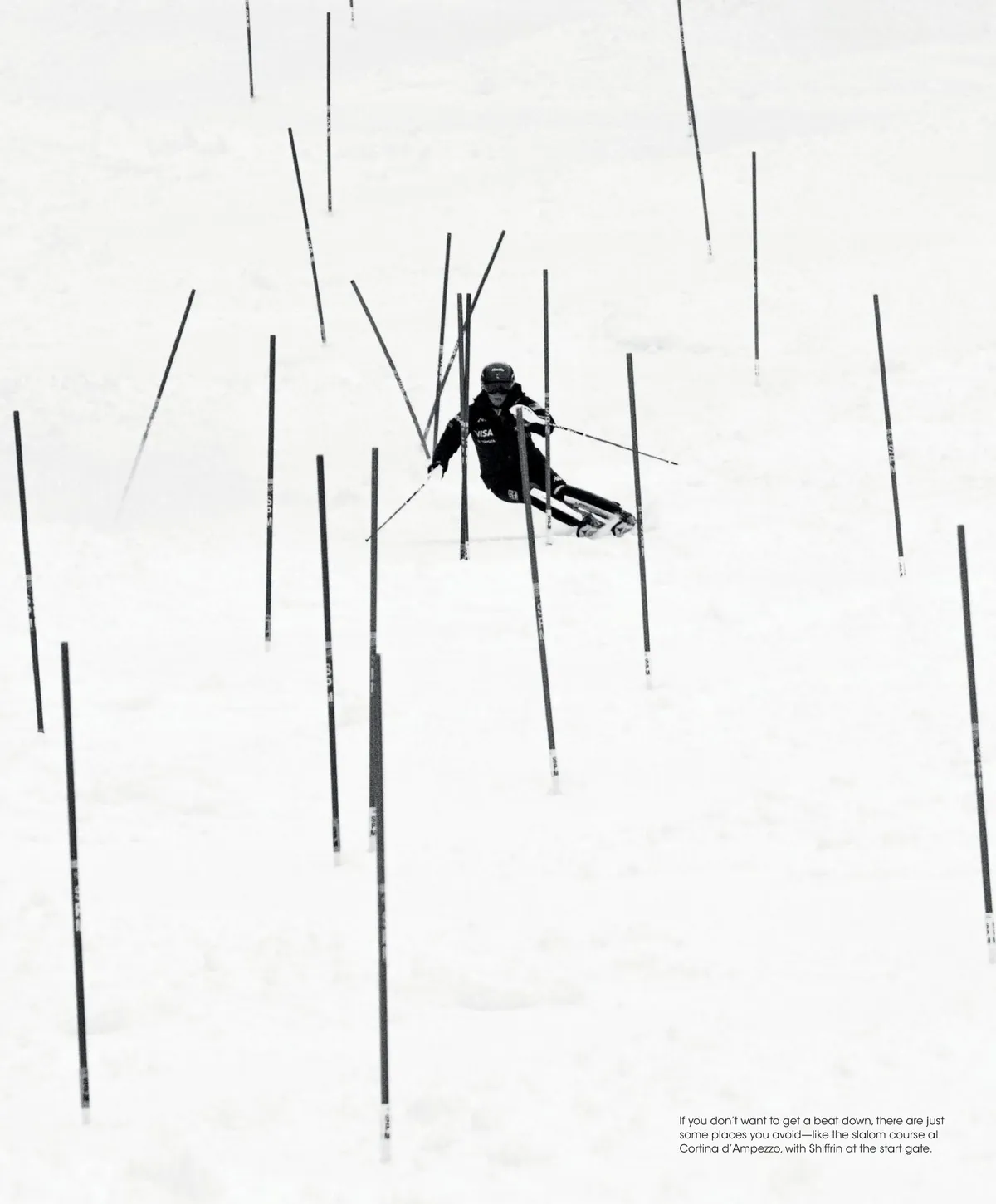
“THE THING THAT SEPARATES MIKAELA IS SHE’S CONTINUALLY STRIVING TO IMPROVE, TO MAKE THE PERFECT TURN, TO STUDY THE SPORT, TO STUDY OTHER RACERS, TO PUSH THE ENVELOPE OF WHAT’S POSSIBLE.” —PAUL KRISTOFIC TO WATCH SHIFFRIN ski is like watching water flow down a river—fluid, fast and in their most natural environ-ment. She started skiing as a 2-year-old, sliding down her Vail, CO, driveway on plastic skis from Safeway. When she turned 8, her dad, an anesthesiologist, got a job in New Hampshire, so the family, including older brother, Taylor, moved back East. Her parents, Jeff and Eileen Shiffrin, had both been high-level ski racers from the Northeast; her dad skied for Dartmouth. It would be a serendipitous homecoming. By ninth grade, Shiffrin was enrolled at Burke Mountain Academy, an elite ski racing school in Vermont. As a youth, her parents decided that training was more important than racing. So, she focused on drills and training gates and often would skip race days where athletes got a lot less time on snow. “Repetition is key was always the idea,” Shiffrin told me in one of those early interviews. “Emphasize the training you do and put the investment in and that will pay off in the long run.” When she did race, she’d win by huge margins in a sport often won by hundredths or tenths of a second. Clearly, something was working. In her early teens, Shiffrin started strength training regu-larly and trained on snow extensively in Europe, where she met Austrian ski racer Kilian Albrecht, her eventual agent. “My parents emphasized skiing well with proper technique,” Shiffrin once told me. “The theory was if you’re going to ski fast, then you better ski well so you’re safe. If you’re going to do this sport, you better know how to do it properly. That was the motivation.” Shiffrin’s first-ever World Cup win, in December 2012 at the age of 17, was in Åre, Sweden. It was a night race, with light snow falling, and Shiffrin told reporters it felt like a fairytale. Though she missed a lot of high school due to racing on the World Cup, she graduated on time, in 2013. “I joked that I was studying abroad,” Shiffrin said. A year after graduating, she won her first Olympic gold. When she wins a race—and she wins many of them— there is no fist pumping, no throwing of skis like other racers do. Shiffrin is thoughtful with her victories, rarely celebrating in a visible way. Early in her career, photogra-phers used to complain that she didn’t make good pictures, because she wasn’t triumphant enough in the finish corral. In 2013, after her first FIS World Championships win at Schladming, Austria, a then 17-year-old Shiffrin kneeled in the finish area, her head bowed, for minutes. It was the humble introspection of a young champion. Photographers finally got their image. Routine and repetition have always been Shiffrin’s secret weapon. On her backpack, she’s written a gear checklist (lift pass, boots, mouthguard, headphones…) in Sharpie so she never forgets. “The thing that separates Mikaela is she’s continually striving to improve, to make the perfect turn, to study the sport, to study other racers, to push the envelope of what’s possible,” says Paul Kristofic, the head coach of the U.S. Women’s Ski Team. On race day, her warmup is scheduled to the very minute. She inspects courses on her own, with coaches spread along the hill if questions arise. She feels the snow conditions through her skis and takes a couple of turns. She arrives at the starting area at an exact time to warm up, listen to course reports and take a few quiet moments for breathing and visualization. In February 2020, her family was dealt a tragic blow when Shiffrin’s dad, Jeff, died suddenly in an accident. Jeff had instilled in Shiffrin so much of her ethos, and losing him was beyond hard. I spoke to her the summer after, during the height of COVID, when she was locked down and grieving. “First we had to make sure we could survive, taking care of all the things my dad did,” she said at the time. “Then once you realize you can survive, you start to feel the absence of that person.” She said the waves of sadness would hit right before she fell asleep at night. 048 The Ski Journal
The Ski Journal Volume 17, Issue 3: Page 48