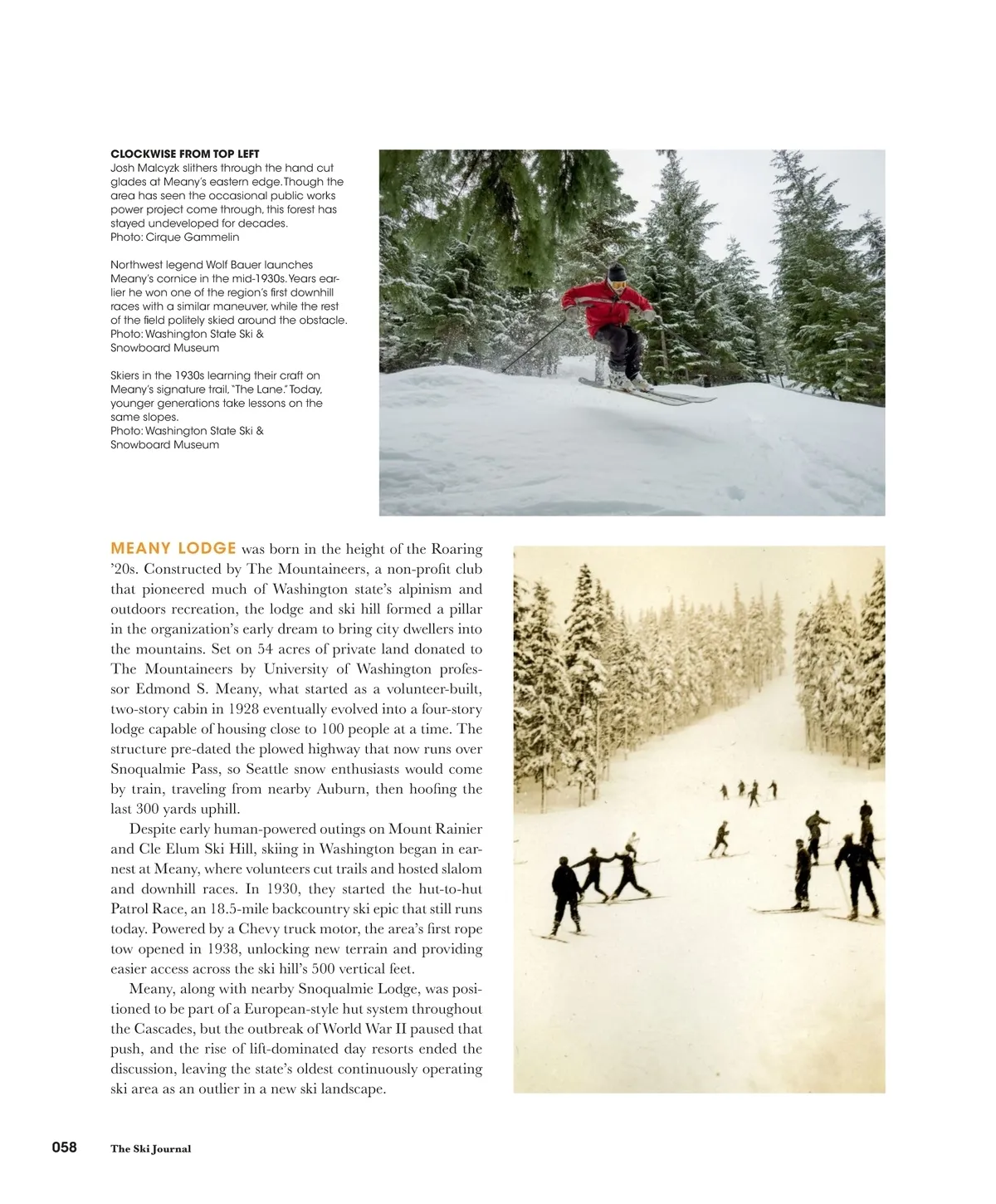
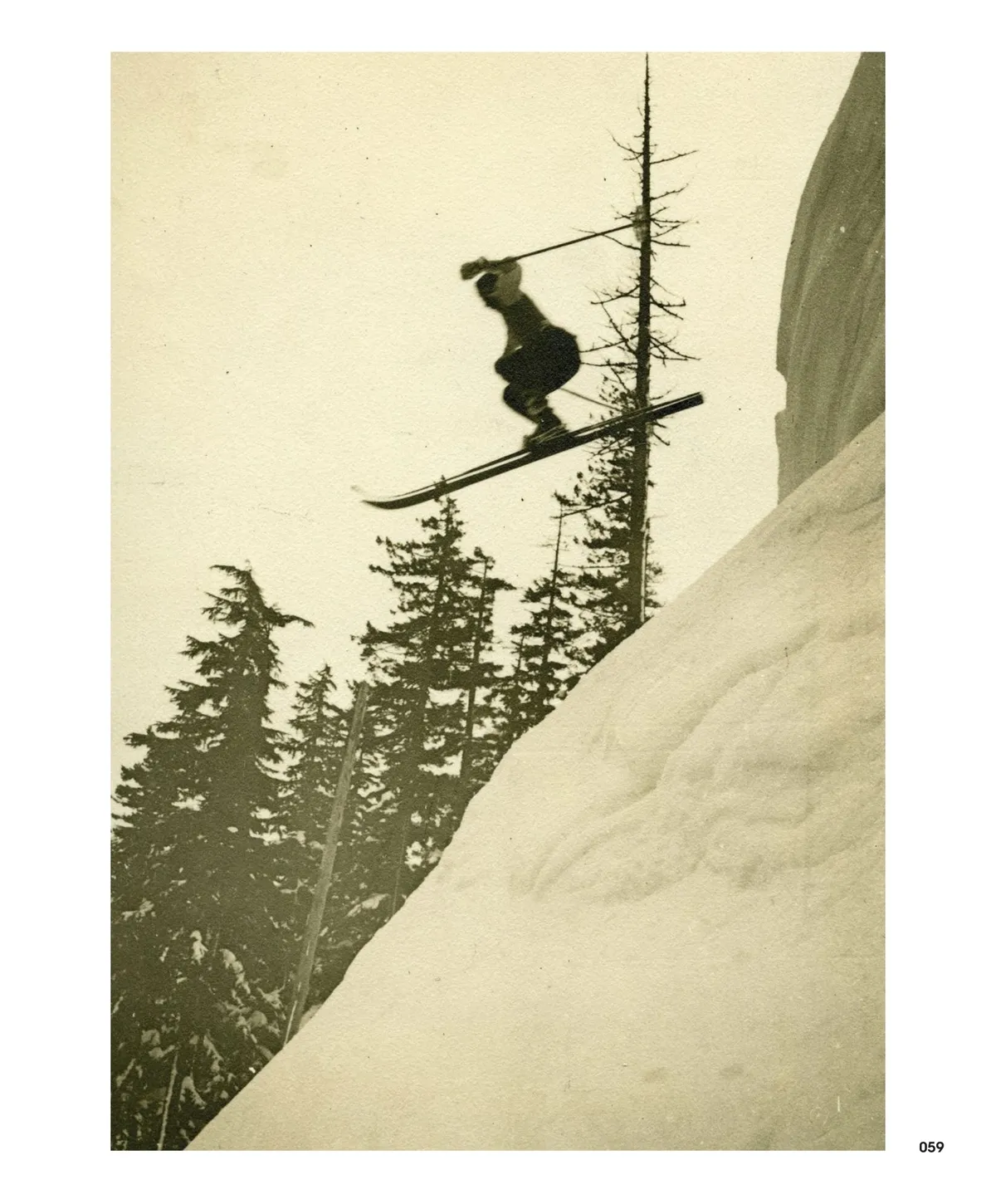
CLOCKWISE FROM TOP LEFT Josh Malcyzk slithers through the hand cut glades at Meany’s eastern edge. Though the area has seen the occasional public works power project come through, this forest has stayed undeveloped for decades. Photo: Cirque Gammelin Northwest legend Wolf Bauer launches Meany’s cornice in the mid-1930s. Years ear-lier he won one of the region’s first downhill races with a similar maneuver, while the rest of the field politely skied around the obstacle. Photo: Washington State Ski & Snowboard Museum Skiers in the 1930s learning their craft on Meany’s signature trail, “The Lane.” Today, younger generations take lessons on the same slopes. Photo: Washington State Ski & Snowboard Museum MEANY LODGE was born in the height of the Roaring ’20s. Constructed by The Mountaineers, a non-profit club that pioneered much of Washington state’s alpinism and outdoors recreation, the lodge and ski hill formed a pillar in the organization’s early dream to bring city dwellers into the mountains. Set on 54 acres of private land donated to The Mountaineers by University of Washington profes-sor Edmond S. Meany, what started as a volunteer-built, two-story cabin in 1928 eventually evolved into a four-story lodge capable of housing close to 100 people at a time. The structure pre-dated the plowed highway that now runs over Snoqualmie Pass, so Seattle snow enthusiasts would come by train, traveling from nearby Auburn, then hoofing the last 300 yards uphill. Despite early human-powered outings on Mount Rainier and Cle Elum Ski Hill, skiing in Washington began in ear-nest at Meany, where volunteers cut trails and hosted slalom and downhill races. In 1930, they started the hut-to-hut Patrol Race, an 18.5-mile backcountry ski epic that still runs today. Powered by a Chevy truck motor, the area’s first rope tow opened in 1938, unlocking new terrain and providing easier access across the ski hill’s 500 vertical feet. Meany, along with nearby Snoqualmie Lodge, was posi-tioned to be part of a European-style hut system throughout the Cascades, but the outbreak of World War II paused that push, and the rise of lift-dominated day resorts ended the discussion, leaving the state’s oldest continuously operating ski area as an outlier in a new ski landscape. 058 The Ski Journal
The Ski Journal Volume 17, Issue 3: Page 58