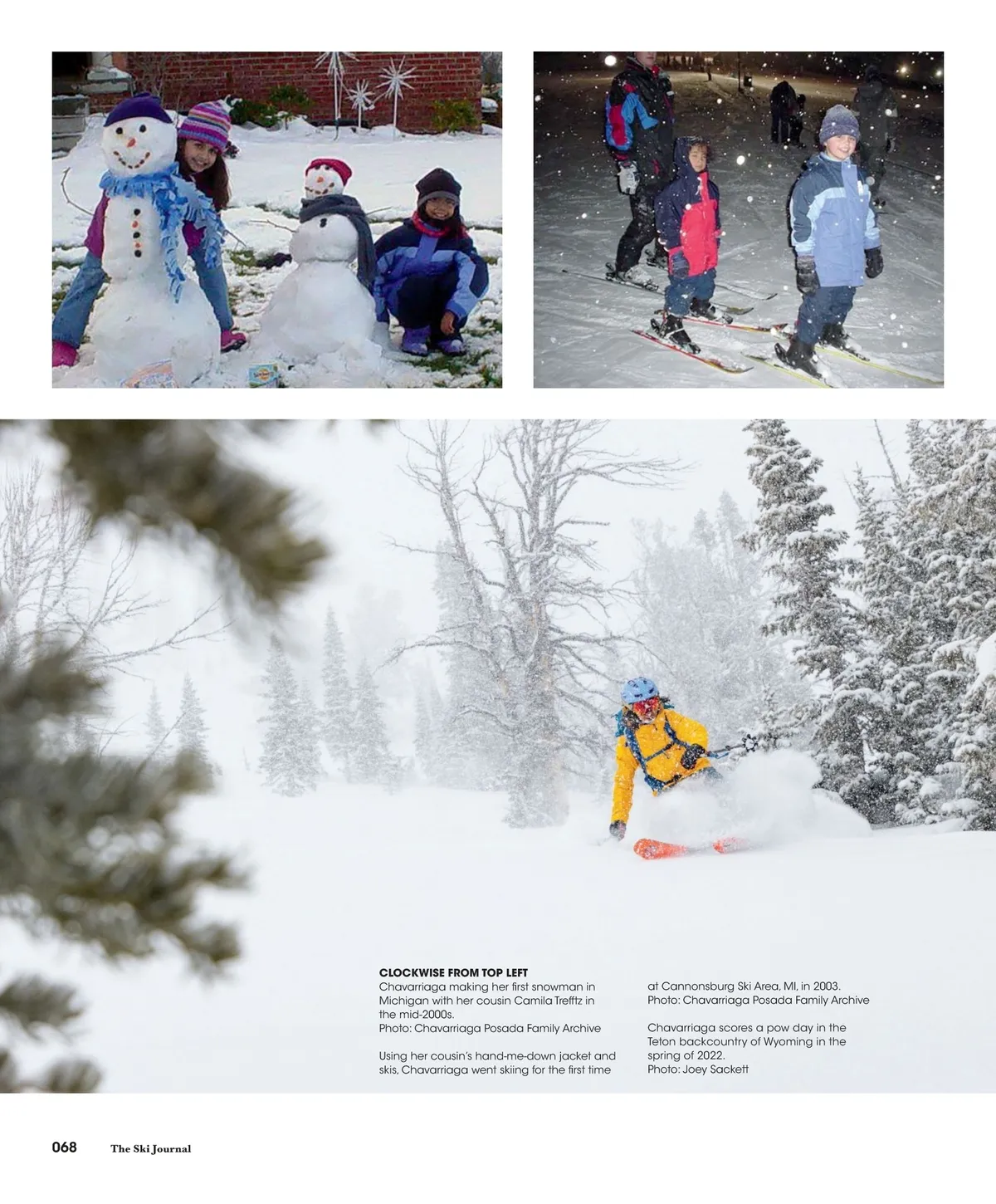
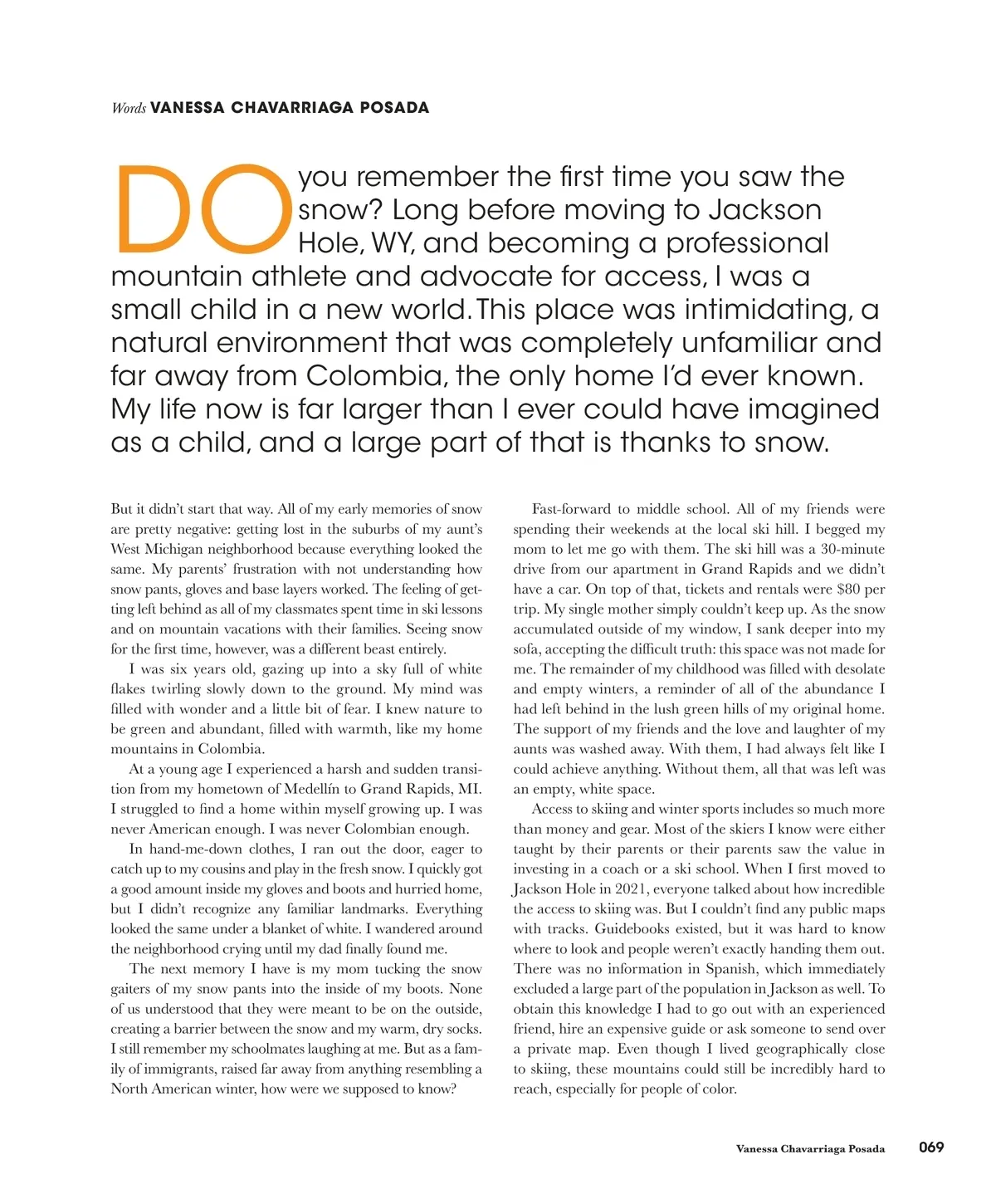
Words VANESSA CHAVARRIAGA POSADA DO you remember the first time you saw the snow? Long before moving to Jackson Hole, WY, and becoming a professional mountain athlete and advocate for access, I was a small child in a new world. This place was intimidating, a natural environment that was completely unfamiliar and far away from Colombia, the only home I’d ever known. My life now is far larger than I ever could have imagined as a child, and a large part of that is thanks to snow. Fast-forward to middle school. All of my friends were spending their weekends at the local ski hill. I begged my mom to let me go with them. The ski hill was a 30-minute drive from our apartment in Grand Rapids and we didn’t have a car. On top of that, tickets and rentals were $80 per trip. My single mother simply couldn’t keep up. As the snow accumulated outside of my window, I sank deeper into my sofa, accepting the difficult truth: this space was not made for me. The remainder of my childhood was filled with desolate and empty winters, a reminder of all of the abundance I had left behind in the lush green hills of my original home. The support of my friends and the love and laughter of my aunts was washed away. With them, I had always felt like I could achieve anything. Without them, all that was left was an empty, white space. Access to skiing and winter sports includes so much more than money and gear. Most of the skiers I know were either taught by their parents or their parents saw the value in investing in a coach or a ski school. When I first moved to Jackson Hole in 2021, everyone talked about how incredible the access to skiing was. But I couldn’t find any public maps with tracks. Guidebooks existed, but it was hard to know where to look and people weren’t exactly handing them out. There was no information in Spanish, which immediately excluded a large part of the population in Jackson as well. To obtain this knowledge I had to go out with an experienced friend, hire an expensive guide or ask someone to send over a private map. Even though I lived geographically close to skiing, these mountains could still be incredibly hard to reach, especially for people of color. But it didn’t start that way. All of my early memories of snow are pretty negative: getting lost in the suburbs of my aunt’s West Michigan neighborhood because everything looked the same. My parents’ frustration with not understanding how snow pants, gloves and base layers worked. The feeling of get-ting left behind as all of my classmates spent time in ski lessons and on mountain vacations with their families. Seeing snow for the first time, however, was a different beast entirely. I was six years old, gazing up into a sky full of white flakes twirling slowly down to the ground. My mind was filled with wonder and a little bit of fear. I knew nature to be green and abundant, filled with warmth, like my home mountains in Colombia. At a young age I experienced a harsh and sudden transi-tion from my hometown of Medellín to Grand Rapids, MI. I struggled to find a home within myself growing up. I was never American enough. I was never Colombian enough. In hand-me-down clothes, I ran out the door, eager to catch up to my cousins and play in the fresh snow. I quickly got a good amount inside my gloves and boots and hurried home, but I didn’t recognize any familiar landmarks. Everything looked the same under a blanket of white. I wandered around the neighborhood crying until my dad finally found me. The next memory I have is my mom tucking the snow gaiters of my snow pants into the inside of my boots. None of us understood that they were meant to be on the outside, creating a barrier between the snow and my warm, dry socks. I still remember my schoolmates laughing at me. But as a fam-ily of immigrants, raised far away from anything resembling a North American winter, how were we supposed to know? Vanessa Chavarriaga Posada 069
The Ski Journal Volume 17, Issue 3: Page 69