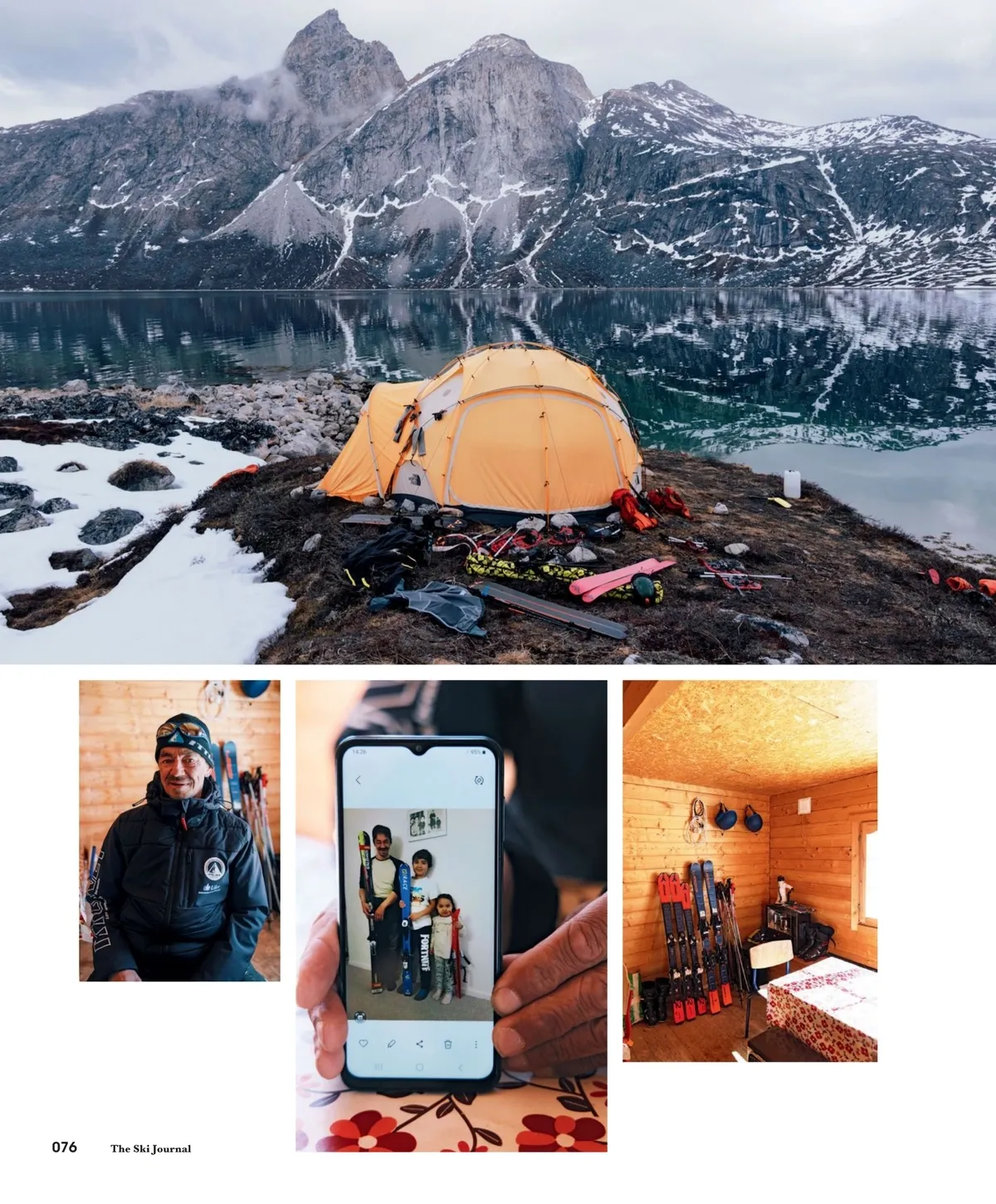
CLOCKWISE FROM TOP Raven’s Nest Camp at Itisoq Fjord. This basecamp serves as a jumping-off point for backcountry ski and snowshoe adventures with Kjeldsen’s guide company, Two Ravens. Qeqertarsuaq DSP purchased extra gear for young skiers who might not be able to afford their own ski equipment. The extra equipment lives in the clubhouse at the base of the club’s backcountry training grounds. Kale Moelgaard proudly displays an im-age of his grandchildren with their skis at Christmas. Though Kale doesn’t speak English and I don’t speak Greenlandic or Danish, his pride in his family was easily understood. Kale Moelgaard, the organizer of Qeqertar-suaq Ski Club (DSP), has an afternoon coffee in the club house. Like many Greenlanders, Kjeldsen relies on self-harvested stocks of caribou, seal, and smoked cod to fuel his adventures. And despite spending weeks each year heli-skiing in world-class terrain, he prefers slower days spent guiding human-powered skiing, enjoying the connection to his surroundings and shared conversation with his partners. Skiing with Kjeldsen is a joy—his alpine racing background is evident as he carves with precision at high speeds, whoop-ing with childlike enthusiasm. Kjeldsen grew up in Aasiaat, an Arctic community of just over 3,000 residents. According to Kjeldsen, the town is located on “the flattest land in Greenland,” and much of his childhood lacked a ski lift. The local club would ski across the frozen bay to a hilly island, trudging uphill in alpine gear to race back down. For five weeks each winter, the sun doesn’t rise in Aasiaat. But starting in January, even with only a couple hours of daylight, the ski club would train and race. In spite of harsh elements, community through sport is a common thread across Greenlandic life. For Kjeldsen, the chosen sport has always been skiing. DESPITE ITS recreational popularity, skiing was not a tra-ditional Inuit means of travel—long distance winter travel was completed by dog sled. Through the influence of ongo-ing Danish colonization, skiing gained traction in Green-land in the 1950s during a period of rapid modernization. The Greenland Ski Federation is the country’s oldest sport association, founded in 1969. Many adult skiers in Greenland had similar ski roots to Kjeldsen, hiking uphill with their friends and a handful of Federation coaches to ski back down. Today, the largest towns in Greenland have small lifts, but like many aspects of Greenlandic life, skiing still melds the old with the new—longstanding cultural values like community care and reciprocity thrive alongside the newer feeling of sliding downhill on snow. On the closing afternoon at Sisorarfiit-Skiliften in Nuuk, everyone on the hill knows each other by name. The base feels somewhat industrial, situated just above the airport, but the slopes offer sweeping views over the city and the surrounding fjord system. Local youth arrive to Sisorarfit via a city bus after school. Sandwiched between strips of reddish tundra and gran-ite bedrock, two slushy blue-square runs blanket 417 feet of vertical drop. There’s been a severe lack of snow this year, and the bedrock-to-snow ratio doesn’t look too promising. It’s April 20, and these bull wheels are stopping weeks earlier than usual. But the afternoon turnout is good, and a steady stream of skiers lap the piste. I stand out enough that a kid named Fredrick asks who I am and how I got here before helping me navigate the POMA lift. As the sun creeps across the northern sky, toddlers in snowsuits spin casual laps with their parents, and teens gather above jumps, hitting airs one by one. When the lift stops running at 6 p.m., it feels far too soon. There are still four hours until sunset, after all. Sisorarfiit’s early closure pushes me further north to Sisimiut, the second largest community in Greenland. In the town of 5,500, just north of the arctic circle, there are reports of “the worst winter ever” as a lack of precipitation threatens another early end to the ski season. The town sits adjacent to the country’s largest swath of ice-free terrain, making it both a haven for game hunting and a backcountry paradise. Snowmachine highways snake out from Sisimiut’s edges, passing dozens of rowdy dog yards and eventually topping out on nearby summits. Nestled in the backcountry three miles from town, a T-bar and a small ski area called Solbakken, “the sunny slope,” sit surrounded by dramatic couloirs. While some locals sled-ski the chutes and nearby glaciers, most families spend weekends skiing mellow laps at Solbakken with the local ski club, Sisimiut SSP. Greenland 077
The Ski Journal Volume 17, Issue 3: Page 77