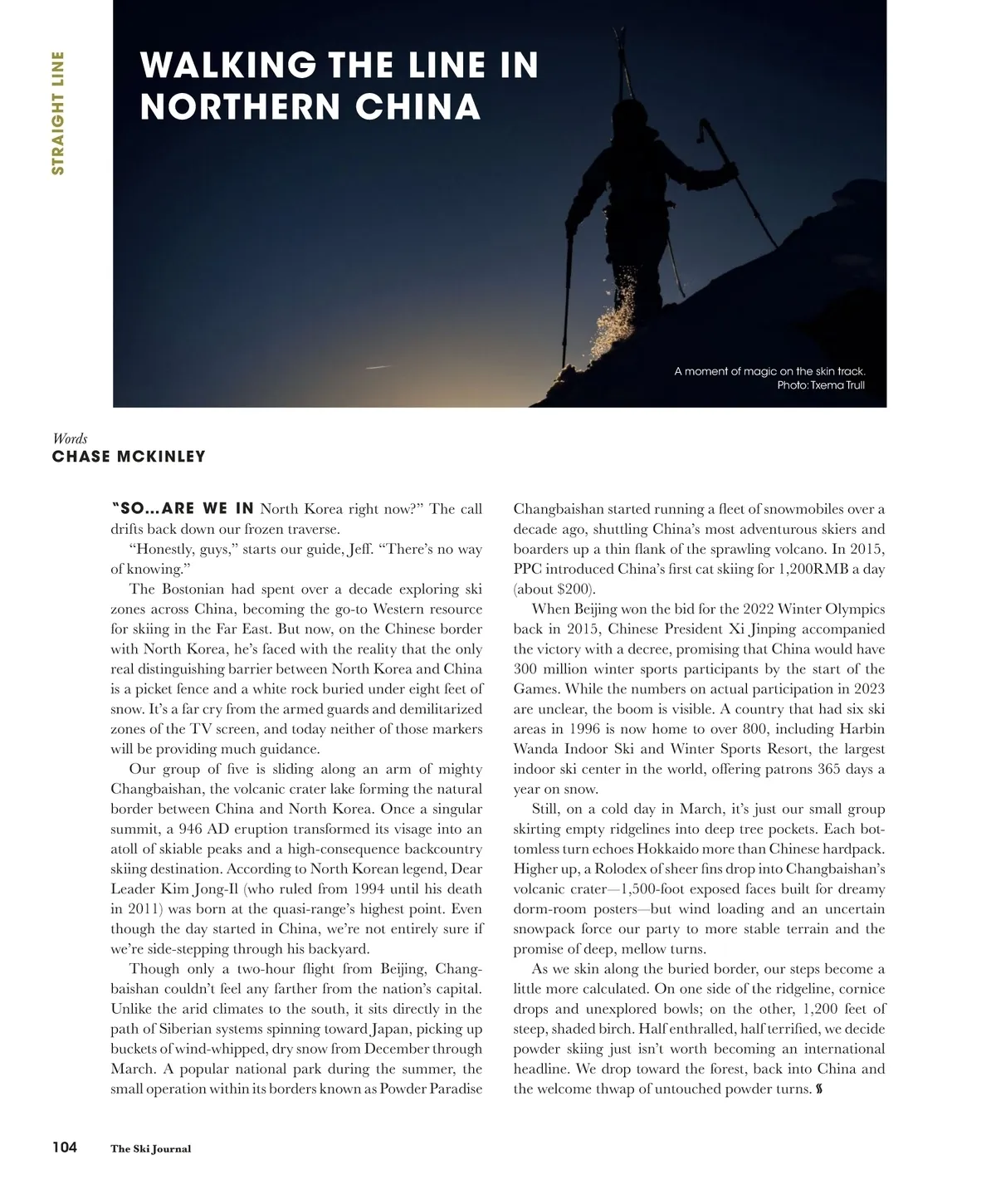
STRAIGHT LINE WALKING THE LINE IN NORTHERN CHINA A moment of magic on the skin track. Photo: Txema Trull Words CHASE MCKINLEY “SO…ARE WE IN North Korea right now?” The call drifts back down our frozen traverse. “Honestly, guys,” starts our guide, Jeff. “There’s no way of knowing.” The Bostonian had spent over a decade exploring ski zones across China, becoming the go-to Western resource for skiing in the Far East. But now, on the Chinese border with North Korea, he’s faced with the reality that the only real distinguishing barrier between North Korea and China is a picket fence and a white rock buried under eight feet of snow. It’s a far cry from the armed guards and demilitarized zones of the TV screen, and today neither of those markers will be providing much guidance. Our group of five is sliding along an arm of mighty Changbaishan, the volcanic crater lake forming the natural border between China and North Korea. Once a singular summit, a 946 AD eruption transformed its visage into an atoll of skiable peaks and a high-consequence backcountry skiing destination. According to North Korean legend, Dear Leader Kim Jong-Il (who ruled from 1994 until his death in 2011) was born at the quasi-range’s highest point. Even though the day started in China, we’re not entirely sure if we’re side-stepping through his backyard. Though only a two-hour flight from Beijing, Chang-baishan couldn’t feel any farther from the nation’s capital. Unlike the arid climates to the south, it sits directly in the path of Siberian systems spinning toward Japan, picking up buckets of wind-whipped, dry snow from December through March. A popular national park during the summer, the small operation within its borders known as Powder Paradise Changbaishan started running a fleet of snowmobiles over a decade ago, shuttling China’s most adventurous skiers and boarders up a thin flank of the sprawling volcano. In 2015, PPC introduced China’s first cat skiing for 1,200RMB a day (about $200). When Beijing won the bid for the 2022 Winter Olympics back in 2015, Chinese President Xi Jinping accompanied the victory with a decree, promising that China would have 300 million winter sports participants by the start of the Games. While the numbers on actual participation in 2023 are unclear, the boom is visible. A country that had six ski areas in 1996 is now home to over 800, including Harbin Wanda Indoor Ski and Winter Sports Resort, the largest indoor ski center in the world, offering patrons 365 days a year on snow. Still, on a cold day in March, it’s just our small group skirting empty ridgelines into deep tree pockets. Each bot-tomless turn echoes Hokkaido more than Chinese hardpack. Higher up, a Rolodex of sheer fins drop into Changbaishan’s volcanic crater—1,500-foot exposed faces built for dreamy dorm-room posters—but wind loading and an uncertain snowpack force our party to more stable terrain and the promise of deep, mellow turns. As we skin along the buried border, our steps become a little more calculated. On one side of the ridgeline, cornice drops and unexplored bowls; on the other, 1,200 feet of steep, shaded birch. Half enthralled, half terrified, we decide powder skiing just isn’t worth becoming an international headline. We drop toward the forest, back into China and the welcome thwap of untouched powder turns. 104 The Ski Journal
The Ski Journal Volume 17, Issue 4: Page 104