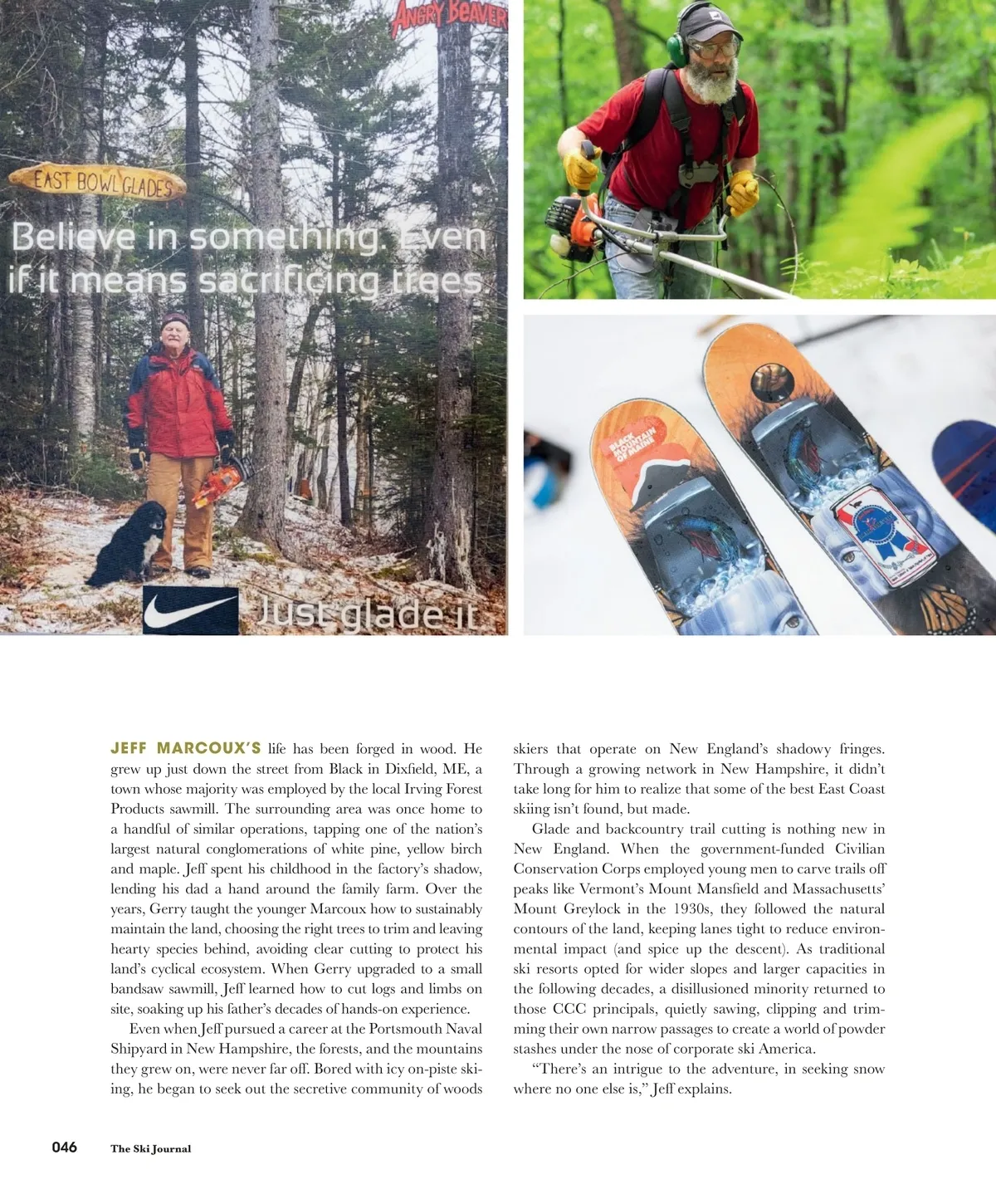
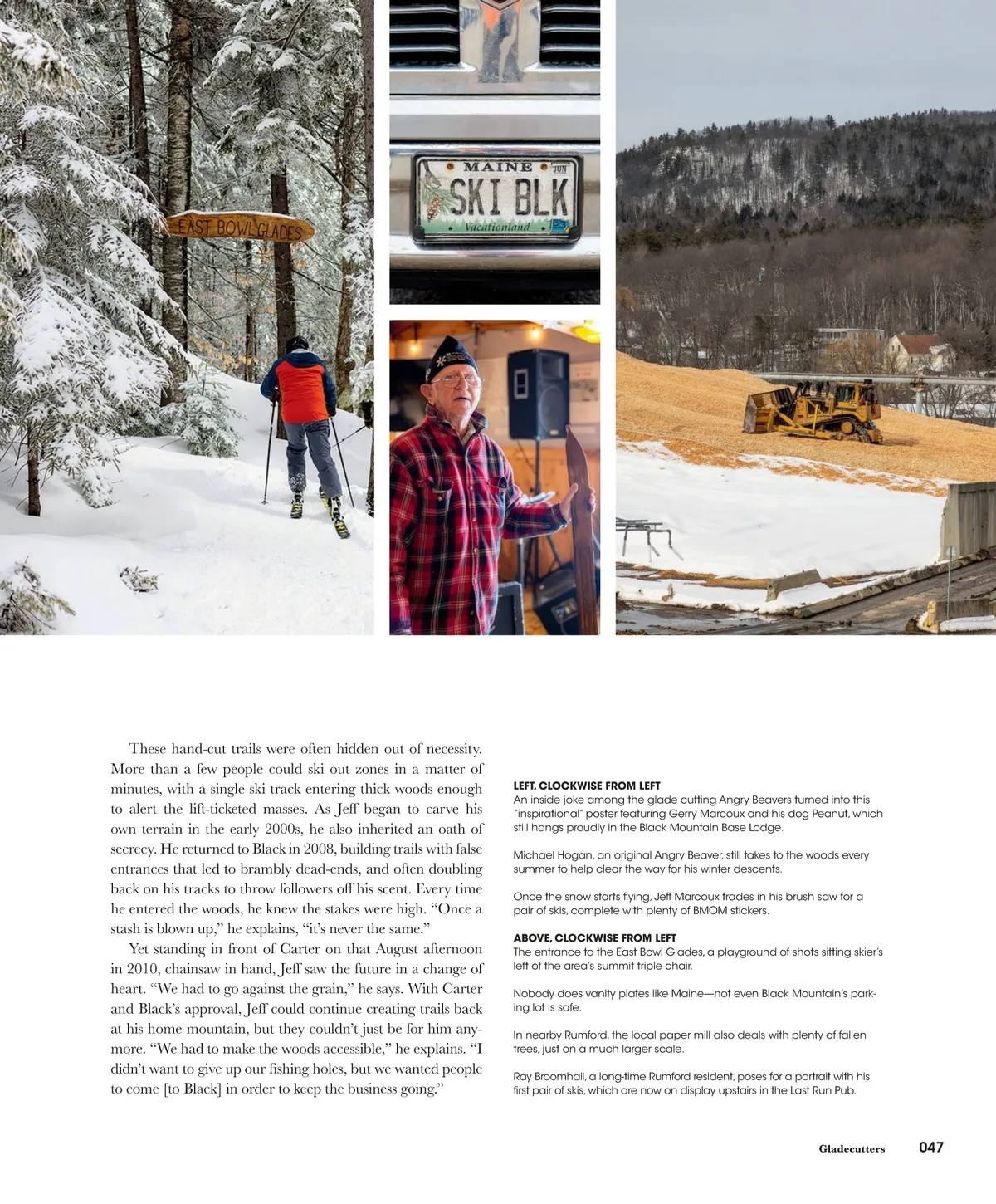
JEFF MARCOUX’S life has been forged in wood. He grew up just down the street from Black in Dixfield, ME, a town whose majority was employed by the local Irving Forest Products sawmill. The surrounding area was once home to a handful of similar operations, tapping one of the nation’s largest natural conglomerations of white pine, yellow birch and maple. Jeff spent his childhood in the factory’s shadow, lending his dad a hand around the family farm. Over the years, Gerry taught the younger Marcoux how to sustainably maintain the land, choosing the right trees to trim and leaving hearty species behind, avoiding clear cutting to protect his land’s cyclical ecosystem. When Gerry upgraded to a small bandsaw sawmill, Jeff learned how to cut logs and limbs on site, soaking up his father’s decades of hands-on experience. Even when Jeff pursued a career at the Portsmouth Naval Shipyard in New Hampshire, the forests, and the mountains they grew on, were never far off. Bored with icy on-piste ski-ing, he began to seek out the secretive community of woods skiers that operate on New England’s shadowy fringes. Through a growing network in New Hampshire, it didn’t take long for him to realize that some of the best East Coast skiing isn’t found, but made. Glade and backcountry trail cutting is nothing new in New England. When the government-funded Civilian Conservation Corps employed young men to carve trails off peaks like Vermont’s Mount Mansfield and Massachusetts’ Mount Greylock in the 1930s, they followed the natural contours of the land, keeping lanes tight to reduce environ-mental impact (and spice up the descent). As traditional ski resorts opted for wider slopes and larger capacities in the following decades, a disillusioned minority returned to those CCC principals, quietly sawing, clipping and trim-ming their own narrow passages to create a world of powder stashes under the nose of corporate ski America. “There’s an intrigue to the adventure, in seeking snow where no one else is,” Jeff explains. 046 The Ski Journal
The Ski Journal Volume 17, Issue 4: Page 46