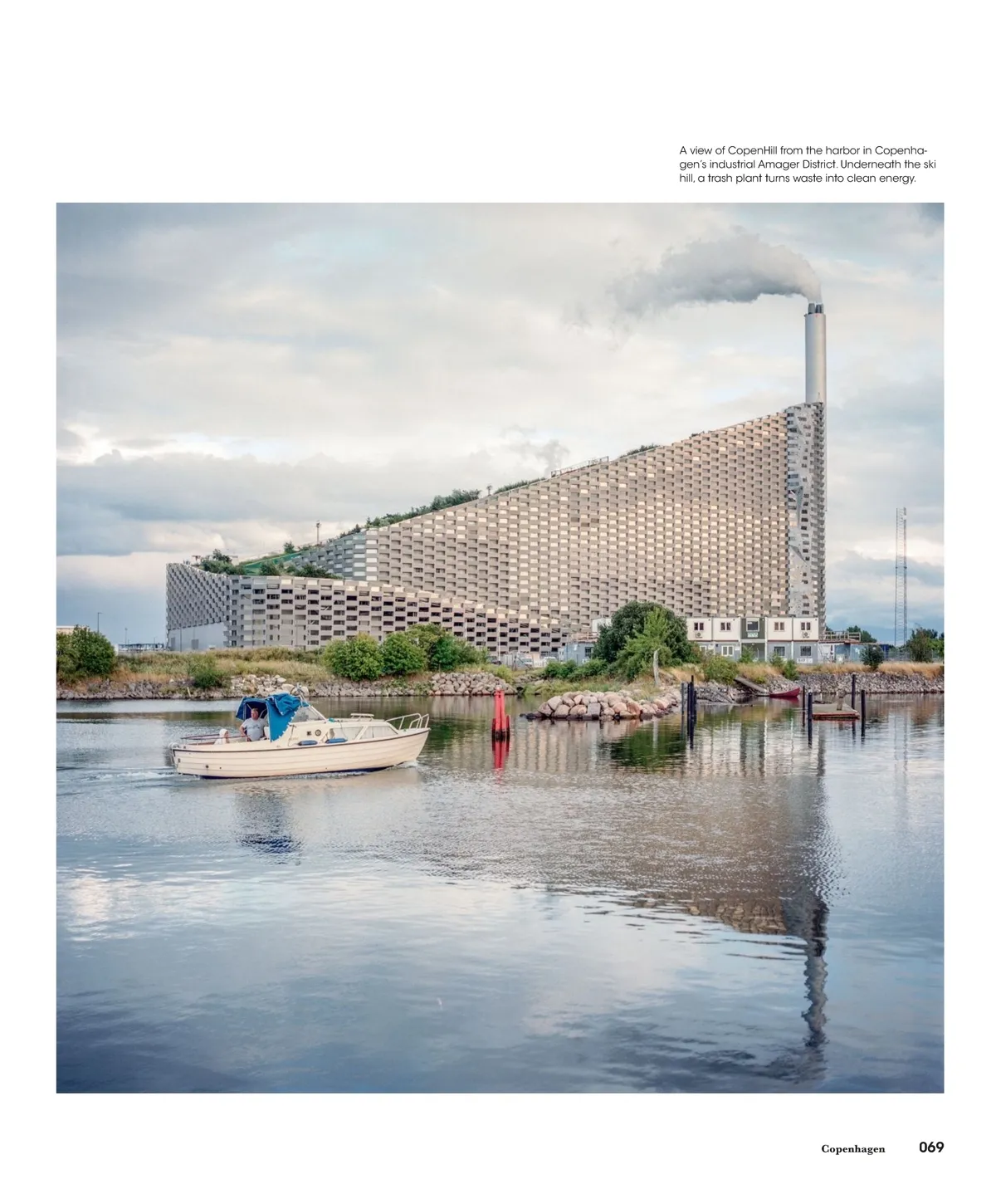
I rolled my rental bike up to the base of the hill and was struck by the enormity of the structure. Rising 300 feet, a cliff face made of raw aluminum rectangles filled with plants held up a jigsaw of colourful climbing holds (I would learn later it’s the highest climbing wall in the world). I strolled right from the street onto the base of the ski hill and found Jakob Ebskamp, Copenhill’s affable marketing manager. Wearing a black t-shirt and ski pants on a warm but windy summer day, the 20-something with dark curly hair was wriggling into his ski boots. I had been emailing with Ebskamp for a month and he was keen to show me around the hill. After all, very few media folks show up to the ski hill, or to ski at all—they’re usually more interested in what the ski slope is built upon. Designed by visionary Danish “star-chitect” Bjarke Ingels, Amager Bakke houses the cleanest waste-to-energy facility in the world. The structure, completed in 2017 and funded by the five municipalities it serves, replaced the 50-year-old waste incineration facility in the Danish capital. Around 300 truckloads of garbage from the greater Copen-hagen area enter the facility per day and are incinerated to produce heat for 160,000 homes and power for more than 60,000, as well as the two magic carpets and T-bar that get skiers to the summit. Despite the steady plume, water vapor and carbon dioxide are the only elements that leave the towering smokestack. UNLIKE ITS Scandinavian cousins, Denmark is decid-edly flat. It wasn’t until 2005 that the highest point was officially confirmed through advanced GPS, a hill called Møllehøj that stands at 561.2 feet, although some argue that it’s 560.3-foot Yding Skohøj, if you count the Bronze Age burial mound which makes it around four feet higher. All this to say, Denmark isn’t a mountain country. And with Copenhagen only getting 2.2 inches of snow per year, it isn’t ski country either. Yet, despite its mountain modesty and the nearest natu-ral ski hill a six-hour drive away in Sweden, Denmark is full of skiers. “We all go on at least one ski holiday each year,” explains Ebskamp as we chat on the magic carpet ascending the first part of the mountain. “Now we have a hill of our own.” I step off of the lift onto the spongy synthetic ski surface sourced from an Italian dry slope manufacturer (it was modified by the Ingels group for aesthetic and functional reasons). Grass grows naturally amongst it. The sides of the run are planted with 400 trees and countless other plants, all indigenous to Denmark. For a project only five years old, I was surprised at how much wilding had already taken place. Apparently, a fox had even taken up residence in this synthetic alpine meadow. I spent the rest of the afternoon wandering the mountain and photographing Ebskamp, who doubles (and triples) as a talented freestyle skier and filmmaker, on the various rails that make up the terrain park on the lower mountain. He introduced me to a handful of young skiers doggedly practicing tricks with him, their exploits attracting the odd spectator from the hiking trail on the sidelines. These young men reminded me of park rats I’ve seen the world over, with loose-fitting ski pants and camera in hand, filming each other’s victories and defeats with boundless enthusiasm. At Copenhill, Ingels followed an architectural philoso-phy employed in several of his projects he calls “hedonistic sustainability”: the idea that modern buildings shouldn’t compromise economic viability or enjoyment for the benefit of environmental sustainability. In unending mid-summer light, Ebskamp slid one last rail before arching graceful turns down to his office. He said he needed to review footage for a social media post. New skiers plowed past me from the steep upper T-bar and a steady stream of hikers headed up for an end-of-day beer at the rooftop cafe. I was struck by how many people enjoyed a space normally designated for shedding weather or host-ing the occasional birdsnest. While the major industrial operation burned in the bowels below, this place was so incredibly, well, alive. Hedonistic sustainability indeed. 068 The Ski Journal
The Ski Journal Volume 17, Issue 4: Page 68