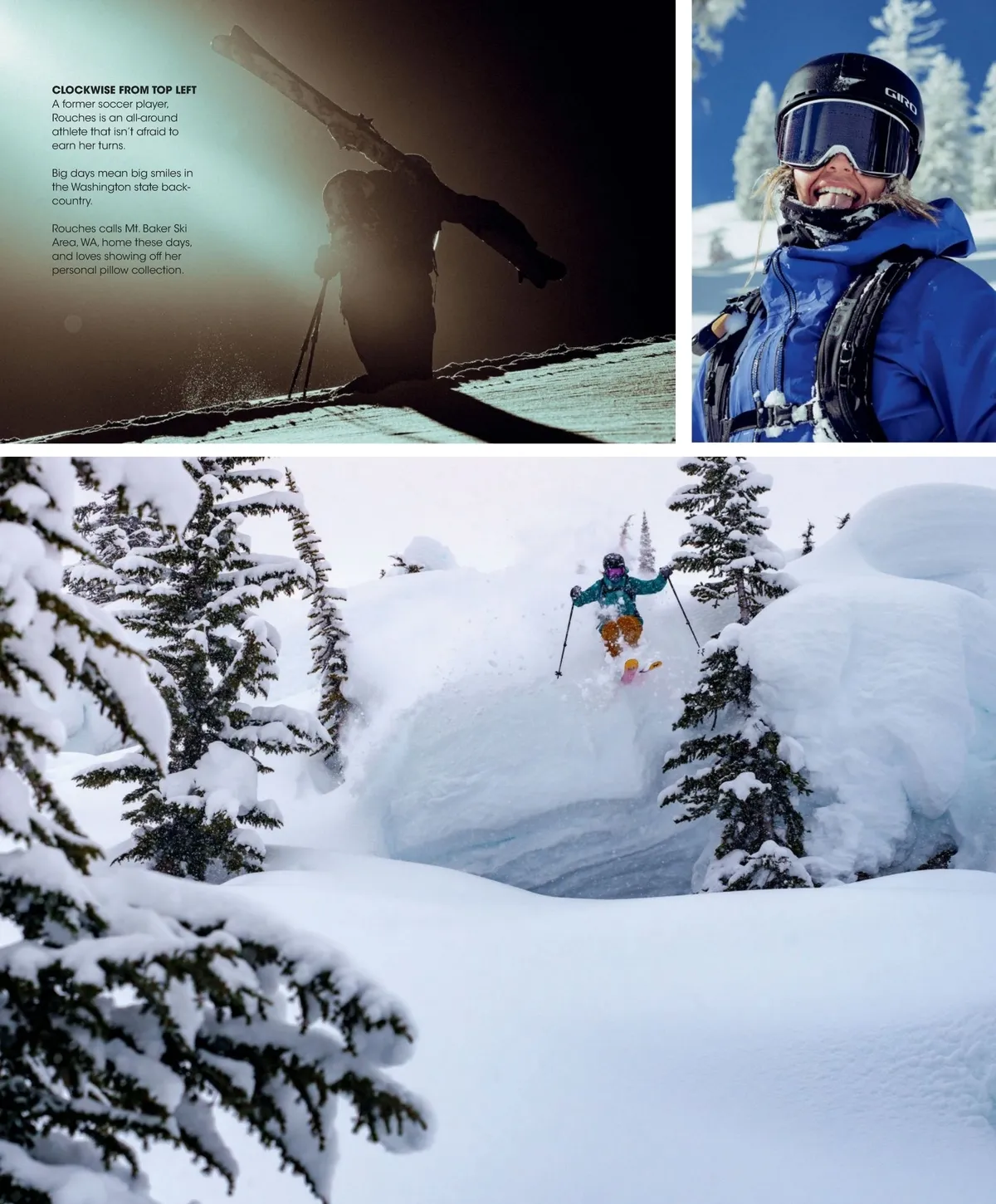
“WE NEED CHANGE. NOT JUST MORE TYPES OF SKIERS IN MOVIES, WHICH HAS SUPERFICIALLY IMPROVED. BUT BEHIND THE CAMERA. AND, ULTIMATELY, IN THE AUDIENCE THAT CONSUMES THIS CONTENT.” —Sophia Rouches A friend took her to visit Mt. Baker. The deep snow and expansive terrain struck Rouches as “the purest expression of Pacific Northwest skiing” and got her imagining a different, freer direction for her life. She soon walked away from soc-cer and applied to the Environmental Education program at nearby Western Washington University in Bellingham, WA. When not studying, she went all-in on skiing—still not with the explicit goal of becoming a pro, but to continue to chase the elation she got from engaging with the mountains, now just an hour and change up the road at Baker. After a quiet and sometimes lonely first couple of years on the hill, a professional ski career started to develop organi-cally for Rouches. Micah Evangelista, Zack Giffin and a few other top Baker skiers saw what she was doing, and she got invited along on some photo shoots with Grant Gunderson and Gabe Rogel. She proved herself to them. Then did it again and again. As her ski career picked up momentum, Rouches incor-rectly assumed she’d avoid some of the barriers faced by other women in the sport. “I had internalized this whole idea that if I worked hard, and excelled at things and took the right risks, I’d be taken seriously and wouldn’t be dismissed as weak or incompetent,” Rouches, now 27, explained from her Bellingham home. “But as things progressed, more and more of my self-worth came from being validated by the guys, and I subconsciously pushed so hard to be ‘different from the other girls’ without understanding how I could only ever be me—and that my goals were simply upholding the status quo.” Now, when she sees a scene from a film that focuses more on slo-mo of her hair blowing in the wind than her actual skiing, or when she’s sidelined during a shoot day like “some kind of prop,” or knocked down a peg moments after flipping over a very real, very cement highway, she realizes that it’s not her, but the wider industry that needs to progress. “We need change,” she said. “Not just more types of skiers in movies, which has superficially improved. But behind the camera. And, ultimately, in the audience that consumes this content.” She figures that this kind of change won’t come from trying to match male ski celebrity personalities with an equivalent female ego-driven revolution in skiing. “Skiing needs less ego,” she says. “I think the future is about solid role models, mentoring and welcoming in a new generation that naturally expands how we all think about the sport.” Rouches herself has been fortunate to now be mentored by Backstrom, her childhood idol. “People say, ‘Sophia’s so talented, she doesn’t need a mentor.’ But, unfortunately, it’s not just about being the best skier,” Backstrom says. “There’s lots to figure out in terms of navigating the industry. I’ll help her any way I can, and I know that she’ll do the same for the next generation.” For Rouches, much of her path forward is based around Mt. Baker. The area isn’t as connected to the broader ski industry as Salt Lake City, Denver or Tahoe. At Baker, in-dependence runs from management all the way down—it’s one of the last sizable independently owned ski areas in North America. But it’s not just about its understated culture, steep and ungroomed inbounds skiing or the record-setting snowfall. Baker has a relatively lenient rope line policy that allows riders to head up the boot pack and explore backcountry at their own risk. “Patrol will tell you, ‘Hey we saw a bunch of slides today, are you sure you want to do this?’ But the choice is still yours,” Rouches said. “That lets you push your boundaries and progress in ways you can’t elsewhere. It’s fairly lawless, and there’s still a sense that you can define things on your terms.” “Sophia does things her way, but she also brings along others,” Backstrom says. “By nature of being out there film-ing, being a team player and often encouraging her friends to take the best lines, she is setting a positive example that will create more opportunities for all skiers.” To further balance the demands of the pro ski lifestyle, Rouches recently bought and runs Moondance Sea Kayak Adventures in Bellingham during the off season. Prior to getting into sea kayaking, she’d had a lot of experience with whitewater guiding and all of the adrenaline and partying that comes along with it. But in this different iteration of the sport, she rediscov-ered a quieter, more contemplative connection with the outdoors. And as a guide, she is there to serve others and help them to better understand the natural world. Learning to become a teacher and a mentor now reflects back into her evolving approach to the ski world. Sophia Rouches 079
The Ski Journal Volume 17, Issue 4: Page 79