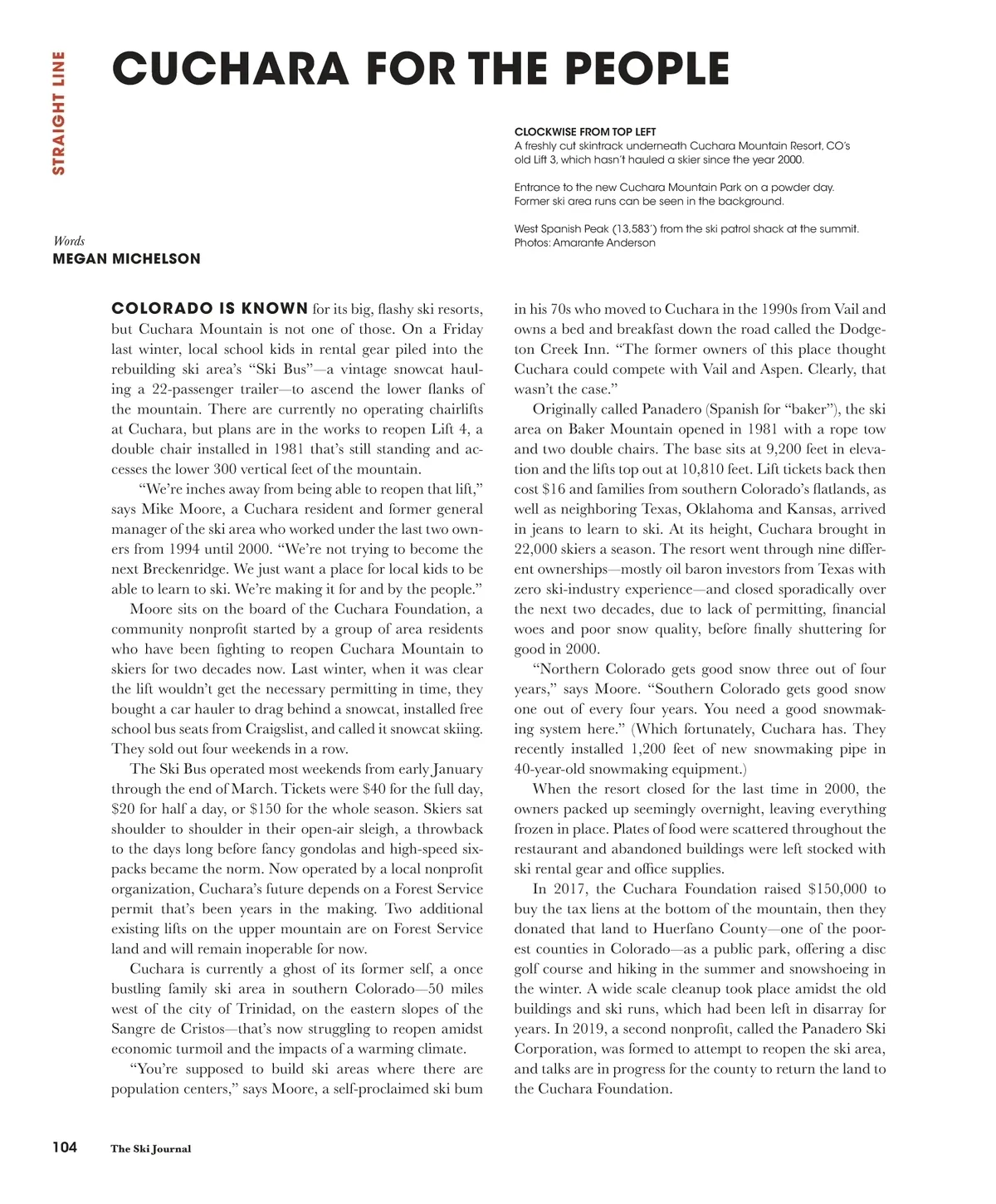
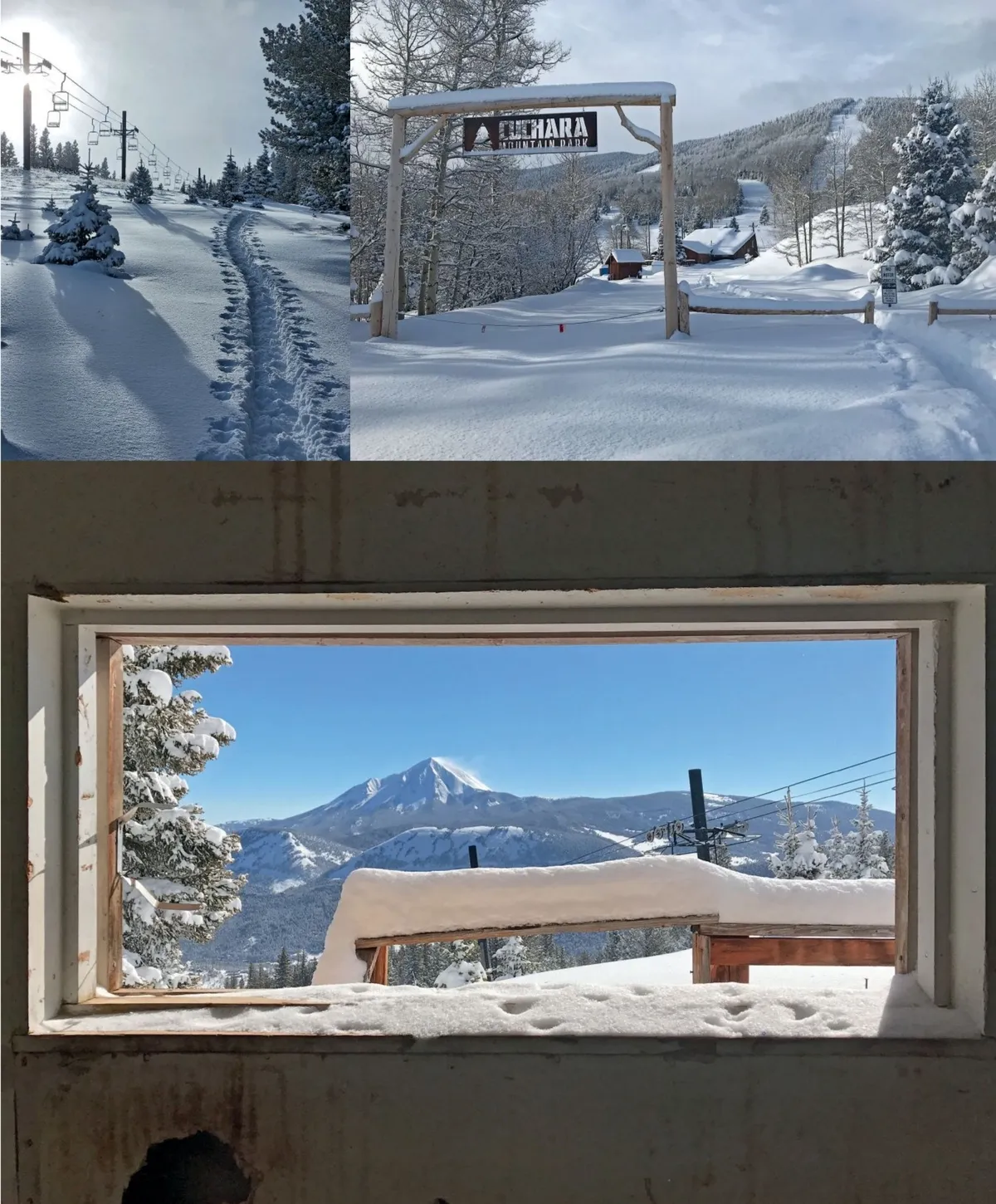
STRAIGHT LINE CUCHARA FOR THE PEOPLE CLOCKWISE FROM TOP LEFT A freshly cut skintrack underneath Cuchara Mountain Resort, CO’s old Lift 3, which hasn’t hauled a skier since the year 2000. Entrance to the new Cuchara Mountain Park on a powder day. Former ski area runs can be seen in the background. West Spanish Peak (13,583’) from the ski patrol shack at the summit. Photos: Amarante Anderson Words MEGAN MICHELSON COLORADO IS KNOWN for its big, flashy ski resorts, but Cuchara Mountain is not one of those. On a Friday last winter, local school kids in rental gear piled into the rebuilding ski area’s “Ski Bus”—a vintage snowcat haul-ing a 22-passenger trailer—to ascend the lower flanks of the mountain. There are currently no operating chairlifts at Cuchara, but plans are in the works to reopen Lift 4, a double chair installed in 1981 that’s still standing and ac-cesses the lower 300 vertical feet of the mountain. “We’re inches away from being able to reopen that lift,” says Mike Moore, a Cuchara resident and former general manager of the ski area who worked under the last two own-ers from 1994 until 2000. “We’re not trying to become the next Breckenridge. We just want a place for local kids to be able to learn to ski. We’re making it for and by the people.” Moore sits on the board of the Cuchara Foundation, a community nonprofit started by a group of area residents who have been fighting to reopen Cuchara Mountain to skiers for two decades now. Last winter, when it was clear the lift wouldn’t get the necessary permitting in time, they bought a car hauler to drag behind a snowcat, installed free school bus seats from Craigslist, and called it snowcat skiing. They sold out four weekends in a row. The Ski Bus operated most weekends from early January through the end of March. Tickets were $40 for the full day, $20 for half a day, or $150 for the whole season. Skiers sat shoulder to shoulder in their open-air sleigh, a throwback to the days long before fancy gondolas and high-speed six-packs became the norm. Now operated by a local nonprofit organization, Cuchara’s future depends on a Forest Service permit that’s been years in the making. Two additional existing lifts on the upper mountain are on Forest Service land and will remain inoperable for now. Cuchara is currently a ghost of its former self, a once bustling family ski area in southern Colorado—50 miles west of the city of Trinidad, on the eastern slopes of the Sangre de Cristos—that’s now struggling to reopen amidst economic turmoil and the impacts of a warming climate. “You’re supposed to build ski areas where there are population centers,” says Moore, a self-proclaimed ski bum in his 70s who moved to Cuchara in the 1990s from Vail and owns a bed and breakfast down the road called the Dodge-ton Creek Inn. “The former owners of this place thought Cuchara could compete with Vail and Aspen. Clearly, that wasn’t the case.” Originally called Panadero (Spanish for “baker”), the ski area on Baker Mountain opened in 1981 with a rope tow and two double chairs. The base sits at 9,200 feet in eleva-tion and the lifts top out at 10,810 feet. Lift tickets back then cost $16 and families from southern Colorado’s flatlands, as well as neighboring Texas, Oklahoma and Kansas, arrived in jeans to learn to ski. At its height, Cuchara brought in 22,000 skiers a season. The resort went through nine differ-ent ownerships—mostly oil baron investors from Texas with zero ski-industry experience—and closed sporadically over the next two decades, due to lack of permitting, financial woes and poor snow quality, before finally shuttering for good in 2000. “Northern Colorado gets good snow three out of four years,” says Moore. “Southern Colorado gets good snow one out of every four years. You need a good snowmak-ing system here.” (Which fortunately, Cuchara has. They recently installed 1,200 feet of new snowmaking pipe in 40-year-old snowmaking equipment.) When the resort closed for the last time in 2000, the owners packed up seemingly overnight, leaving everything frozen in place. Plates of food were scattered throughout the restaurant and abandoned buildings were left stocked with ski rental gear and office supplies. In 2017, the Cuchara Foundation raised $150,000 to buy the tax liens at the bottom of the mountain, then they donated that land to Huerfano County—one of the poor-est counties in Colorado—as a public park, offering a disc golf course and hiking in the summer and snowshoeing in the winter. A wide scale cleanup took place amidst the old buildings and ski runs, which had been left in disarray for years. In 2019, a second nonprofit, called the Panadero Ski Corporation, was formed to attempt to reopen the ski area, and talks are in progress for the county to return the land to the Cuchara Foundation. 104 The Ski Journal
The Ski Journal Volume 18, Issue 1: Page 104