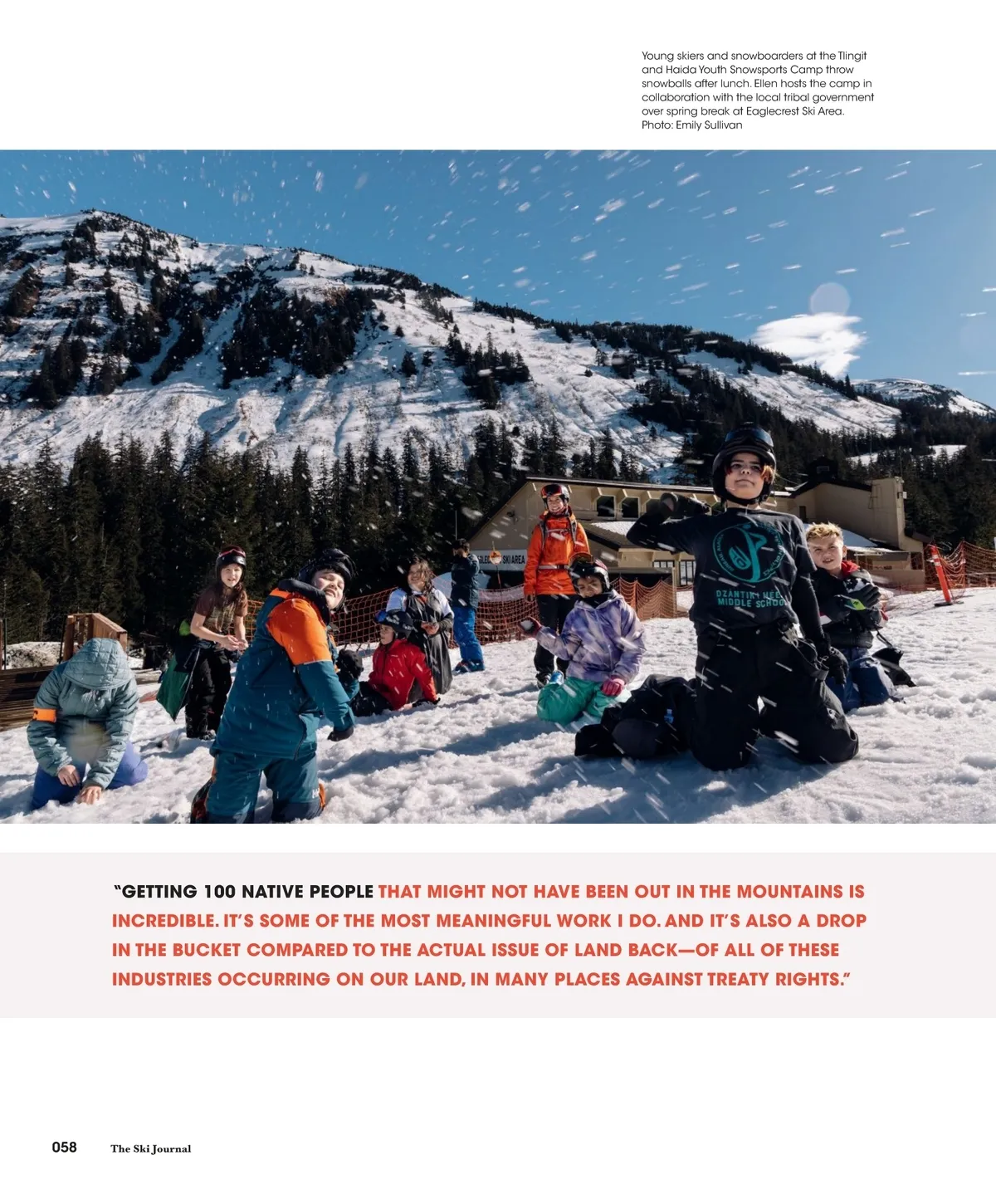
“That [mindset] doesn’t acknowledge a relationship to the land,” she says. “I would really like to see reciprocity reflected in the ski industry. Giving back, sacrificing, donating—what-ever it is—to these places, to the land, and to the people.” In that spirit, Ellen helps run several additional programs aimed at developing skills and providing a point of entry to skiing for Indigenous peoples across the U.S. She mentors an Alaska Native snow science intern with the Sealaska Heritage Institute in Juneau, helps run an Indigenous back-country hut trip in Oregon with the Wy’East Canary Club, and facilitates a scholarship program in collaboration with Ikon Pass. In 2024, the scholarship provided a free Ikon Pass and some essential gear to 30 Indigenous skiers. Ellen considers herself a “purpose-driven version of a pro skier” and says that collaborating with others doing similar equity work across the outdoor industry is imperative to driving meaningful change. Grete Eliassen, a champion freestyle skier who Ellen sees as an industry mentor, says that meeting Ellen while skiing at Alta and subsequently learning from her, “changed my world forever.” Hearing Ellen’s perspective opened Elias-sen’s eyes to deeper layers of nuance of inequity within the ski industry. “I never want to let her down,” says Eliassen. “I look to her for advice and I’m excited for the ski industry to get to know her, too.” Though the impact of her work is clearly tangible, Ellen knows that changing the ski industry is a long game. “Get-ting 100 Native people that might not have been out in the mountains is incredible,” says Ellen. “It’s some of the most meaningful work I do. And it’s also a drop in the bucket compared to the actual issue of Land Back—of all of these industries occurring on our land, in many places against treaty rights.” Her vision for the future of the ski industry includes In-digenous people everywhere having agency over their land. She says that the commercialization of skiing on Indigenous lands feels so obvious to her in Colorado, where tourists ski by the millions, but rarely does one see Ute, Cheyenne or Arapahoe skiers. She says that the industry can do better by spearheading and supporting initiatives that encourage Indigenous access to skiing—from scholarship programs to affinity skills workshops. “Every single resort needs to be engaged with their local tribal communities and with programs that are working to get Indigenous people back on their land,” she says, adding, “So much of skiing occurs on land that was stolen from tribes.” Meaningful storytelling in ski media is also needed, she says. By supporting “Indigenous people in front of and behind the camera, helping to determine the direction of storytelling,” Ellen says that ski media can begin to elevate purposeful narratives that explore the concepts of reciprocity and respect on Indigenous lands. Ellen is currently directing her own film about seeking equity as an Indigenous skier in Alaska, for which she is still seeking industry sponsorship. Ellen Bradley 059
The Ski Journal Volume 18, Issue 1: Page 59