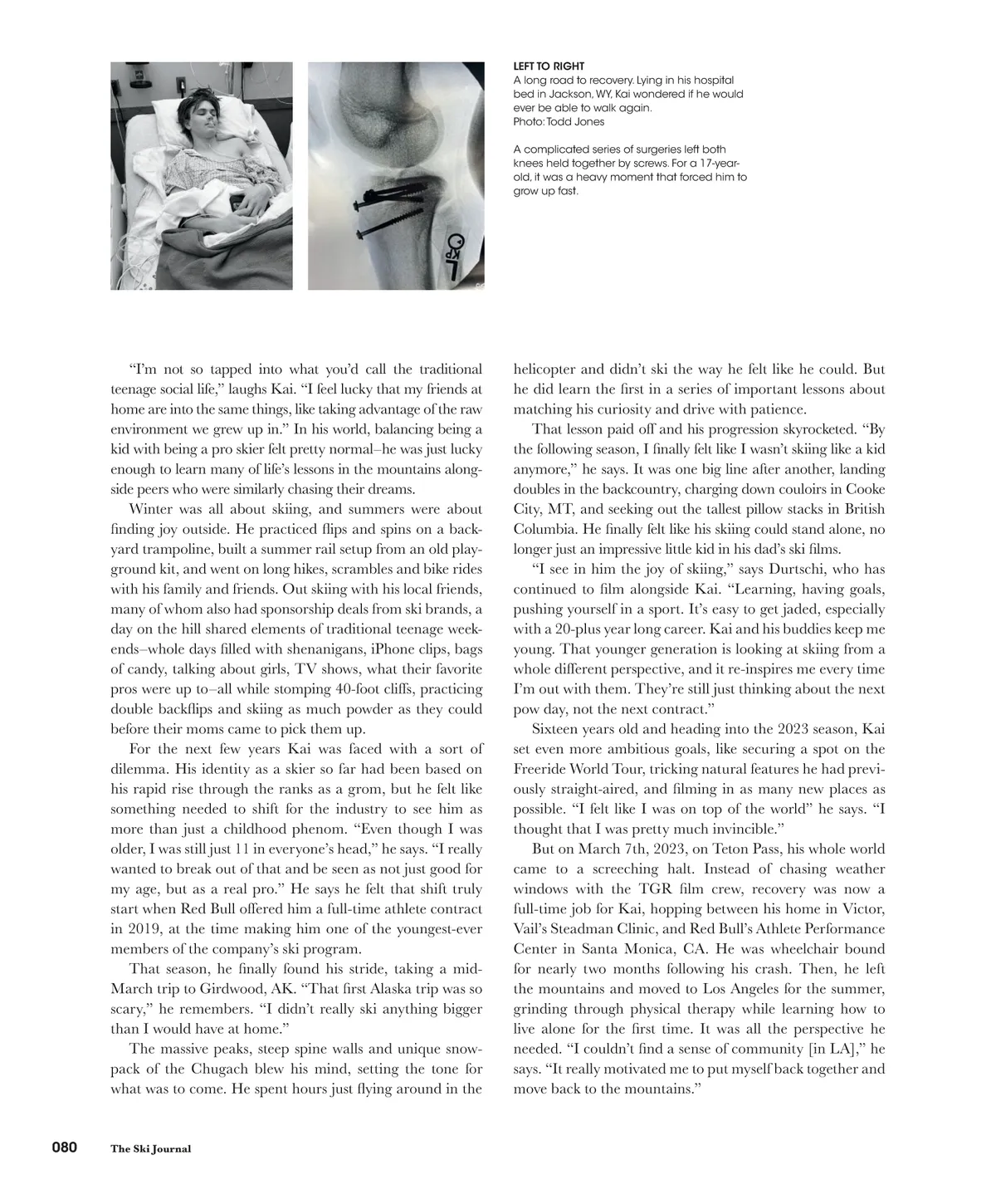
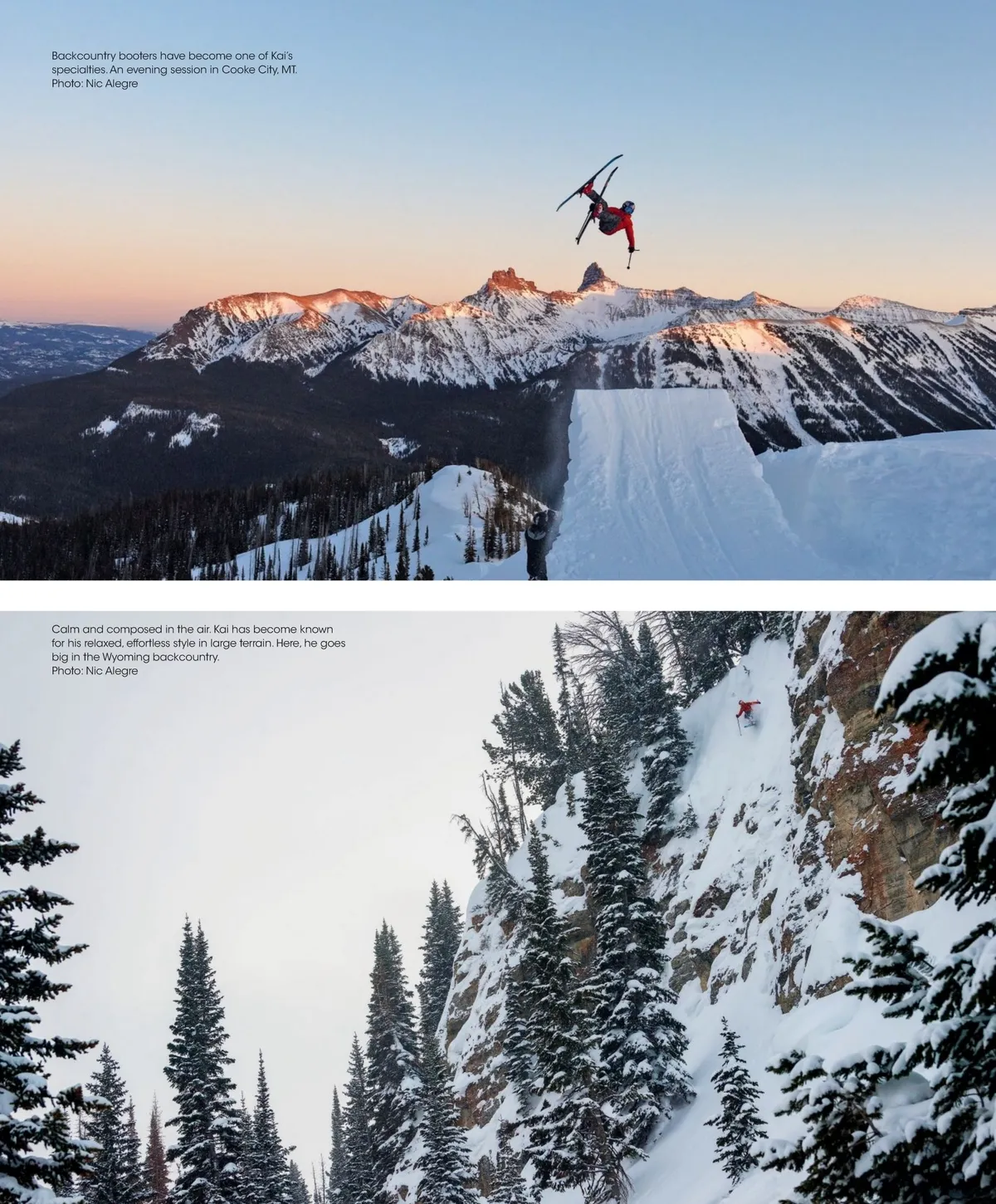
LEFT TO RIGHT A long road to recovery. Lying in his hospital bed in Jackson, WY, Kai wondered if he would ever be able to walk again. Photo: Todd Jones A complicated series of surgeries left both knees held together by screws. For a 17-year-old, it was a heavy moment that forced him to grow up fast. “I’m not so tapped into what you’d call the traditional teenage social life,” laughs Kai. “I feel lucky that my friends at home are into the same things, like taking advantage of the raw environment we grew up in.” In his world, balancing being a kid with being a pro skier felt pretty normal–he was just lucky enough to learn many of life’s lessons in the mountains along-side peers who were similarly chasing their dreams. Winter was all about skiing, and summers were about finding joy outside. He practiced flips and spins on a back-yard trampoline, built a summer rail setup from an old play-ground kit, and went on long hikes, scrambles and bike rides with his family and friends. Out skiing with his local friends, many of whom also had sponsorship deals from ski brands, a day on the hill shared elements of traditional teenage week-ends–whole days filled with shenanigans, iPhone clips, bags of candy, talking about girls, TV shows, what their favorite pros were up to–all while stomping 40-foot cliffs, practicing double backflips and skiing as much powder as they could before their moms came to pick them up. For the next few years Kai was faced with a sort of dilemma. His identity as a skier so far had been based on his rapid rise through the ranks as a grom, but he felt like something needed to shift for the industry to see him as more than just a childhood phenom. “Even though I was older, I was still just 11 in everyone’s head,” he says. “I really wanted to break out of that and be seen as not just good for my age, but as a real pro.” He says he felt that shift truly start when Red Bull offered him a full-time athlete contract in 2019, at the time making him one of the youngest-ever members of the company’s ski program. That season, he finally found his stride, taking a mid-March trip to Girdwood, AK. “That first Alaska trip was so scary,” he remembers. “I didn’t really ski anything bigger than I would have at home.” The massive peaks, steep spine walls and unique snow-pack of the Chugach blew his mind, setting the tone for what was to come. He spent hours just flying around in the helicopter and didn’t ski the way he felt like he could. But he did learn the first in a series of important lessons about matching his curiosity and drive with patience. That lesson paid off and his progression skyrocketed. “By the following season, I finally felt like I wasn’t skiing like a kid anymore,” he says. It was one big line after another, landing doubles in the backcountry, charging down couloirs in Cooke City, MT, and seeking out the tallest pillow stacks in British Columbia. He finally felt like his skiing could stand alone, no longer just an impressive little kid in his dad’s ski films. “I see in him the joy of skiing,” says Durtschi, who has continued to film alongside Kai. “Learning, having goals, pushing yourself in a sport. It’s easy to get jaded, especially with a 20-plus year long career. Kai and his buddies keep me young. That younger generation is looking at skiing from a whole different perspective, and it re-inspires me every time I’m out with them. They’re still just thinking about the next pow day, not the next contract.” Sixteen years old and heading into the 2023 season, Kai set even more ambitious goals, like securing a spot on the Freeride World Tour, tricking natural features he had previ-ously straight-aired, and filming in as many new places as possible. “I felt like I was on top of the world” he says. “I thought that I was pretty much invincible.” But on March 7th, 2023, on Teton Pass, his whole world came to a screeching halt. Instead of chasing weather windows with the TGR film crew, recovery was now a full-time job for Kai, hopping between his home in Victor, Vail’s Steadman Clinic, and Red Bull’s Athlete Performance Center in Santa Monica, CA. He was wheelchair bound for nearly two months following his crash. Then, he left the mountains and moved to Los Angeles for the summer, grinding through physical therapy while learning how to live alone for the first time. It was all the perspective he needed. “I couldn’t find a sense of community [in LA],” he says. “It really motivated me to put myself back together and move back to the mountains.” 080 The Ski Journal
The Ski Journal Volume 18, Issue 1: Page 80