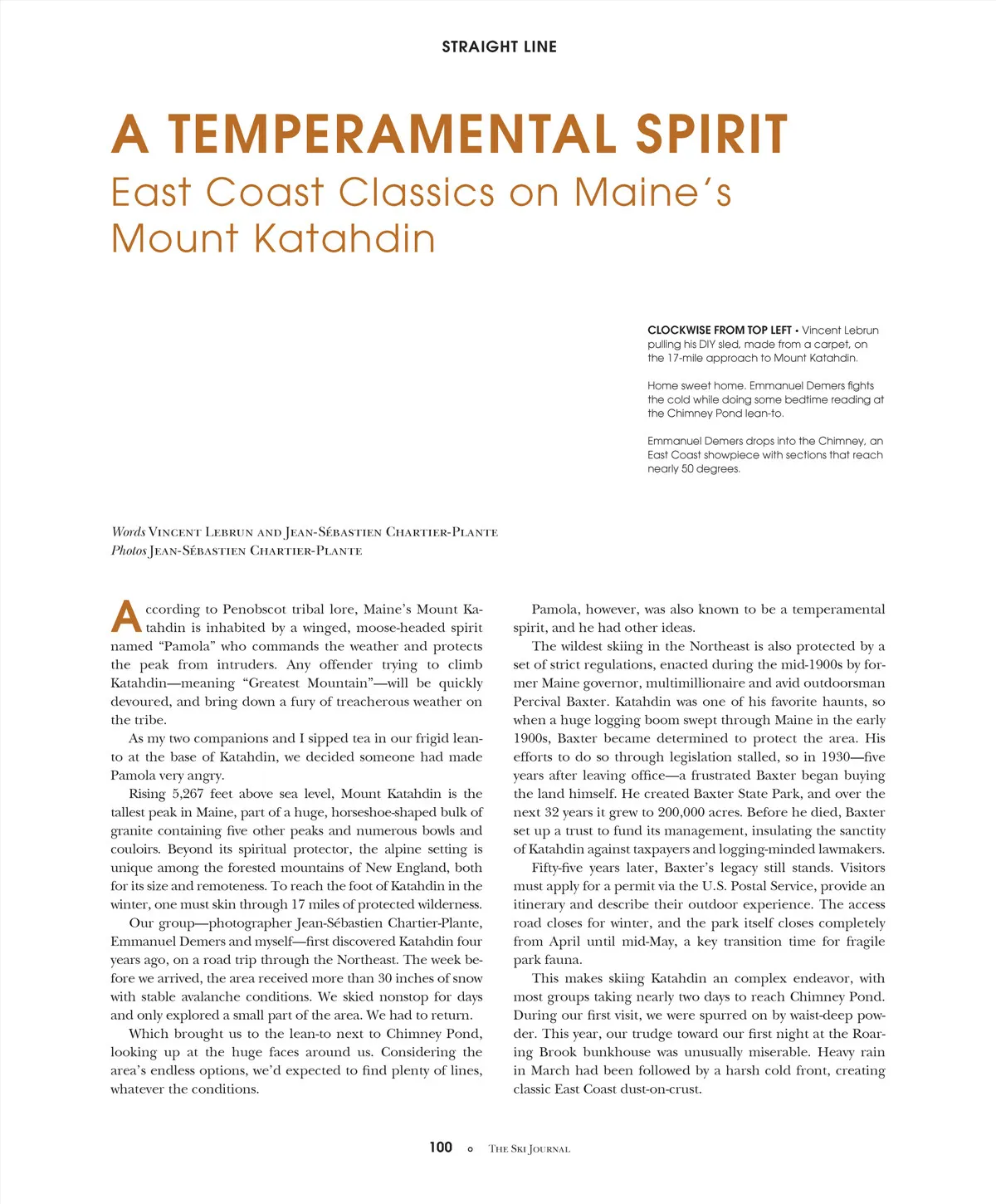
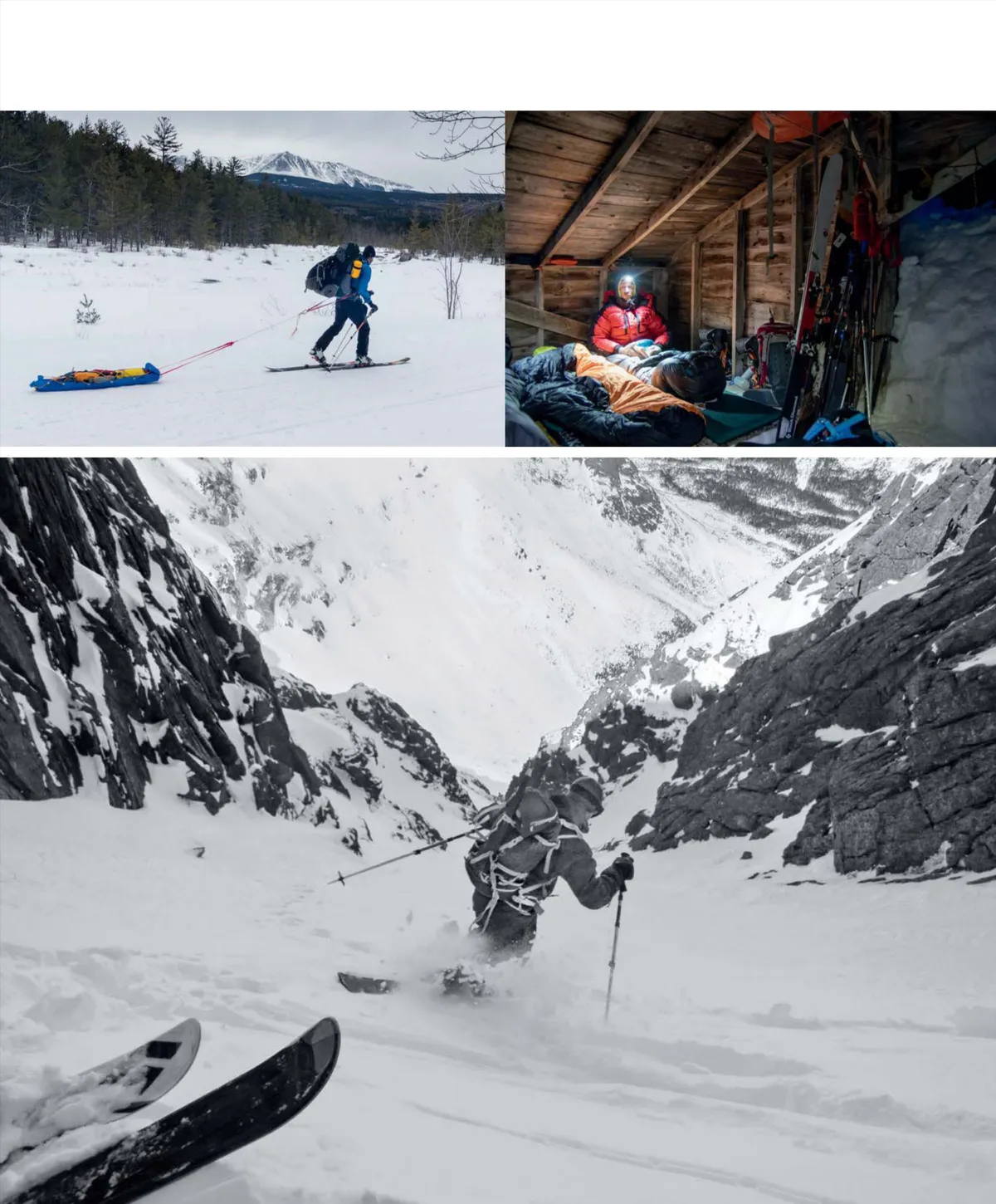
STRAIGHT LINE A TEMPERAMENTAL SPIRIT East Coast Classics on Maine’s Mount Katahdin CLOCKWISE FROM TOP LEFT • Vincent Lebrun pulling his DIY sled, made from a carpet, on the 17-mile approach to Mount Katahdin. Home sweet home. Emmanuel Demers fights the cold while doing some bedtime reading at the Chimney Pond lean-to. Four’s a crowd. Emmanuel Demers drops into the Chimney, an Photo: Garrett Grove East Coast showpiece with sections that reach nearly 50 degrees. Words Vincent Lebrun and Jean-Sébastien Chartier-Plante Photos Jean-Sébastien Chartier-Plante ccording to Penobscot tribal lore, Maine’s Mount Ka-tahdin is inhabited by a winged, moose-headed spirit named “Pamola” who commands the weather and protects the peak from intruders. Any offender trying to climb Katahdin—meaning “Greatest Mountain”—will be quickly devoured, and bring down a fury of treacherous weather on the tribe. As my two companions and I sipped tea in our frigid lean-to at the base of Katahdin, we decided someone had made Pamola very angry. Rising 5,267 feet above sea level, Mount Katahdin is the tallest peak in Maine, part of a huge, horseshoe-shaped bulk of granite containing five other peaks and numerous bowls and couloirs. Beyond its spiritual protector, the alpine setting is unique among the forested mountains of New England, both for its size and remoteness. To reach the foot of Katahdin in the winter, one must skin through 17 miles of protected wilderness. Our group—photographer Jean-Sébastien Chartier-Plante, Emmanuel Demers and myself—first discovered Katahdin four years ago, on a road trip through the Northeast. The week be-fore we arrived, the area received more than 30 inches of snow with stable avalanche conditions. We skied nonstop for days and only explored a small part of the area. We had to return. Which brought us to the lean-to next to Chimney Pond, looking up at the huge faces around us. Considering the area’s endless options, we’d expected to find plenty of lines, whatever the conditions. A Pamola, however, was also known to be a temperamental spirit, and he had other ideas. The wildest skiing in the Northeast is also protected by a set of strict regulations, enacted during the mid-1900s by for-mer Maine governor, multimillionaire and avid outdoorsman Percival Baxter. Katahdin was one of his favorite haunts, so when a huge logging boom swept through Maine in the early 1900s, Baxter became determined to protect the area. His efforts to do so through legislation stalled, so in 1930—five years after leaving office—a frustrated Baxter began buying the land himself. He created Baxter State Park, and over the next 32 years it grew to 200,000 acres. Before he died, Baxter set up a trust to fund its management, insulating the sanctity of Katahdin against taxpayers and logging-minded lawmakers. Fifty-five years later, Baxter’s legacy still stands. Visitors must apply for a permit via the U.S. Postal Service, provide an itinerary and describe their outdoor experience. The access road closes for winter, and the park itself closes completely from April until mid-May, a key transition time for fragile park fauna. This makes skiing Katahdin an complex endeavor, with most groups taking nearly two days to reach Chimney Pond. During our first visit, we were spurred on by waist-deep pow-der. This year, our trudge toward our first night at the Roar-ing Brook bunkhouse was unusually miserable. Heavy rain in March had been followed by a harsh cold front, creating classic East Coast dust-on-crust. 100 The Ski Journal
The Ski Journal Volume Eleven, Issue Four: Page 100