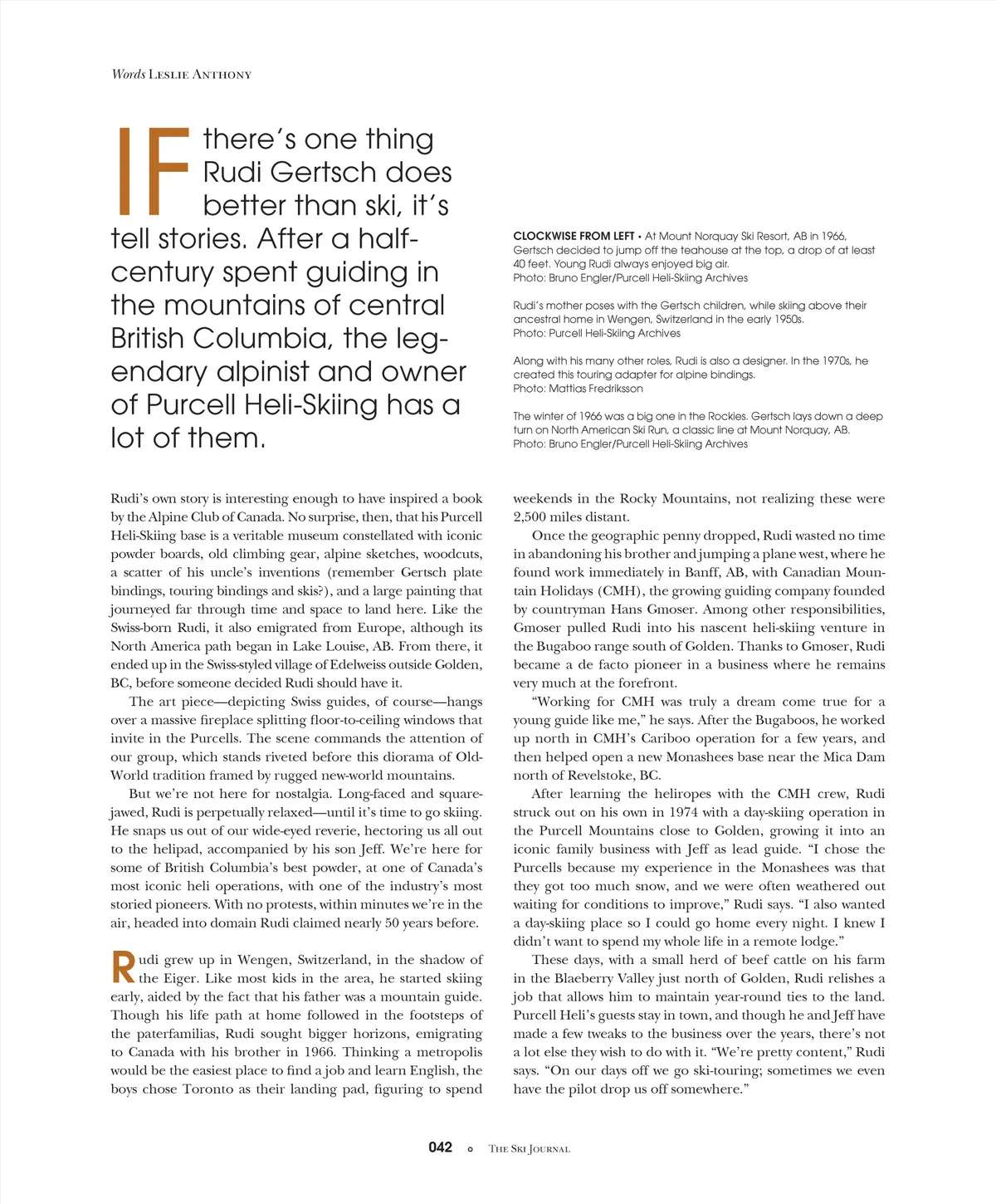
Words Leslie Anthony IF there’s one thing Rudi Gertsch does better than ski, it’s tell stories. After a half-century spent guiding in the mountains of central British Columbia, the leg-endary alpinist and owner of Purcell Heli-Skiing has a lot of them. CLOCKWISE FROM LEFT • At Mount Norquay Ski Resort, AB in 1966, Gertsch decided to jump off the teahouse at the top, a drop of at least 40 feet. Young Rudi always enjoyed big air. Photo: Bruno Engler/Purcell Heli-Skiing Archives Rudi’s mother poses with the Gertsch children, while skiing above their ancestral home in Wengen, Switzerland in the early 1950s. Photo: Purcell Heli-Skiing Archives Along with his many other roles, Rudi is also a designer. In the 1970s, he created this touring adapter for alpine bindings. Photo: Mattias Fredriksson The winter of 1966 was a big one in the Rockies. Gertsch lays down a deep turn on North American Ski Run, a classic line at Mount Norquay, AB. Photo: Bruno Engler/Purcell Heli-Skiing Archives Rudi’s own story is interesting enough to have inspired a book by the Alpine Club of Canada. No surprise, then, that his Purcell Heli-Skiing base is a veritable museum constellated with iconic powder boards, old climbing gear, alpine sketches, woodcuts, a scatter of his uncle’s inventions (remember Gertsch plate bindings, touring bindings and skis?), and a large painting that journeyed far through time and space to land here. Like the Swiss-born Rudi, it also emigrated from Europe, although its North America path began in Lake Louise, AB. From there, it ended up in the Swiss-styled village of Edelweiss outside Golden, BC, before someone decided Rudi should have it. The art piece—depicting Swiss guides, of course—hangs over a massive fireplace splitting floor-to-ceiling windows that invite in the Purcells. The scene commands the attention of our group, which stands riveted before this diorama of Old-World tradition framed by rugged new-world mountains. But we’re not here for nostalgia. Long-faced and square-jawed, Rudi is perpetually relaxed—until it’s time to go skiing. He snaps us out of our wide-eyed reverie, hectoring us all out to the helipad, accompanied by his son Jeff. We’re here for some of British Columbia’s best powder, at one of Canada’s most iconic heli operations, with one of the industry’s most storied pioneers. With no protests, within minutes we’re in the air, headed into domain Rudi claimed nearly 50 years before. udi grew up in Wengen, Switzerland, in the shadow of the Eiger. Like most kids in the area, he started skiing early, aided by the fact that his father was a mountain guide. Though his life path at home followed in the footsteps of the paterfamilias, Rudi sought bigger horizons, emigrating to Canada with his brother in 1966. Thinking a metropolis would be the easiest place to find a job and learn English, the boys chose Toronto as their landing pad, figuring to spend R weekends in the Rocky Mountains, not realizing these were 2,500 miles distant. Once the geographic penny dropped, Rudi wasted no time in abandoning his brother and jumping a plane west, where he found work immediately in Banff, AB, with Canadian Moun-tain Holidays (CMH), the growing guiding company founded by countryman Hans Gmoser. Among other responsibilities, Gmoser pulled Rudi into his nascent heli-skiing venture in the Bugaboo range south of Golden. Thanks to Gmoser, Rudi became a de facto pioneer in a business where he remains very much at the forefront. “Working for CMH was truly a dream come true for a young guide like me,” he says. After the Bugaboos, he worked up north in CMH’s Cariboo operation for a few years, and then helped open a new Monashees base near the Mica Dam north of Revelstoke, BC. After learning the heliropes with the CMH crew, Rudi struck out on his own in 1974 with a day-skiing operation in the Purcell Mountains close to Golden, growing it into an iconic family business with Jeff as lead guide. “I chose the Purcells because my experience in the Monashees was that they got too much snow, and we were often weathered out waiting for conditions to improve,” Rudi says. “I also wanted a day-skiing place so I could go home every night. I knew I didn’t want to spend my whole life in a remote lodge.” These days, with a small herd of beef cattle on his farm in the Blaeberry Valley just north of Golden, Rudi relishes a job that allows him to maintain year-round ties to the land. Purcell Heli’s guests stay in town, and though he and Jeff have made a few tweaks to the business over the years, there’s not a lot else they wish to do with it. “We’re pretty content,” Rudi says. “On our days off we go ski-touring; sometimes we even have the pilot drop us off somewhere.” 042 The Ski Journal
The Ski Journal Volume Eleven, Issue Four: Page 42