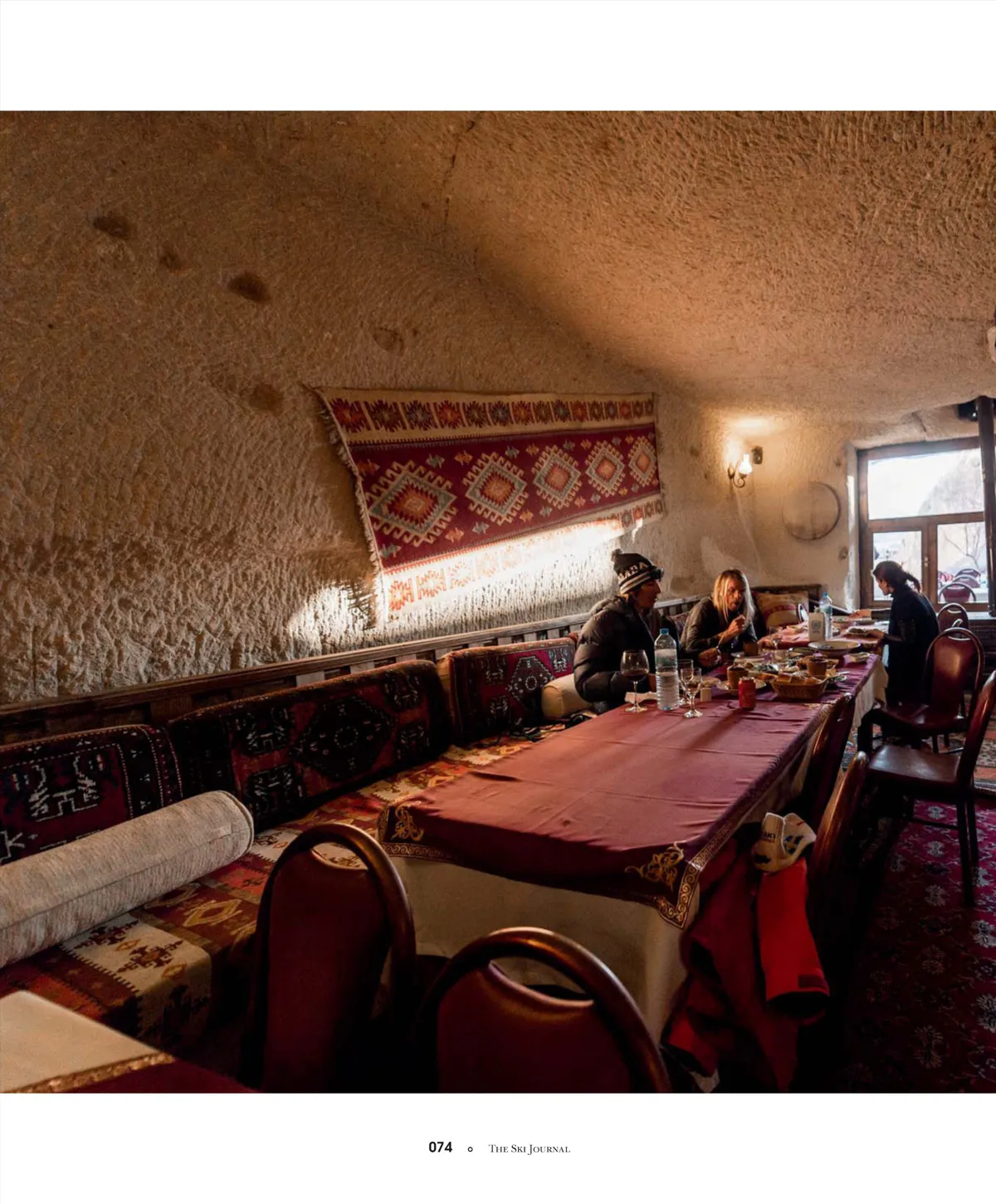
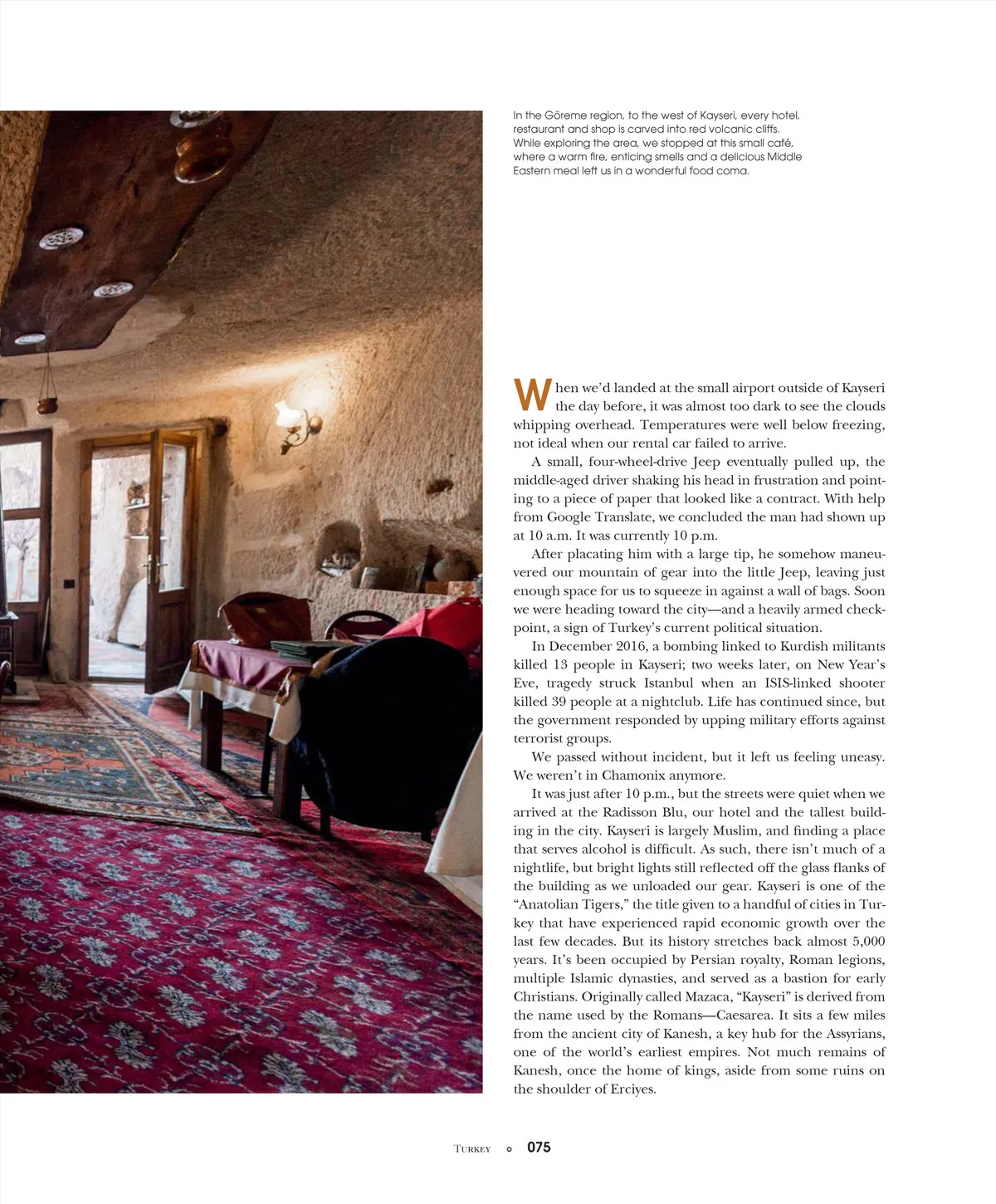
In the Göreme region, to the west of Kayseri, every hotel, restaurant and shop is carved into red volcanic cliffs. While exploring the area, we stopped at this small café, where a warm fire, enticing smells and a delicious Middle Eastern meal left us in a wonderful food coma. W hen we’d landed at the small airport outside of Kayseri the day before, it was almost too dark to see the clouds whipping overhead. Temperatures were well below freezing, not ideal when our rental car failed to arrive. A small, four-wheel-drive Jeep eventually pulled up, the middle-aged driver shaking his head in frustration and point-ing to a piece of paper that looked like a contract. With help from Google Translate, we concluded the man had shown up at 10 a.m. It was currently 10 p.m. After placating him with a large tip, he somehow maneu-vered our mountain of gear into the little Jeep, leaving just enough space for us to squeeze in against a wall of bags. Soon we were heading toward the city—and a heavily armed check-point, a sign of Turkey’s current political situation. In December 2016, a bombing linked to Kurdish militants killed 13 people in Kayseri; two weeks later, on New Year’s Eve, tragedy struck Istanbul when an ISIS-linked shooter killed 39 people at a nightclub. Life has continued since, but the government responded by upping military efforts against terrorist groups. We passed without incident, but it left us feeling uneasy. We weren’t in Chamonix anymore. It was just after 10 p.m., but the streets were quiet when we arrived at the Radisson Blu, our hotel and the tallest build-ing in the city. Kayseri is largely Muslim, and finding a place that serves alcohol is difficult. As such, there isn’t much of a nightlife, but bright lights still reflected off the glass flanks of the building as we unloaded our gear. Kayseri is one of the “Anatolian Tigers,” the title given to a handful of cities in Tur-key that have experienced rapid economic growth over the last few decades. But its history stretches back almost 5,000 years. It’s been occupied by Persian royalty, Roman legions, multiple Islamic dynasties, and served as a bastion for early Christians. Originally called Mazaca, “Kayseri” is derived from the name used by the Romans—Caesarea. It sits a few miles from the ancient city of Kanesh, a key hub for the Assyrians, one of the world’s earliest empires. Not much remains of Kanesh, once the home of kings, aside from some ruins on the shoulder of Erciyes. Turkey 075
The Ski Journal Volume Eleven, Issue Four: Page 75