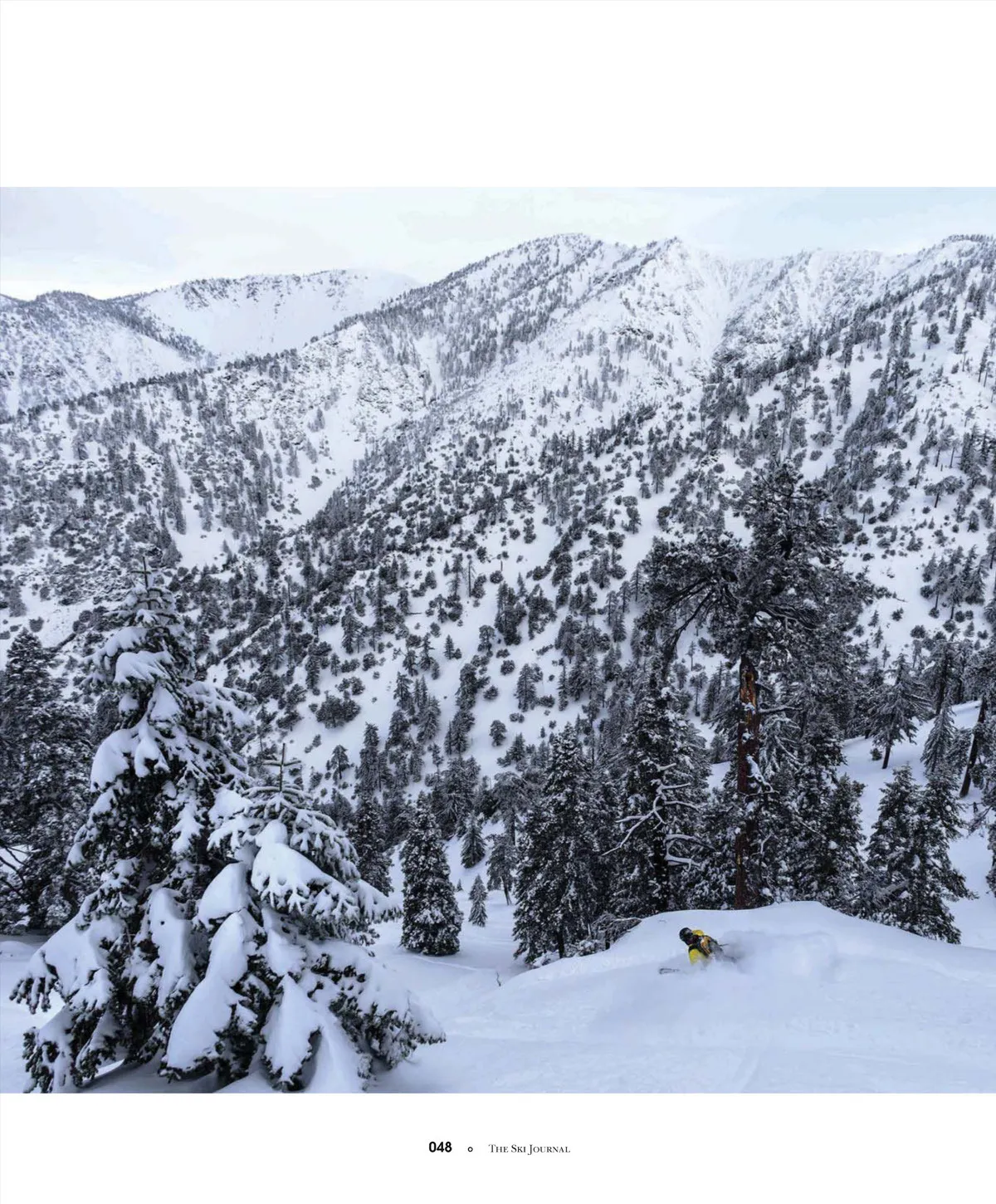
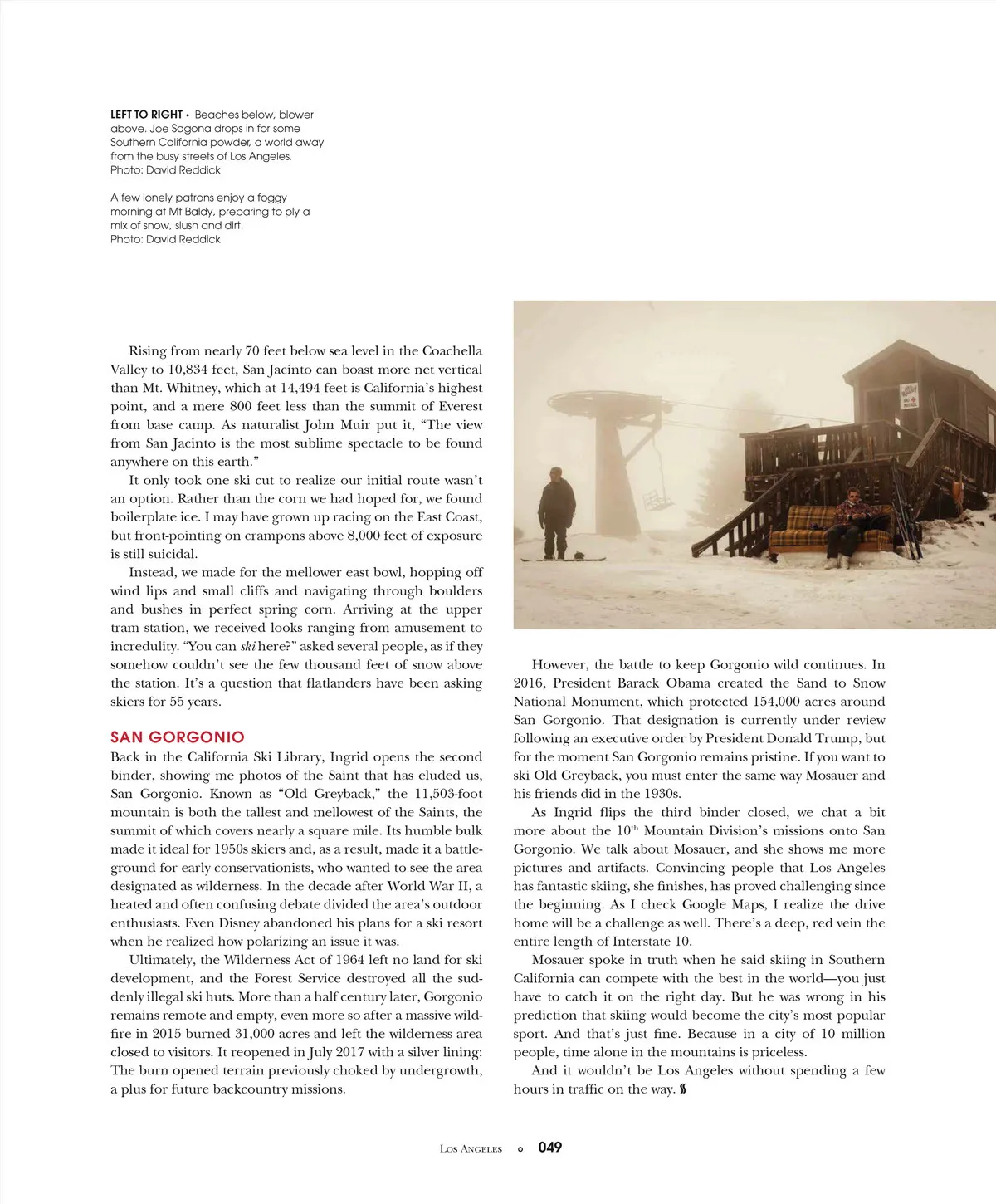
LEFT TO RIGHT • Beaches below, blower above. Joe Sagona drops in for some Southern California powder, a world away from the busy streets of Los Angeles. Photo: David Reddick A few lonely patrons enjoy a foggy morning at Mt Baldy, preparing to ply a mix of snow, slush and dirt. Photo: David Reddick Rising from nearly 70 feet below sea level in the Coachella Valley to 10,834 feet, San Jacinto can boast more net vertical than Mt. Whitney, which at 14,494 feet is California’s highest point, and a mere 800 feet less than the summit of Everest from base camp. As naturalist John Muir put it, “The view from San Jacinto is the most sublime spectacle to be found anywhere on this earth.” It only took one ski cut to realize our initial route wasn’t an option. Rather than the corn we had hoped for, we found boilerplate ice. I may have grown up racing on the East Coast, but front-pointing on crampons above 8,000 feet of exposure is still suicidal. Instead, we made for the mellower east bowl, hopping off wind lips and small cliffs and navigating through boulders and bushes in perfect spring corn. Arriving at the upper tram station, we received looks ranging from amusement to incredulity. “You can ski here?” asked several people, as if they somehow couldn’t see the few thousand feet of snow above the station. It’s a question that flatlanders have been asking skiers for 55 years. SAN GORGONIO Back in the California Ski Library, Ingrid opens the second binder, showing me photos of the Saint that has eluded us, San Gorgonio. Known as “Old Greyback,” the 11,503-foot mountain is both the tallest and mellowest of the Saints, the summit of which covers nearly a square mile. Its humble bulk made it ideal for 1950s skiers and, as a result, made it a battle-ground for early conservationists, who wanted to see the area designated as wilderness. In the decade after World War II, a heated and often confusing debate divided the area’s outdoor enthusiasts. Even Disney abandoned his plans for a ski resort when he realized how polarizing an issue it was. Ultimately, the Wilderness Act of 1964 left no land for ski development, and the Forest Service destroyed all the sud-denly illegal ski huts. More than a half century later, Gorgonio remains remote and empty, even more so after a massive wild-fire in 2015 burned 31,000 acres and left the wilderness area closed to visitors. It reopened in July 2017 with a silver lining: The burn opened terrain previously choked by undergrowth, a plus for future backcountry missions. However, the battle to keep Gorgonio wild continues. In 2016, President Barack Obama created the Sand to Snow National Monument, which protected 154,000 acres around San Gorgonio. That designation is currently under review following an executive order by President Donald Trump, but for the moment San Gorgonio remains pristine. If you want to ski Old Greyback, you must enter the same way Mosauer and his friends did in the 1930s. As Ingrid flips the third binder closed, we chat a bit more about the 10 th Mountain Division’s missions onto San Gorgonio. We talk about Mosauer, and she shows me more pictures and artifacts. Convincing people that Los Angeles has fantastic skiing, she finishes, has proved challenging since the beginning. As I check Google Maps, I realize the drive home will be a challenge as well. There’s a deep, red vein the entire length of Interstate 10. Mosauer spoke in truth when he said skiing in Southern California can compete with the best in the world—you just have to catch it on the right day. But he was wrong in his prediction that skiing would become the city’s most popular sport. And that’s just fine. Because in a city of 10 million people, time alone in the mountains is priceless. And it wouldn’t be Los Angeles without spending a few hours in traffic on the way. Los Angeles 049
The Ski Journal Volume Eleven, Issue One: Page 49