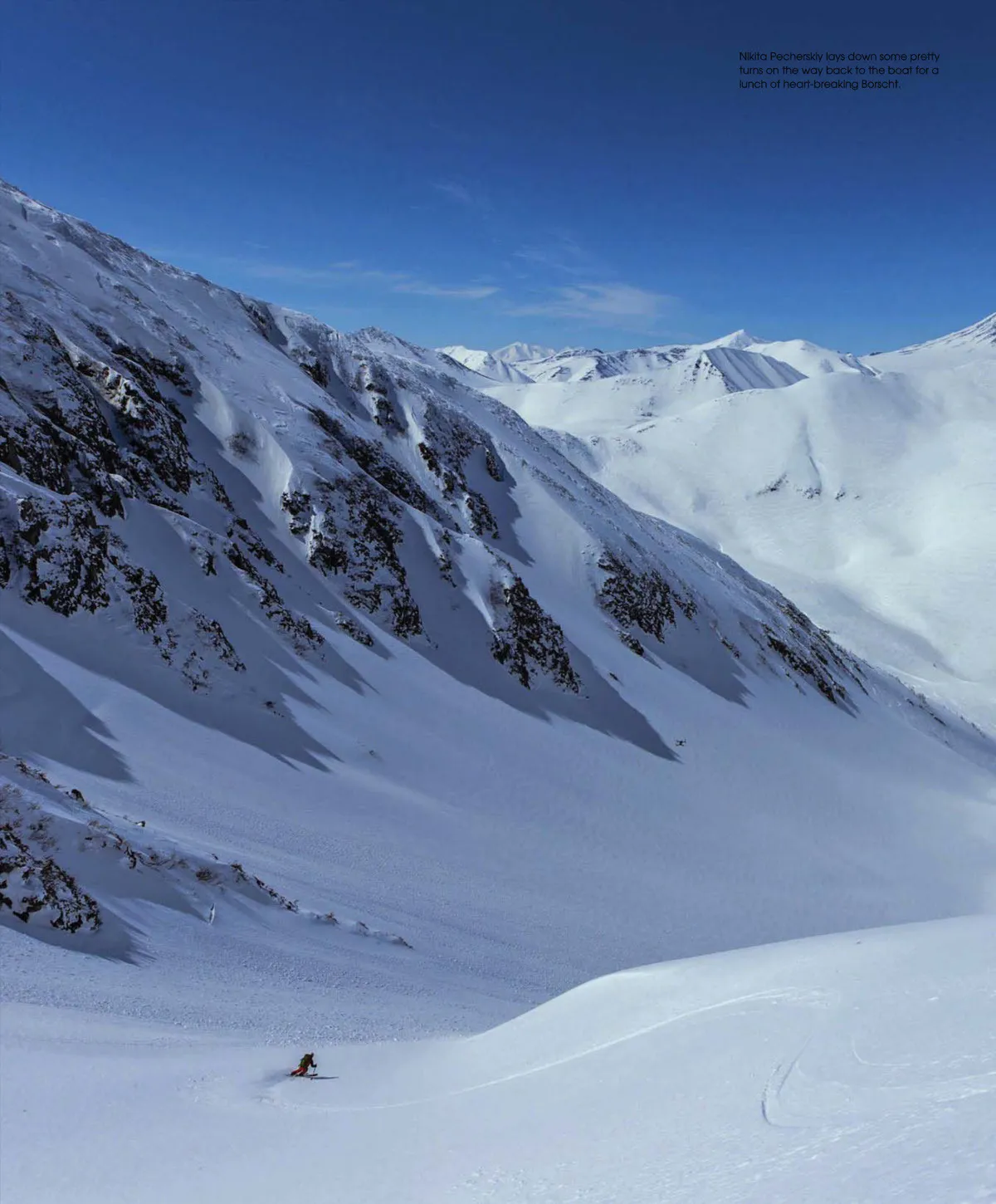
Words and Photos Mary McIntyre “WHAT The Kamchatka Peninsula is not known for its local ski scene, nor for being on the edge of pop culture. The spurt of land, jutting 800 miles into the Pacific from the westernmost edge of Russia, is known for its monstrous bears, massive fish, ac-tive volcanoes and huge swaths of wilderness. The capital of Kamchatka, Petropavlovsk-Kamchatsky, is the second largest city in the world unreachable by road, but the entirety of the peninsula is home to less than 350,000 people. Add a nine-hour flight from Moscow, and it’s easy to expect a community lost in time. But that’s not the case at the Bay House, the Kamchatka Freeride Community’s [KFC] headquarters and base of operations. Located at the southern edge of the capital, the building is bright and modern, and the fancy gear-drying room downstairs is packed with the hottest skis, bindings, boots and avalanche gear. As I try to explain the intricacies of “Sendy AF,” two cute girls in their 20s offer espresso and buttery porridge before flipping on the big-screen TV to videos of local freeride competitions. Taking place on the birch-forested slopes surrounding the city, most participants speed straight down the run until blowing up. And, for lack of a better term, they are purely, utterly and completely stoked. This is Kamchatkan freeskiing. does it mean, ‘Sendy AF?’” Evgeny Matalyga asks with a perplexed look. He’s scrolling through Instagram on a comfy couch be-neath ocean-view windows, one of many at the hostel in which we’re staying. Courtesy of @jerryoftheday, the Sendy AF shirt catches Evegny’s eye because he, and everyone I meet in Kamchatka, is fascinated by main-stream ski culture. six-day mission to scout the scene in anticipation of bringing clients. But, after 26 hours of traveling, our first destination is Petropavlovsk-Kamchatsky’s fish market. Nose-burning salinity hangs thick in the air, and vendors display king crab, multiple species of salmon, halibut steaks, five-gallon vats of caviar, pristine white calamari rings, and an assortment of other fish, the names of which there is no chance of me pronouncing correctly. As word spreads of English speakers in the market, we’re beset by a litany of sing-songy, “Hell-O! How are you? Where do you come from? What would you like to buy?” Petropavlovsk-Kamchatsky is a gritty derelict of a city, its Soviet-era buildings coated with black volcanic dust and pre-sided over by a 100-foot-tall statue of Lenin. The people are as friendly as the snow is dirty, greeting us with open smiles as we pass. Smiles are about the only language we share. All signs and billboards in the capital are written in Cyrillic, and less than 10 percent of people speak English. Shopping consists of pointing and nodding, and I purchase mystery breads and vegetables by holding out money and letting the vendor pick out the coins she needs. Returning to the hostel, I meet Kirill Seregin, CEO and founder of KFC. He’s in his early 30s and sports a long, slouchy hoody and Armada baseball cap. “Welcome to our hostel and Kamchatka,” he says. “We are happy to have you in our home.” His English is limited but sufficient, and he’s clearly very proud of the community—both foreign and do-mestic—he’s created. I t’s mid-April, and I’m en route to KFC’s 60-foot catamaran. I’m here to see my friend Matt Edwards. Edwards is a Ca-nadian ski guide and owner of an adventure company called Expedition Engineering. He invited me to Kamchatka for a 074 The Ski Journal
The Ski Journal Volume Eleven, Issue One: Page 74