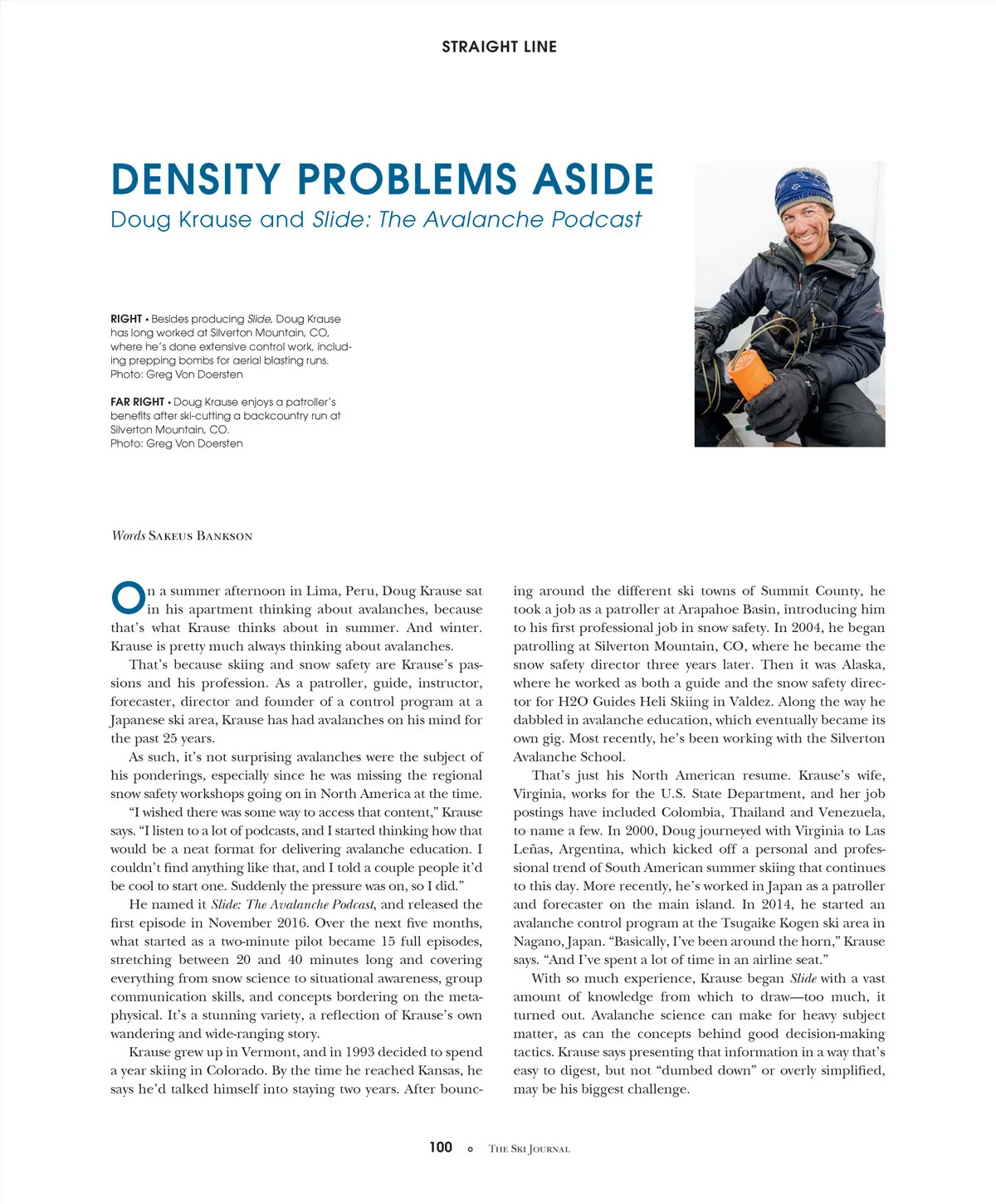
STRAIGHT LINE DENSITY PROBLEMS ASIDE Doug Krause and Slide: The Avalanche Podcast RIGHT • Besides producing Slide, Doug Krause has long worked at Silverton Mountain, CO, where he’s done extensive control work, includ-ing prepping bombs for aerial blasting runs. Photo: Greg Von Doersten FAR RIGHT • Doug Krause enjoys a patroller’s benefits after ski-cutting a backcountry run at Silverton Mountain, CO. Photo: Greg Von Doersten Words Sakeus Bankson n a summer afternoon in Lima, Peru, Doug Krause sat in his apartment thinking about avalanches, because that’s what Krause thinks about in summer. And winter. Krause is pretty much always thinking about avalanches. That’s because skiing and snow safety are Krause’s pas-sions and his profession. As a patroller, guide, instructor, forecaster, director and founder of a control program at a Japanese ski area, Krause has had avalanches on his mind for the past 25 years. As such, it’s not surprising avalanches were the subject of his ponderings, especially since he was missing the regional snow safety workshops going on in North America at the time. “I wished there was some way to access that content,” Krause says. “I listen to a lot of podcasts, and I started thinking how that would be a neat format for delivering avalanche education. I couldn’t find anything like that, and I told a couple people it’d be cool to start one. Suddenly the pressure was on, so I did.” He named it Slide: The Avalanche Podcast , and released the first episode in November 2016. Over the next five months, what started as a two-minute pilot became 15 full episodes, stretching between 20 and 40 minutes long and covering everything from snow science to situational awareness, group communication skills, and concepts bordering on the meta-physical. It’s a stunning variety, a reflection of Krause’s own wandering and wide-ranging story. Krause grew up in Vermont, and in 1993 decided to spend a year skiing in Colorado. By the time he reached Kansas, he says he’d talked himself into staying two years. After bounc-O ing around the different ski towns of Summit County, he took a job as a patroller at Arapahoe Basin, introducing him to his first professional job in snow safety. In 2004, he began patrolling at Silverton Mountain, CO, where he became the snow safety director three years later. Then it was Alaska, where he worked as both a guide and the snow safety direc-tor for H2O Guides Heli Skiing in Valdez. Along the way he dabbled in avalanche education, which eventually became its own gig. Most recently, he’s been working with the Silverton Avalanche School. That’s just his North American resume. Krause’s wife, Virginia, works for the U.S. State Department, and her job postings have included Colombia, Thailand and Venezuela, to name a few. In 2000, Doug journeyed with Virginia to Las Leñas, Argentina, which kicked off a personal and profes-sional trend of South American summer skiing that continues to this day. More recently, he’s worked in Japan as a patroller and forecaster on the main island. In 2014, he started an avalanche control program at the Tsugaike Kogen ski area in Nagano, Japan. “Basically, I’ve been around the horn,” Krause says. “And I’ve spent a lot of time in an airline seat.” With so much experience, Krause began Slide with a vast amount of knowledge from which to draw—too much, it turned out. Avalanche science can make for heavy subject matter, as can the concepts behind good decision-making tactics. Krause says presenting that information in a way that’s easy to digest, but not “dumbed down” or overly simplified, may be his biggest challenge. 100 The Ski Journal
The Ski Journal Volume Eleven, Issue Three: Page 100