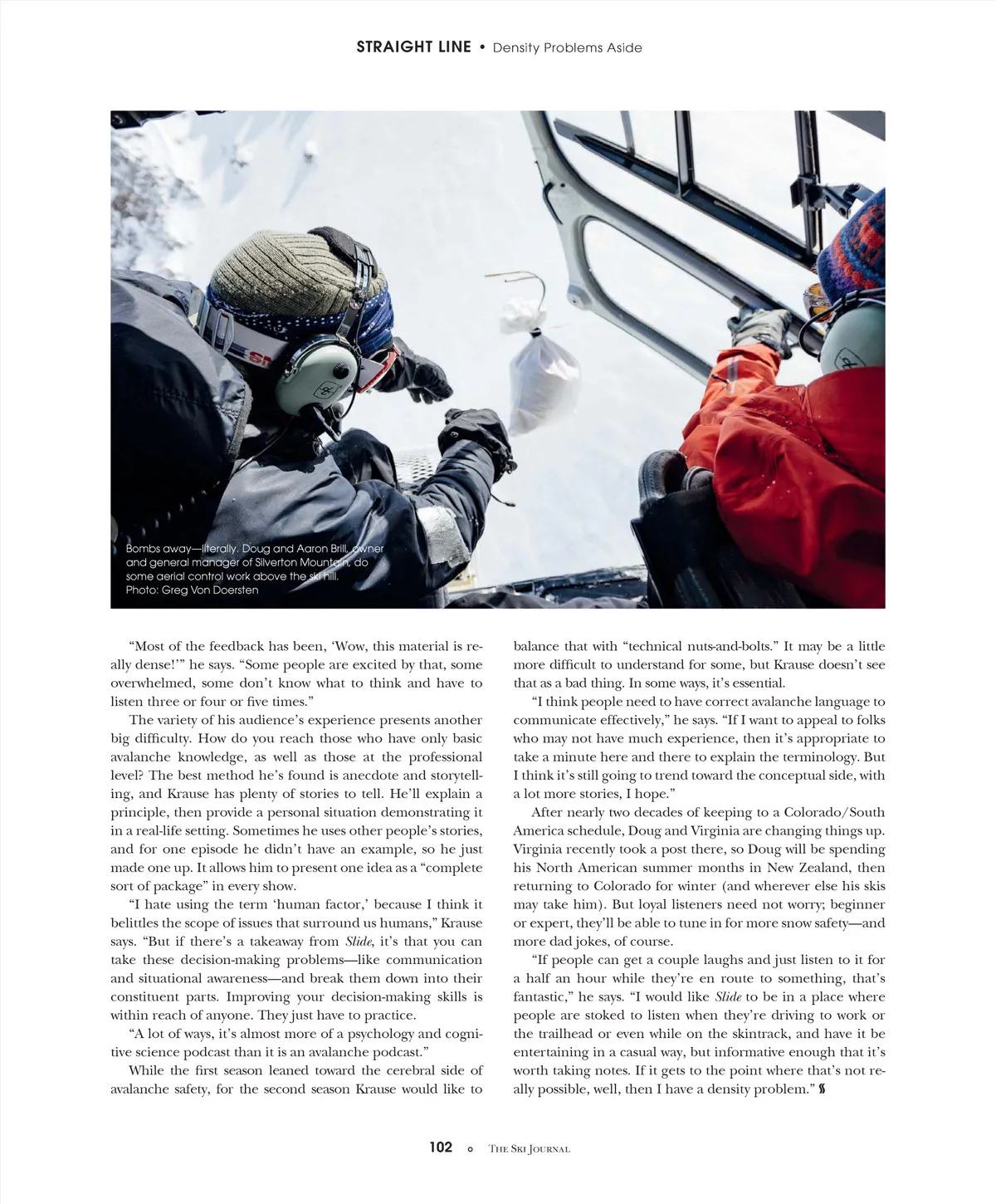
STRAIGHT LINE • Density Problems Aside Bombs away—literally. Doug and Aaron Brill, owner and general manager of Silverton Mountain, do some aerial control work above the ski hill. Photo: Greg Von Doersten “Most of the feedback has been, ‘Wow, this material is re-ally dense!’” he says. “Some people are excited by that, some overwhelmed, some don’t know what to think and have to listen three or four or five times.” The variety of his audience’s experience presents another big difficulty. How do you reach those who have only basic avalanche knowledge, as well as those at the professional level? The best method he’s found is anecdote and storytell-ing, and Krause has plenty of stories to tell. He’ll explain a principle, then provide a personal situation demonstrating it in a real-life setting. Sometimes he uses other people’s stories, and for one episode he didn’t have an example, so he just made one up. It allows him to present one idea as a “complete sort of package” in every show. “I hate using the term ‘human factor,’ because I think it belittles the scope of issues that surround us humans,” Krause says. “But if there’s a takeaway from Slide , it’s that you can take these decision-making problems—like communication and situational awareness—and break them down into their constituent parts. Improving your decision-making skills is within reach of anyone. They just have to practice. “A lot of ways, it’s almost more of a psychology and cogni-tive science podcast than it is an avalanche podcast.” While the first season leaned toward the cerebral side of avalanche safety, for the second season Krause would like to balance that with “technical nuts-and-bolts.” It may be a little more difficult to understand for some, but Krause doesn’t see that as a bad thing. In some ways, it’s essential. “I think people need to have correct avalanche language to communicate effectively,” he says. “If I want to appeal to folks who may not have much experience, then it’s appropriate to take a minute here and there to explain the terminology. But I think it’s still going to trend toward the conceptual side, with a lot more stories, I hope.” After nearly two decades of keeping to a Colorado/South America schedule, Doug and Virginia are changing things up. Virginia recently took a post there, so Doug will be spending his North American summer months in New Zealand, then returning to Colorado for winter (and wherever else his skis may take him). But loyal listeners need not worry; beginner or expert, they’ll be able to tune in for more snow safety—and more dad jokes, of course. “If people can get a couple laughs and just listen to it for a half an hour while they’re en route to something, that’s fantastic,” he says. “I would like Slide to be in a place where people are stoked to listen when they’re driving to work or the trailhead or even while on the skintrack, and have it be entertaining in a casual way, but informative enough that it’s worth taking notes. If it gets to the point where that’s not re-ally possible, well, then I have a density problem.” 102 The Ski Journal
The Ski Journal Volume Eleven, Issue Three: Page 102