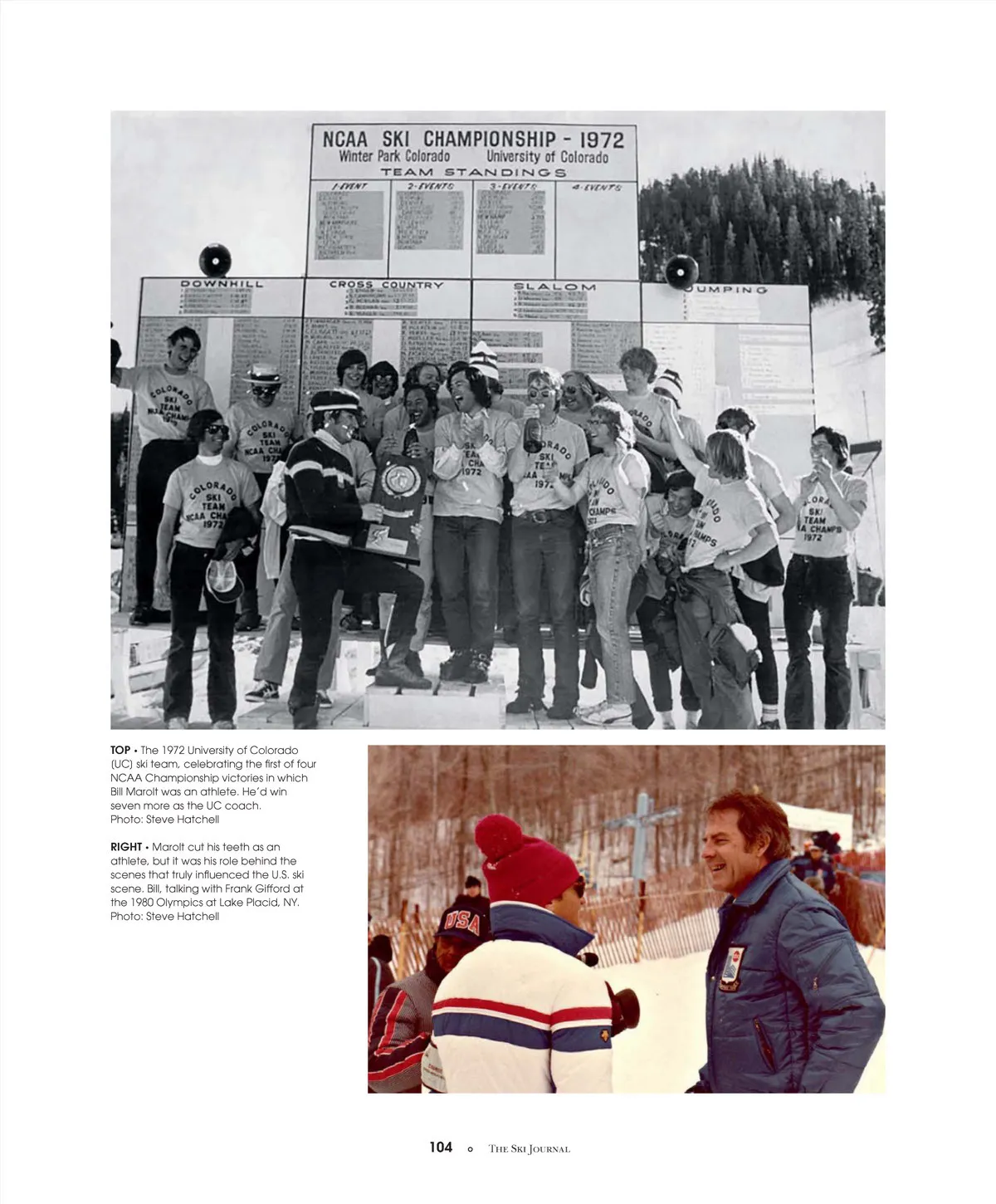
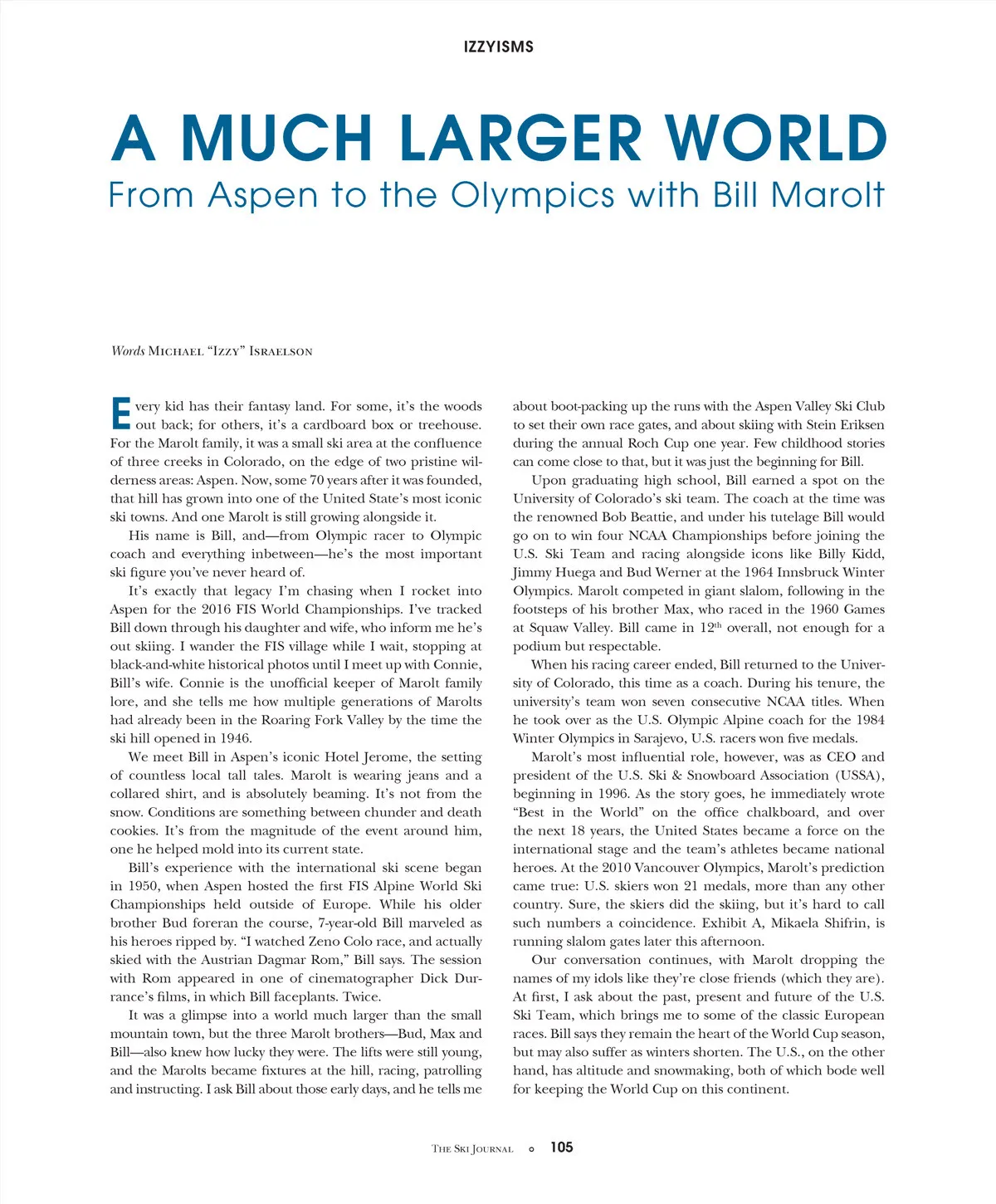
IZZYISMS From Aspen to the Olympics with Bill Marolt A MUCH LARGER WORLD Words Michael “Izzy” Israelson very kid has their fantasy land. For some, it’s the woods out back; for others, it’s a cardboard box or treehouse. For the Marolt family, it was a small ski area at the confluence of three creeks in Colorado, on the edge of two pristine wil-derness areas: Aspen. Now, some 70 years after it was founded, that hill has grown into one of the United State’s most iconic ski towns. And one Marolt is still growing alongside it. His name is Bill, and—from Olympic racer to Olympic coach and everything inbetween—he’s the most important ski figure you’ve never heard of. It’s exactly that legacy I’m chasing when I rocket into Aspen for the 2016 FIS World Championships. I’ve tracked Bill down through his daughter and wife, who inform me he’s out skiing. I wander the FIS village while I wait, stopping at black-and-white historical photos until I meet up with Connie, Bill’s wife. Connie is the unofficial keeper of Marolt family lore, and she tells me how multiple generations of Marolts had already been in the Roaring Fork Valley by the time the ski hill opened in 1946. We meet Bill in Aspen’s iconic Hotel Jerome, the setting of countless local tall tales. Marolt is wearing jeans and a collared shirt, and is absolutely beaming. It’s not from the snow. Conditions are something between chunder and death cookies. It’s from the magnitude of the event around him, one he helped mold into its current state. Bill’s experience with the international ski scene began in 1950, when Aspen hosted the first FIS Alpine World Ski Championships held outside of Europe. While his older brother Bud foreran the course, 7-year-old Bill marveled as his heroes ripped by. “I watched Zeno Colo race, and actually skied with the Austrian Dagmar Rom,” Bill says. The session with Rom appeared in one of cinematographer Dick Dur-rance’s films, in which Bill faceplants. Twice. It was a glimpse into a world much larger than the small mountain town, but the three Marolt brothers—Bud, Max and Bill—also knew how lucky they were. The lifts were still young, and the Marolts became fixtures at the hill, racing, patrolling and instructing. I ask Bill about those early days, and he tells me E about boot-packing up the runs with the Aspen Valley Ski Club to set their own race gates, and about skiing with Stein Eriksen during the annual Roch Cup one year. Few childhood stories can come close to that, but it was just the beginning for Bill. Upon graduating high school, Bill earned a spot on the University of Colorado’s ski team. The coach at the time was the renowned Bob Beattie, and under his tutelage Bill would go on to win four NCAA Championships before joining the U.S. Ski Team and racing alongside icons like Billy Kidd, Jimmy Huega and Bud Werner at the 1964 Innsbruck Winter Olympics. Marolt competed in giant slalom, following in the footsteps of his brother Max, who raced in the 1960 Games at Squaw Valley. Bill came in 12 th overall, not enough for a podium but respectable. When his racing career ended, Bill returned to the Univer-sity of Colorado, this time as a coach. During his tenure, the university’s team won seven consecutive NCAA titles. When he took over as the U.S. Olympic Alpine coach for the 1984 Winter Olympics in Sarajevo, U.S. racers won five medals. Marolt’s most influential role, however, was as CEO and president of the U.S. Ski & Snowboard Association (USSA), beginning in 1996. As the story goes, he immediately wrote “Best in the World” on the office chalkboard, and over the next 18 years, the United States became a force on the international stage and the team’s athletes became national heroes. At the 2010 Vancouver Olympics, Marolt’s prediction came true: U.S. skiers won 21 medals, more than any other country. Sure, the skiers did the skiing, but it’s hard to call such numbers a coincidence. Exhibit A, Mikaela Shifrin, is running slalom gates later this afternoon. Our conversation continues, with Marolt dropping the names of my idols like they’re close friends (which they are). At first, I ask about the past, present and future of the U.S. Ski Team, which brings me to some of the classic European races. Bill says they remain the heart of the World Cup season, but may also suffer as winters shorten. The U.S., on the other hand, has altitude and snowmaking, both of which bode well for keeping the World Cup on this continent. The Ski Journal 105
The Ski Journal Volume Eleven, Issue Three: Page 105