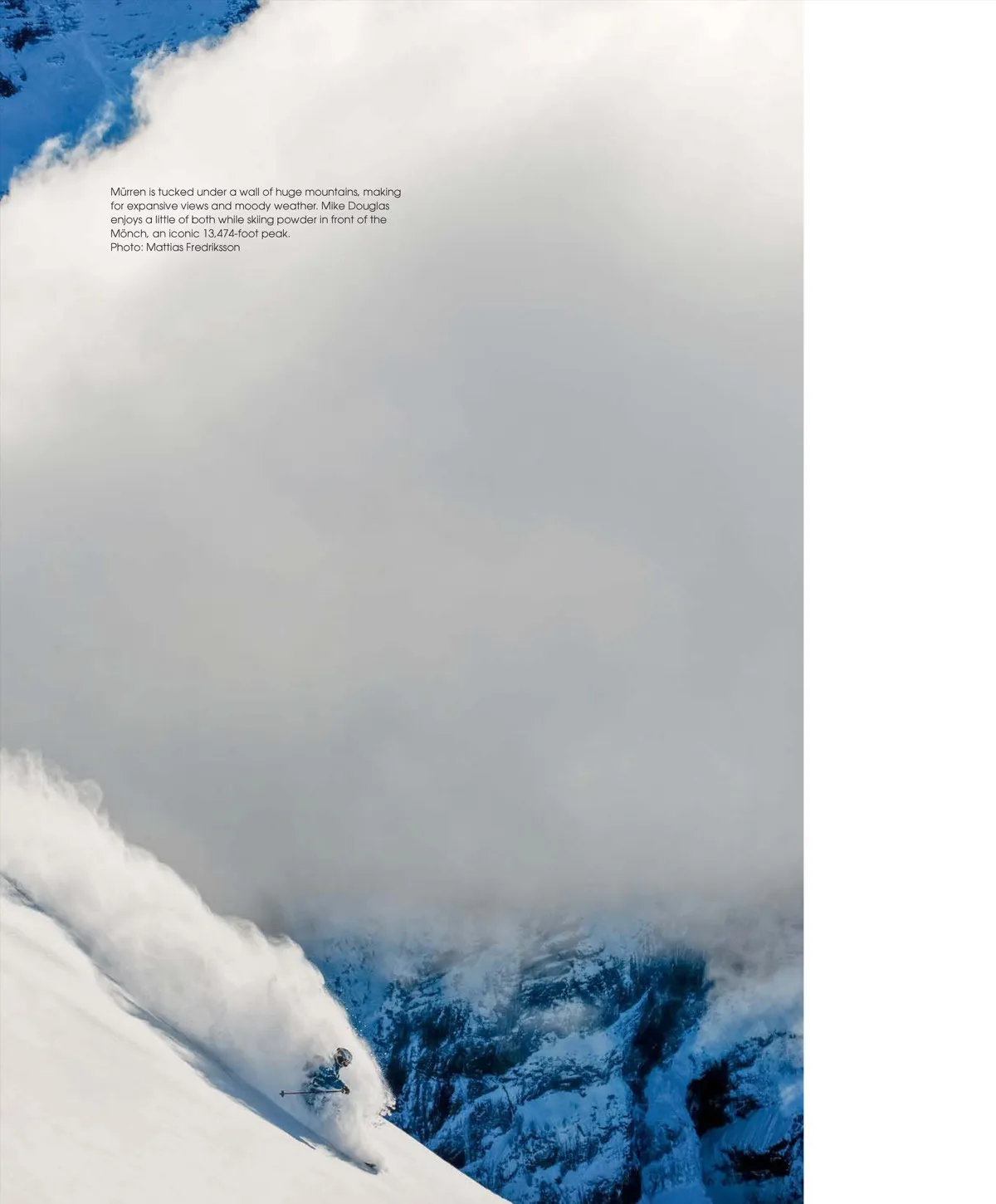
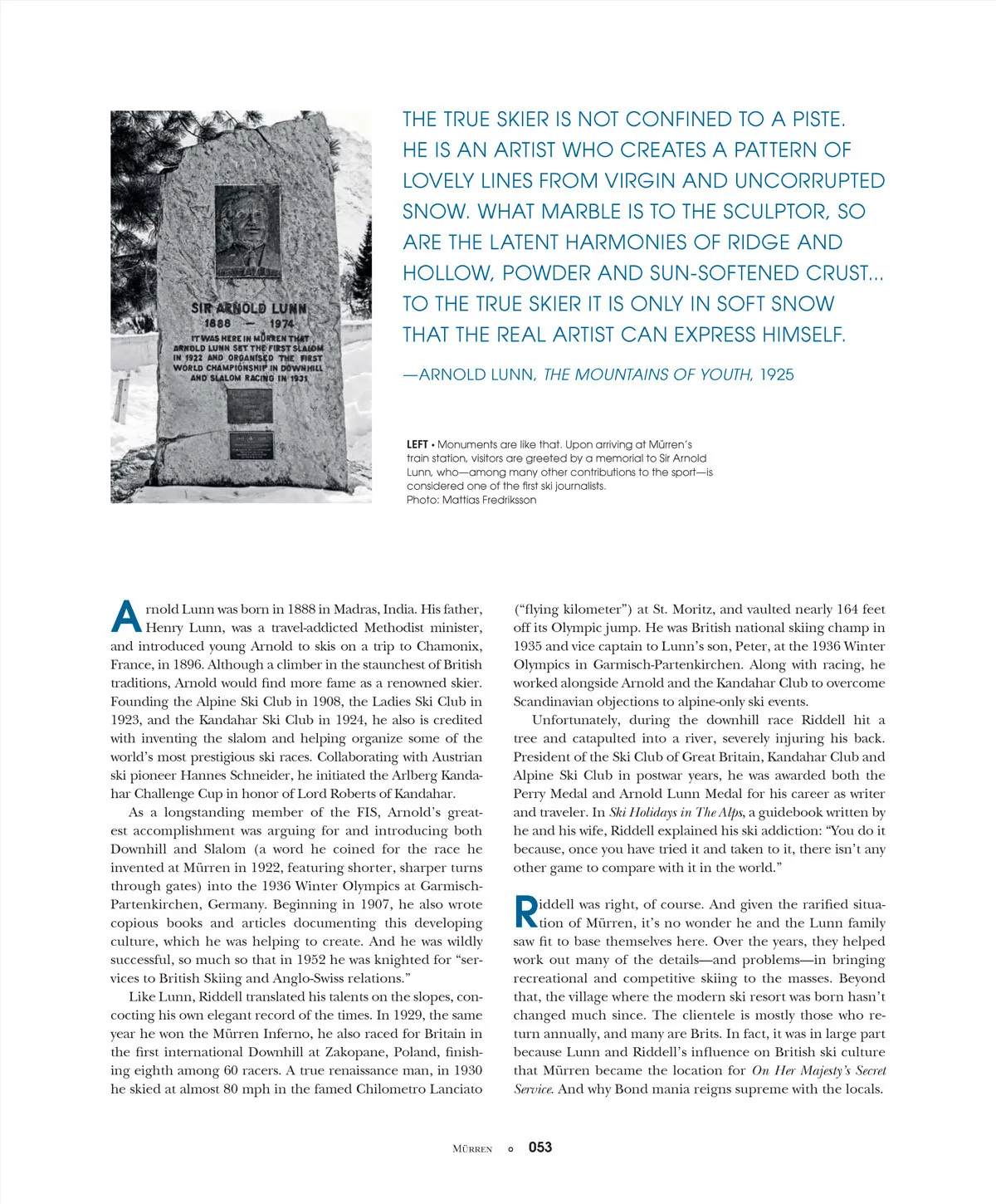
THE TRUE SKIER IS NOT CONFINED TO A PISTE. HE IS AN ARTIST WHO CREATES A PATTERN OF LOVELY LINES FROM VIRGIN AND UNCORRUPTED SNOW. WHAT MARBLE IS TO THE SCULPTOR, SO ARE THE LATENT HARMONIES OF RIDGE AND HOLLOW, POWDER AND SUN-SOFTENED CRUST... TO THE TRUE SKIER IT IS ONLY IN SOFT SNOW THAT THE REAL ARTIST CAN EXPRESS HIMSELF. —ARNOLD LUNN, THE MOUNTAINS OF YOUTH , 1925 LEFT • Monuments are like that. Upon arriving at Mürren’s train station, visitors are greeted by a memorial to Sir Arnold Lunn, who—among many other contributions to the sport—is considered one of the first ski journalists. Photo: Mattias Fredriksson rnold Lunn was born in 1888 in Madras, India. His father, Henry Lunn, was a travel-addicted Methodist minister, and introduced young Arnold to skis on a trip to Chamonix, France, in 1896. Although a climber in the staunchest of British traditions, Arnold would find more fame as a renowned skier. Founding the Alpine Ski Club in 1908, the Ladies Ski Club in 1923, and the Kandahar Ski Club in 1924, he also is credited with inventing the slalom and helping organize some of the world’s most prestigious ski races. Collaborating with Austrian ski pioneer Hannes Schneider, he initiated the Arlberg Kanda-har Challenge Cup in honor of Lord Roberts of Kandahar. As a longstanding member of the FIS, Arnold’s great-est accomplishment was arguing for and introducing both Downhill and Slalom (a word he coined for the race he invented at Mürren in 1922, featuring shorter, sharper turns through gates) into the 1936 Winter Olympics at Garmisch-Partenkirchen, Germany. Beginning in 1907, he also wrote copious books and articles documenting this developing culture, which he was helping to create. And he was wildly successful, so much so that in 1952 he was knighted for “ser-vices to British Skiing and Anglo-Swiss relations.” Like Lunn, Riddell translated his talents on the slopes, con-cocting his own elegant record of the times. In 1929, the same year he won the Mürren Inferno, he also raced for Britain in the first international Downhill at Zakopane, Poland, finish-ing eighth among 60 racers. A true renaissance man, in 1930 he skied at almost 80 mph in the famed Chilometro Lanciato A (“flying kilometer”) at St. Moritz, and vaulted nearly 164 feet off its Olympic jump. He was British national skiing champ in 1935 and vice captain to Lunn’s son, Peter, at the 1936 Winter Olympics in Garmisch-Partenkirchen. Along with racing, he worked alongside Arnold and the Kandahar Club to overcome Scandinavian objections to alpine-only ski events. Unfortunately, during the downhill race Riddell hit a tree and catapulted into a river, severely injuring his back. President of the Ski Club of Great Britain, Kandahar Club and Alpine Ski Club in postwar years, he was awarded both the Perry Medal and Arnold Lunn Medal for his career as writer and traveler. In Ski Holidays in The Alps , a guidebook written by he and his wife, Riddell explained his ski addiction: “You do it because, once you have tried it and taken to it, there isn’t any other game to compare with it in the world.” iddell was right, of course. And given the rarified situa-tion of Mürren, it’s no wonder he and the Lunn family saw fit to base themselves here. Over the years, they helped work out many of the details—and problems—in bringing recreational and competitive skiing to the masses. Beyond that, the village where the modern ski resort was born hasn’t changed much since. The clientele is mostly those who re-turn annually, and many are Brits. In fact, it was in large part because Lunn and Riddell’s influence on British ski culture that Mürren became the location for On Her Majesty’s Secret Service . And why Bond mania reigns supreme with the locals. R Mürren 053
The Ski Journal Volume Eleven, Issue Three: Page 53