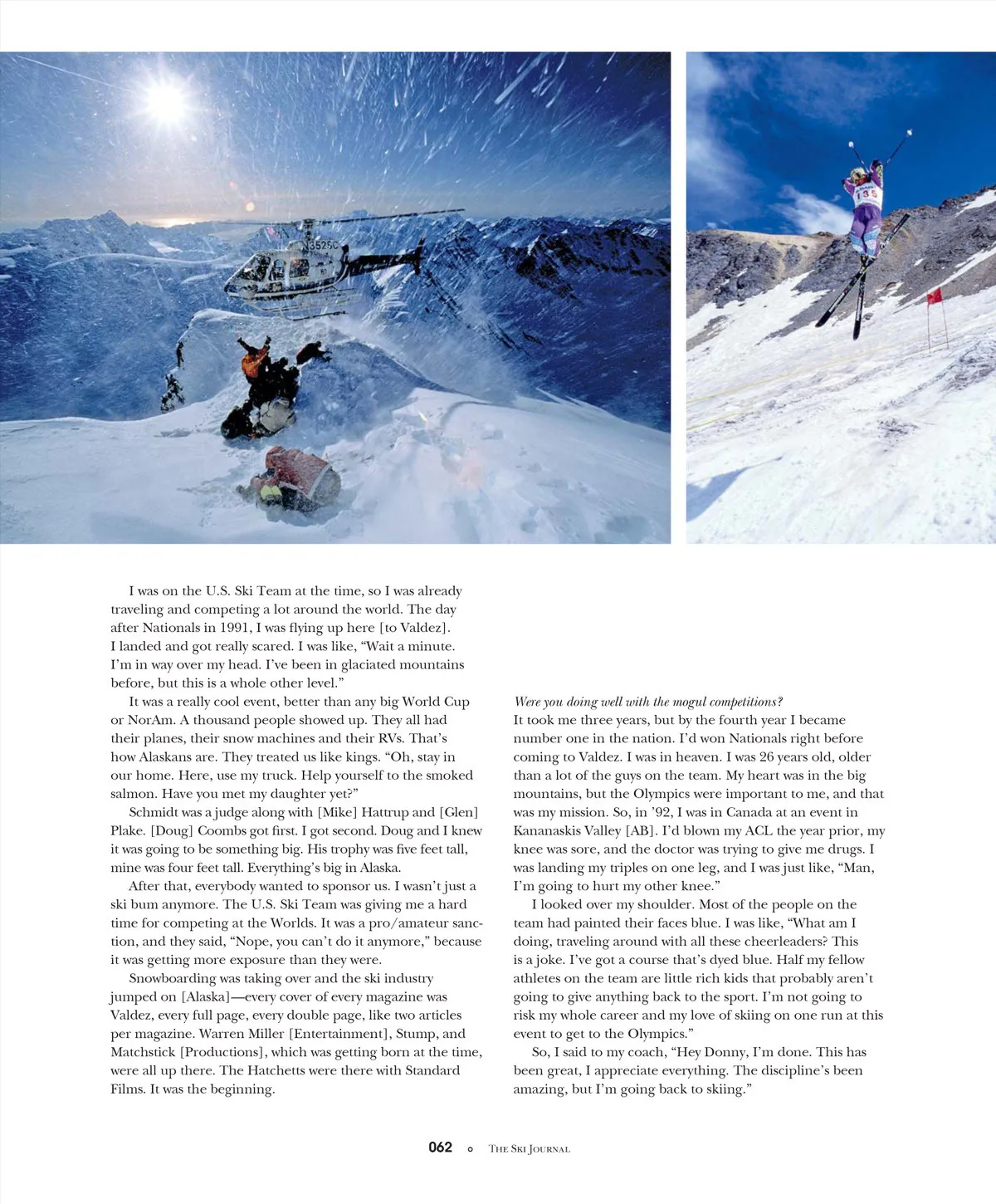
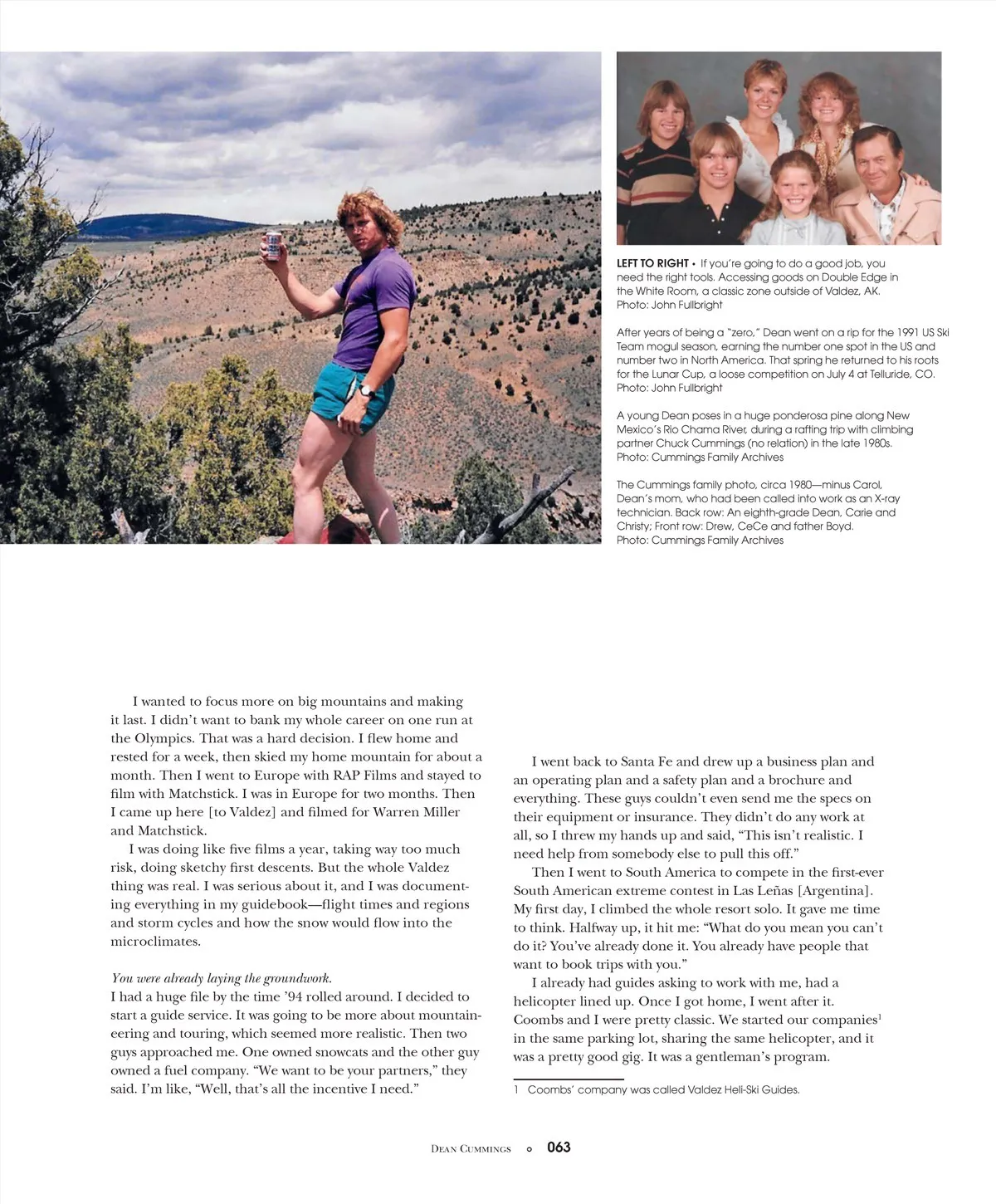
I was on the U.S. Ski Team at the time, so I was already traveling and competing a lot around the world. The day after Nationals in 1991, I was flying up here [to Valdez]. I landed and got really scared. I was like, “Wait a minute. I’m in way over my head. I’ve been in glaciated mountains before, but this is a whole other level.” It was a really cool event, better than any big World Cup or NorAm. A thousand people showed up. They all had their planes, their snow machines and their RVs. That’s how Alaskans are. They treated us like kings. “Oh, stay in our home. Here, use my truck. Help yourself to the smoked salmon. Have you met my daughter yet?” Schmidt was a judge along with [Mike] Hattrup and [Glen] Plake. [Doug] Coombs got first. I got second. Doug and I knew it was going to be something big. His trophy was five feet tall, mine was four feet tall. Everything’s big in Alaska. After that, everybody wanted to sponsor us. I wasn’t just a ski bum anymore. The U.S. Ski Team was giving me a hard time for competing at the Worlds. It was a pro/amateur sanc-tion, and they said, “Nope, you can’t do it anymore,” because it was getting more exposure than they were. Snowboarding was taking over and the ski industry jumped on [Alaska]—every cover of every magazine was Valdez, every full page, every double page, like two articles per magazine. Warren Miller [Entertainment], Stump, and Matchstick [Productions], which was getting born at the time, were all up there. The Hatchetts were there with Standard Films. It was the beginning. Were you doing well with the mogul competitions? It took me three years, but by the fourth year I became number one in the nation. I’d won Nationals right before coming to Valdez. I was in heaven. I was 26 years old, older than a lot of the guys on the team. My heart was in the big mountains, but the Olympics were important to me, and that was my mission. So, in ’92, I was in Canada at an event in Kananaskis Valley [AB]. I’d blown my ACL the year prior, my knee was sore, and the doctor was trying to give me drugs. I was landing my triples on one leg, and I was just like, “Man, I’m going to hurt my other knee.” I looked over my shoulder. Most of the people on the team had painted their faces blue. I was like, “What am I doing, traveling around with all these cheerleaders? This is a joke. I’ve got a course that’s dyed blue. Half my fellow athletes on the team are little rich kids that probably aren’t going to give anything back to the sport. I’m not going to risk my whole career and my love of skiing on one run at this event to get to the Olympics.” So, I said to my coach, “Hey Donny, I’m done. This has been great, I appreciate everything. The discipline’s been amazing, but I’m going back to skiing.” 062 The Ski Journal
The Ski Journal Volume Eleven, Issue Three: Page 62