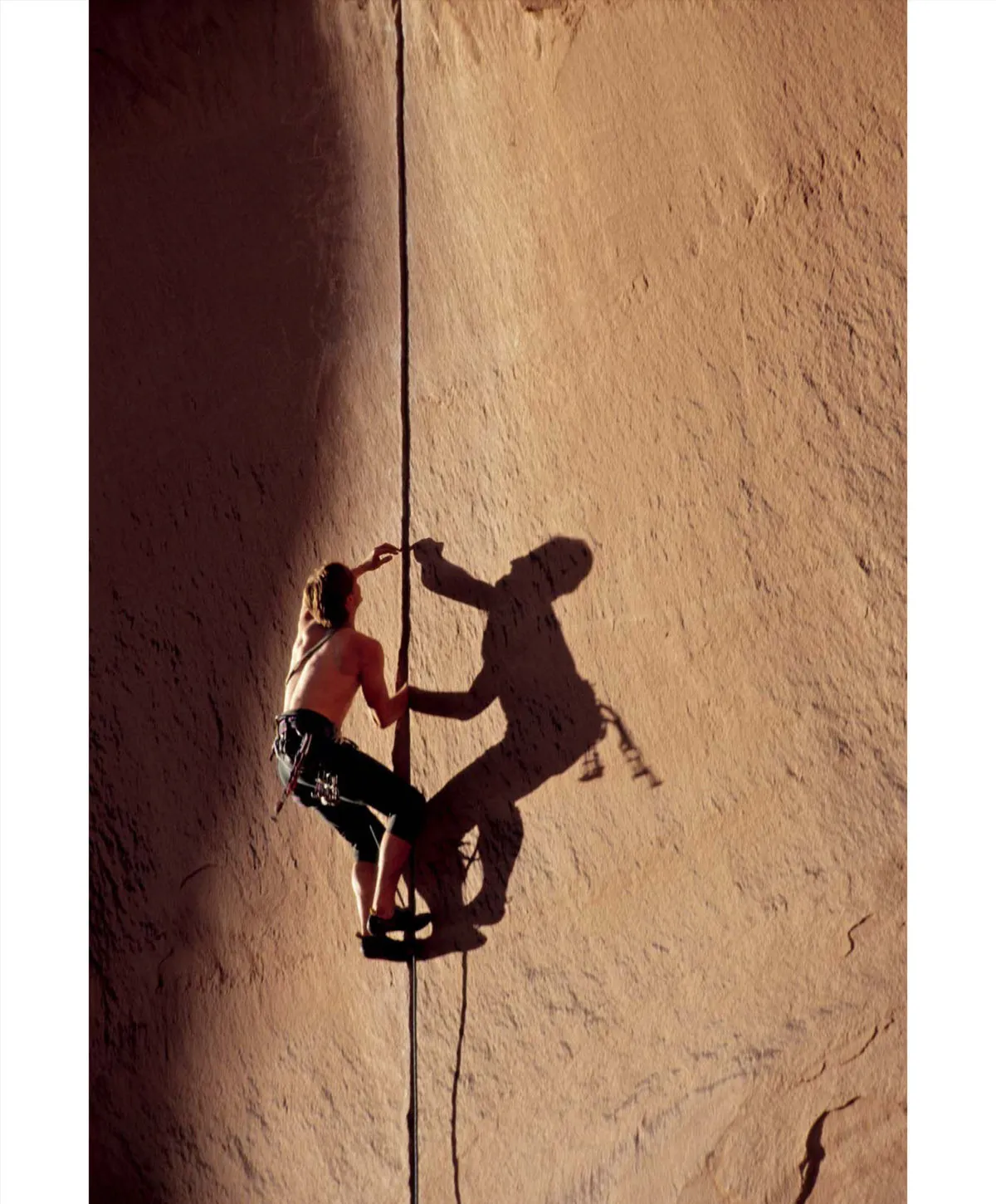
Jared Ogden leading a crack in Indian Creek, UT, in 2000. Around 1982, Kvale traveled to South Africa with film-maker Gary Bigham to put on freestyle skiing demonstrations for large stadium crowds. “We were the Arctic Assault Team,” Kvale says. “We made these huge jumps with scaffolding and these nylon bristles on them, and then huge foam rubber. We would go off in these spotlights and do flips and tricks and land in this foam.” When the demos ended, Kvale hitchhiked north, through Botswana, Zimbabwe, Zambia, and eventually to Lake Malawi, where he caught a flight back to Switzerland. He had uneasy moments along the way. In Botswana, he arrived in a mining town on payday when the miners were out drinking their wages. With his long hair and backpack, he realized he was a target. “It was nighttime. I was being followed wherever I went,” he says. “I found some police. They let me sleep in the jail. The doors were open, but I was in a cell, on the floor, with cockroaches, with the lights on, where I spent the night until it was daylight and I could leave.” Once he got across the Malawi border, the long hair was no longer an issue. “I had been warned that in Malawi long hair was illegal,” he says. He pulled his hair into a tight ponytail, tucked it under his hat, and attempted to cross. “The guard said, ‘You must learn about the customs of our country.’ He opened his drawer and pulled out these freaking huge scis-sors. They looked like a hedge clipper. We went outside and sat under a tree. They pulled my ponytail as tight as they could get it, and went chop.” Kvale documented the trip with a little Rollei camera. When he got back to Verbier, he showed the photos to Sha-piro, who noticed Kvale’s eye for composition. “Marko was going so big at the time that he was getting jobs that he just didn’t want to do,” Kvale says. “So I became his B-shooter. He bought me my first Nikon F3, and basically gave it to me. And he goes, ‘You now owe me this much. But I’m gonna give you this much in jobs, and it’ll be paid for after you do these jobs.’” After nearly 20 years in Clambin, Kvale decided to move back to Telluride. His career was taking off, and the same things that first drew him out of Rochester were pulling him back to the American West. But there was more. “I had a son born in Telluride,” Kvale says. “I had this young boy, and I just couldn’t be apart from him anymore.” His son Walter is 30 now and still lives in Telluride. “He’s awesome. Still the love of my life,” he says. Artistically, Kvale’s work evolved in 2002 while on an ex-pedition to climb Sepu Kangri, the highest unclimbed moun-tain in Tibet at the time. Two members of the seven-person team—Mark Newcomb and Carlos Buhler—reached the summit. “It’s a mountain higher than Denali in the middle of Tibet, but it was just a big, scary mountain in a lot of ways,” Kvale says. “But we had this incredible cultural experience. We were in a village where very few foreigners had ever been.” In a sponsored slide show in Salt Lake City following the expe-dition, Kvale says he didn’t include any shots of Sepu Kangri, opting instead to highlight the people and the community they met. “It was a big, sponsored expedition. We climbed a big mountain, nobody died and, in hindsight, nobody cared,” he says. “But we had this amazing cultural experience, and ever since then I decided that mountain climbing, for me person-ally, was just a means to go to beautiful places.” Kvale calls the work he has done since the most important of his life. After the Sepu Kangri trip, he started working with the dZi Foundation (pronounced “Zee”), a Ridgeway, CO-based nonprofit that currently serves 32,000 people in rural Nepal, focusing on basic infrastructure such as schools, buildings, toilets, drinking water and bridges. Kvale sits on the advisory board and provides photos to the organization. Ace Kvale Gallerie 081
The Ski Journal Volume 12, Issue 3: Page 81