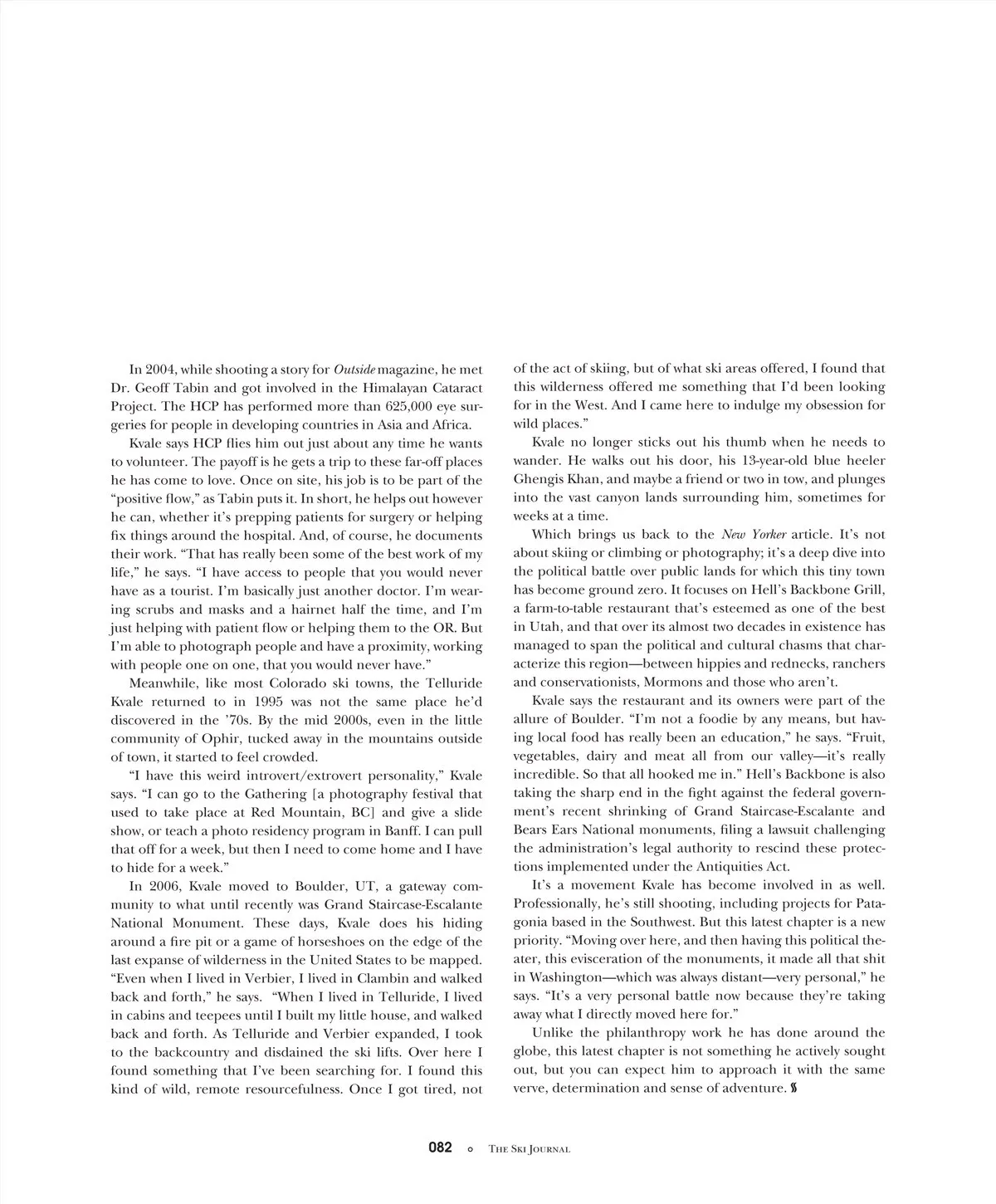
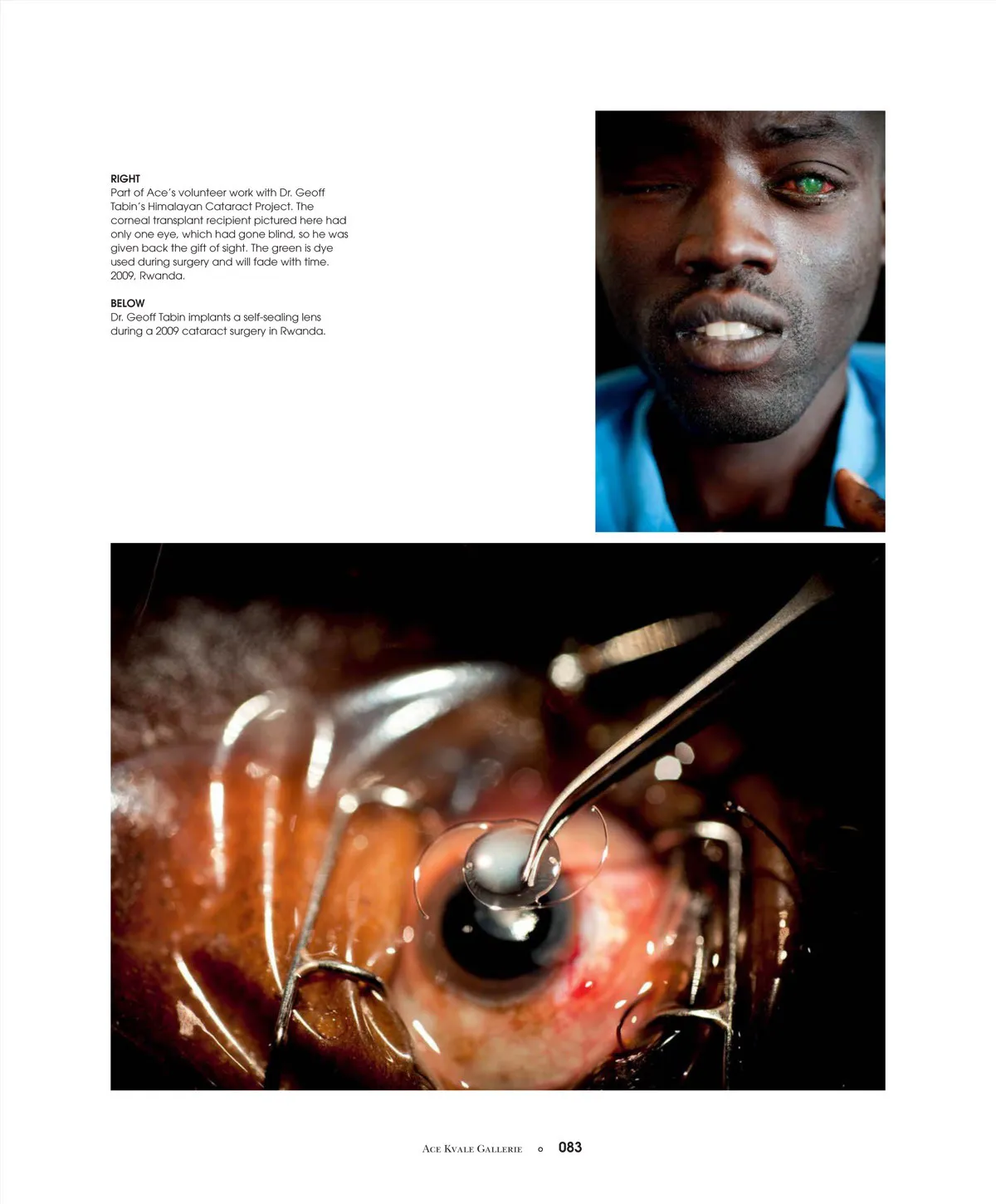
In 2004, while shooting a story for Outside magazine, he met Dr. Geoff Tabin and got involved in the Himalayan Cataract Project. The HCP has performed more than 625,000 eye sur-geries for people in developing countries in Asia and Africa. Kvale says HCP flies him out just about any time he wants to volunteer. The payoff is he gets a trip to these far-off places he has come to love. Once on site, his job is to be part of the “positive flow,” as Tabin puts it. In short, he helps out however he can, whether it’s prepping patients for surgery or helping fix things around the hospital. And, of course, he documents their work. “That has really been some of the best work of my life,” he says. “I have access to people that you would never have as a tourist. I’m basically just another doctor. I’m wear-ing scrubs and masks and a hairnet half the time, and I’m just helping with patient flow or helping them to the OR. But I’m able to photograph people and have a proximity, working with people one on one, that you would never have.” Meanwhile, like most Colorado ski towns, the Telluride Kvale returned to in 1995 was not the same place he’d discovered in the ’70s. By the mid 2000s, even in the little community of Ophir, tucked away in the mountains outside of town, it started to feel crowded. “I have this weird introvert/extrovert personality,” Kvale says. “I can go to the Gathering [a photography festival that used to take place at Red Mountain, BC] and give a slide show, or teach a photo residency program in Banff. I can pull that off for a week, but then I need to come home and I have to hide for a week.” In 2006, Kvale moved to Boulder, UT, a gateway com-munity to what until recently was Grand Staircase-Escalante National Monument. These days, Kvale does his hiding around a fire pit or a game of horseshoes on the edge of the last expanse of wilderness in the United States to be mapped. “Even when I lived in Verbier, I lived in Clambin and walked back and forth,” he says. “When I lived in Telluride, I lived in cabins and teepees until I built my little house, and walked back and forth. As Telluride and Verbier expanded, I took to the backcountry and disdained the ski lifts. Over here I found something that I’ve been searching for. I found this kind of wild, remote resourcefulness. Once I got tired, not of the act of skiing, but of what ski areas offered, I found that this wilderness offered me something that I’d been looking for in the West. And I came here to indulge my obsession for wild places.” Kvale no longer sticks out his thumb when he needs to wander. He walks out his door, his 13-year-old blue heeler Ghengis Khan, and maybe a friend or two in tow, and plunges into the vast canyon lands surrounding him, sometimes for weeks at a time. Which brings us back to the New Yorker article. It’s not about skiing or climbing or photography; it’s a deep dive into the political battle over public lands for which this tiny town has become ground zero. It focuses on Hell’s Backbone Grill, a farm-to-table restaurant that’s esteemed as one of the best in Utah, and that over its almost two decades in existence has managed to span the political and cultural chasms that char-acterize this region—between hippies and rednecks, ranchers and conservationists, Mormons and those who aren’t. Kvale says the restaurant and its owners were part of the allure of Boulder. “I’m not a foodie by any means, but hav-ing local food has really been an education,” he says. “Fruit, vegetables, dairy and meat all from our valley—it’s really incredible. So that all hooked me in.” Hell’s Backbone is also taking the sharp end in the fight against the federal govern-ment’s recent shrinking of Grand Staircase-Escalante and Bears Ears National monuments, filing a lawsuit challenging the administration’s legal authority to rescind these protec-tions implemented under the Antiquities Act. It’s a movement Kvale has become involved in as well. Professionally, he’s still shooting, including projects for Pata-gonia based in the Southwest. But this latest chapter is a new priority. “Moving over here, and then having this political the-ater, this evisceration of the monuments, it made all that shit in Washington—which was always distant—very personal,” he says. “It’s a very personal battle now because they’re taking away what I directly moved here for.” Unlike the philanthropy work he has done around the globe, this latest chapter is not something he actively sought out, but you can expect him to approach it with the same verve, determination and sense of adventure. 082 The Ski Journal
The Ski Journal Volume 12, Issue 3: Page 82