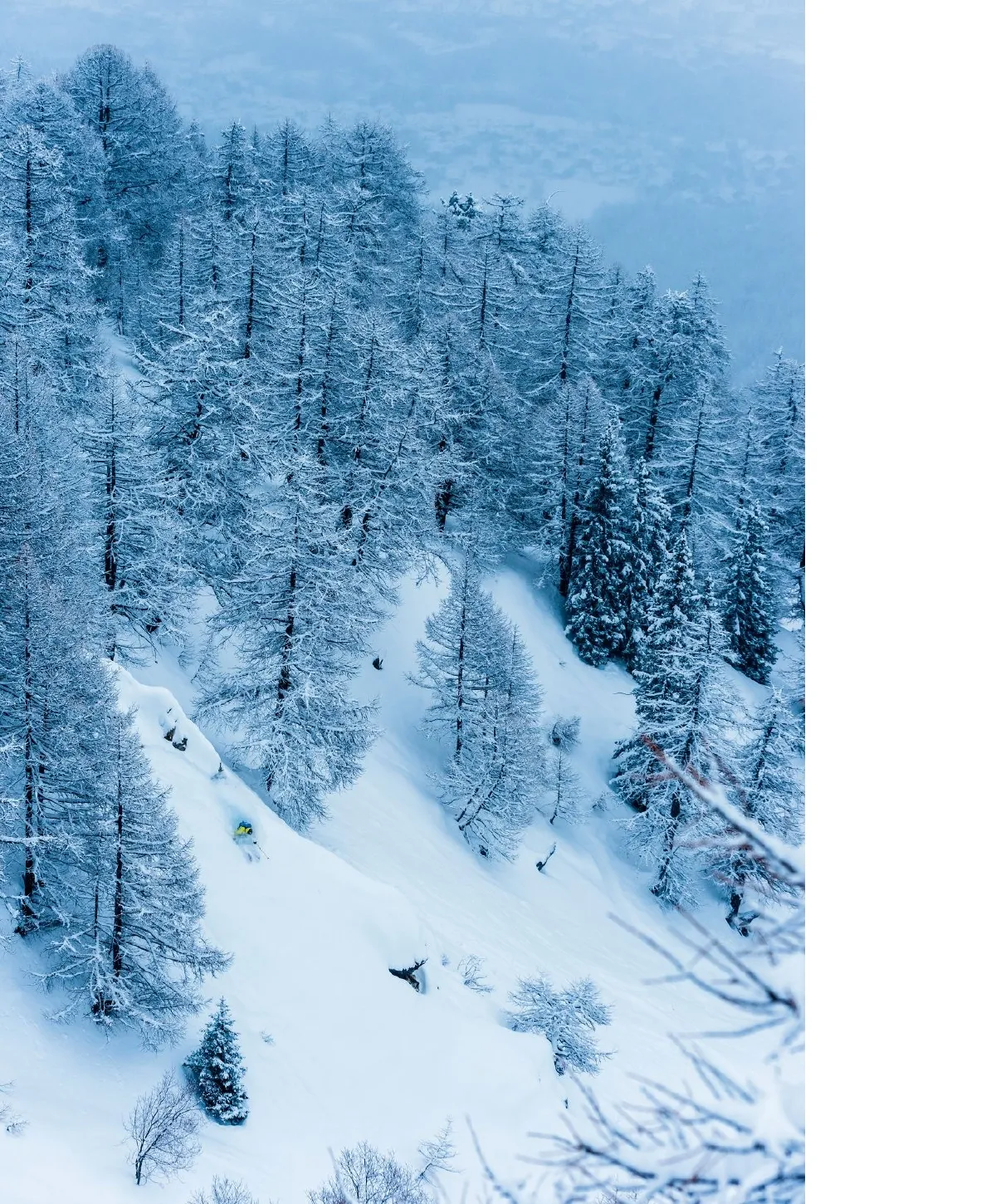
KC Deane in Courmayeur, Italy. Yes, the high alpine is spectacular, but when storms approach from the south, the trees are the place to be. Words Leslie Anthony Photos Mattias Fredriksson snow falls in a dense curtain, the kind that obliterates any view. Outside the cable car, mute tree forms alternately loom then pass like moon shadows, their details lost to dense snowfall and fogged plexiglass. It’s our first run of our first day at a ski area none of us has ever heard of, and so conditions like these offer a potentially exciting welcome. Those same conditions, however, can be onerous when you have no idea where you’re going and vis-ibility is zero—skiing’s equivalent of walking through the back alleys of an unfamiliar city after dark. Naturally, being skiers, exciting wins out. Back at Hotel Eden, Stefano had advised us to head into the trees when we exited the lift. We follow his advice, we think, slicing over an open dome that tips steeply into a pine and larch forest. Snow breaks around our waists, the slope opens into a glade, then the forest closes back in. Several more times the slope parts then narrows like an hourglass, each pinch bringing momentary relief from relentless face shots and a chance to plot the next few turns. Eventually we’re funnelled back to a road that wraps around the bottom of the mountain to deposit us, now panting, back at the base. Pleased to make your acquaintance, La Thuile. THE LA THUILE may have seemed like a stranger but it lived in familiar territory: tucked high in Italy’s extreme northwest, hard on the French border along a road ascending from Pré-Saint-Didier, just south of Courmayeur in the Aosta Valley, a place I’d visited a half-dozen times. My introduction to the area was during one of my first ski trips to Europe, and I’d been dutifully impressed. Taking a bus from the Milan airport to the 1992 World Telemark Championships in Courmayeur, every 50 kilometers seemed to roll back the clock hundreds of years. Indeed, five centu-ries of Roman civilization had left some pretty impressive his-tory: the Via delle Gallie consular road; the Pondel aqueduct bridge; ancient castles galore; and Aosta itself, the walled imperial city—Rome of the Alps—with its spectacular ruins and archaeological sites. Still, these were mere lawn ornaments at the feet of the valley’s great mansions—the Monte Bianco, Monterosa, Matterhorn and Gran Paradiso massifs all soared to higher than 4,000 meters. Given such auspicious cornerstones, it’s unsurprising that Aosta’s ski offerings comprise of 28 villages, 23 resorts, 550 miles of piste and a kingdom of unheralded backcountry whose itineraries basically follow Roman con-quests in and out of Italy, France and Switzerland. On the resort ledger, top-rated Zermatt/Breuil-Cervinia/ Valtournenche-Matterhorn is the largest (200 miles of pistes) and highest (3,899 meters). Haunt of the rich and famous, it drew newly mobile Russian oligarchs in the late 1990s who carried their money in Ziploc bags (true story). Equally mind-bending scenery but better snow and dollar value is found in the smaller resorts of the Monterosa Ski consortium—Alagna Valsesia/Gressoney-La-Trinité/Champoluc/Frachey, with its modest 83 miles of pistes and 20 lifts spread across an enormous region known for freeriding and heli-skiing. Paired with the small French resort of La Rosière, La Thuile now flies under the banner of L’Espace San Bernardo Snowpark. Courmay-eur, at the foot of Monte Bianco (aka Mont Blanc) and the capital of Italian alpinism for 200 years, boasts modest runs but numerous off-piste gems, some accessed from the Punta Hellbronner cable car system that climbs Monte Bianco to abut Chamonix across the massif’s upper reaches. Aosta itself is connected by cable car to the resort of Pila with its 360-de-gree view of the Alps’ highest peaks. Smaller gems of local discovery include Torgnon, Champorcher and Crévacol. In the 25 years I’ve skied the Aosta Valley I’ve witnessed many changes, and yet more of it has stood stone still—perhaps the region’s true charm. Aosta, Italy 039
The Ski Journal Volume 13, Issue 3: Page 39