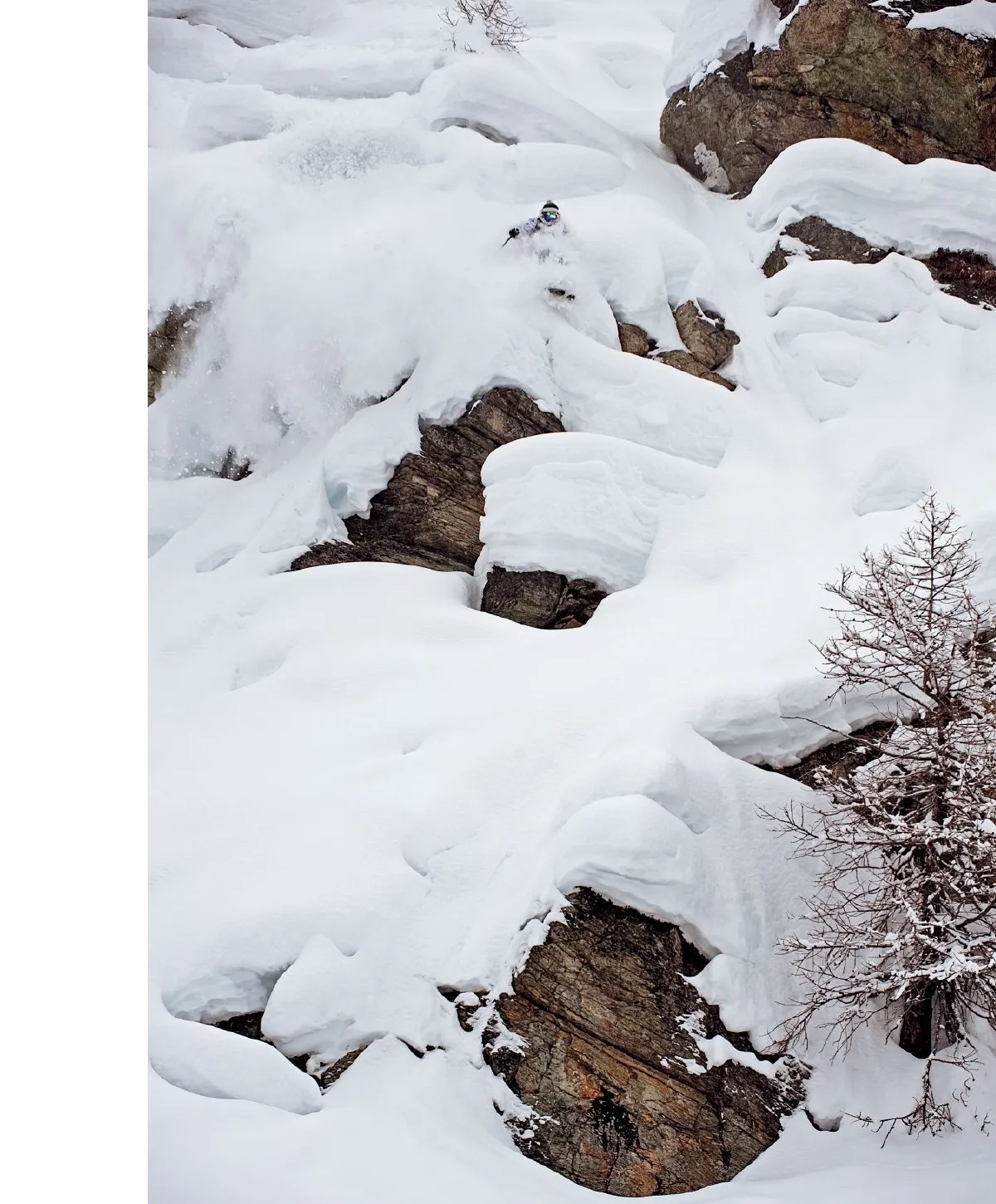
Mark Abma playing with pillows in Gressoney on the Monte Rosa massif. While Gressoney is somewhat off the beaten path, it is still known for deep, cold pow and wild terrain features. On this day, unbeknownst to any of us ahead of time, there were three separate crews shooting there, including skiers Kaj Zackrisson, Chad Sayers, Mike Douglas and Callum Petit alongside photographers Jordan Manley, Adam Clark and many more. ANOTHER CHARM LIES in a decidedly different weather pattern than the northern side of the Alps—when the latter is hurting for snow, the former is often stacked. One February, some friends and I passed through a depressingly dry Chamonix and into the Tunnel du Mont Blanc. Fifteen minutes later, we emerged from the dreaded seven-mile wormhole of diesel exhaust into a world transformed. Heavy snow was adding an inch per hour to 10-foot snowbanks in Courmayeur. What initially began as an early season snowfall anomaly was now officially the best season Italy had seen in a quarter-century. Through a hypnosis-inducing snowstorm we pushed on toward Monterosa Ski, a mystifyingly underrated complex of some of the Alps’ finest skiing. Monterosa Ski consists of three gigantic ski areas spread across the southern flanks of Europe’s second-highest peak— Champoluc on the western edge, Alagna to the east, and Gressoney in the center. Although you can easily ski between these three areas in a single day, by car they’re as far apart as you can be in the western Alps; it takes at least six hours to drive from Champoluc to Alagna. Given the weather outlook, we decided against the virtually piste-less freeride paradise of Alagna (the infamous “Valley Y” of ’90s big-mountain ski culture). Instead, we left the high-speed madness of the Au-tostrada (everyone in the Aosta Valley drives as if they have a Formula One heritage—which is entirely possible) at Pont St. Martin, aiming for Gressoney’s five-star trees, winding pistes and abundant lift-accessed backcountry. Almost immediately, and despite the snow, we could make out Roman aqueducts, mountaintop forts, homes cobbled directly into hillsides and, in some cases, even into massive boulders. Monterosa’s ski towns are tiny, spaced-out hamlets with only a handful of buildings. During our stay in the valley-head village of La Trinité, four generations made their way through the barrage of snow running errands while the men spent much of their time shoveling snow from overburdened roofs of centuries-old buildings. Tired and tipsy on grappa, most gathered each evening in the Hotel Dufour. Surrounded by drunken Swedes strumming out-of-tune guitars, they shrugged in that Italian plea-to-God way that asked When will it stop? not indicating whether they meant the snow or the music. In Champoluc, heavy snow continued as we rode its lower gondola—now the only lift open in all of Monterosa Ski due to avalanche danger. The terrain looked like nothing we’d ever seen in Europe. Well-spaced trees and Rocky Mountain-like bluffs covered in giant scoops of fluffy,white ice cream. It was like being teleported into the center of an epic British Columbia winter—but with better food and coffee. There are many reasons to love the Italian people—their contagious zest for life, gracious hospitality and laid-back at-titude among them. But what we learned to love most on that trip was that they don’t like to ski when it’s snowing. It seemed the only reason lifts even ran on snowy days was in case the occasional Canadian, American or Swede showed up. Whether we’d spent the day skiing two feet of untracked blower under the lift, or banging off pillow lines next to a groomed piste, our toast at dinner each night was to the Italians—Grazie, prego! 040 The Ski Journal
The Ski Journal Volume 13, Issue 3: Page 40