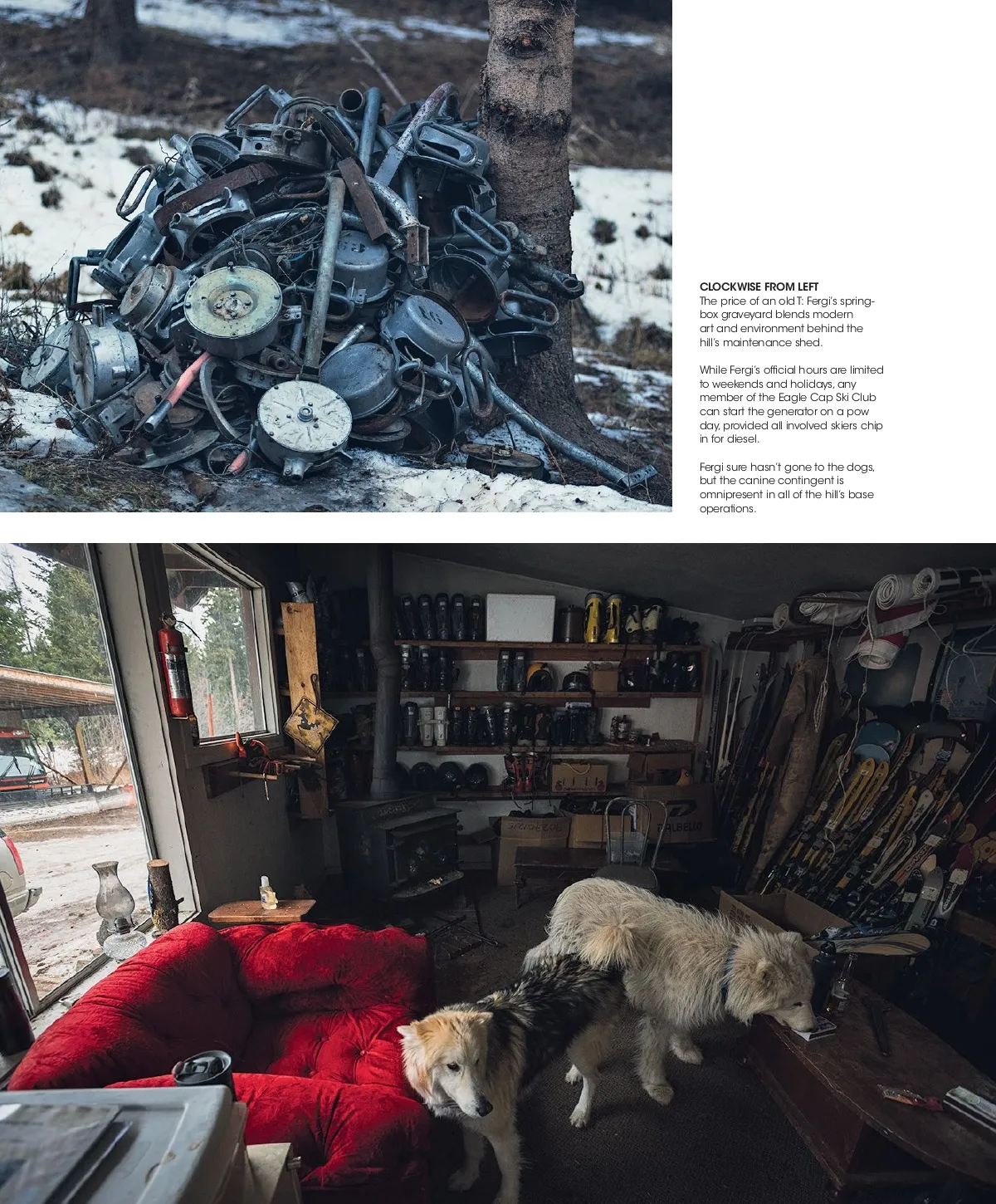
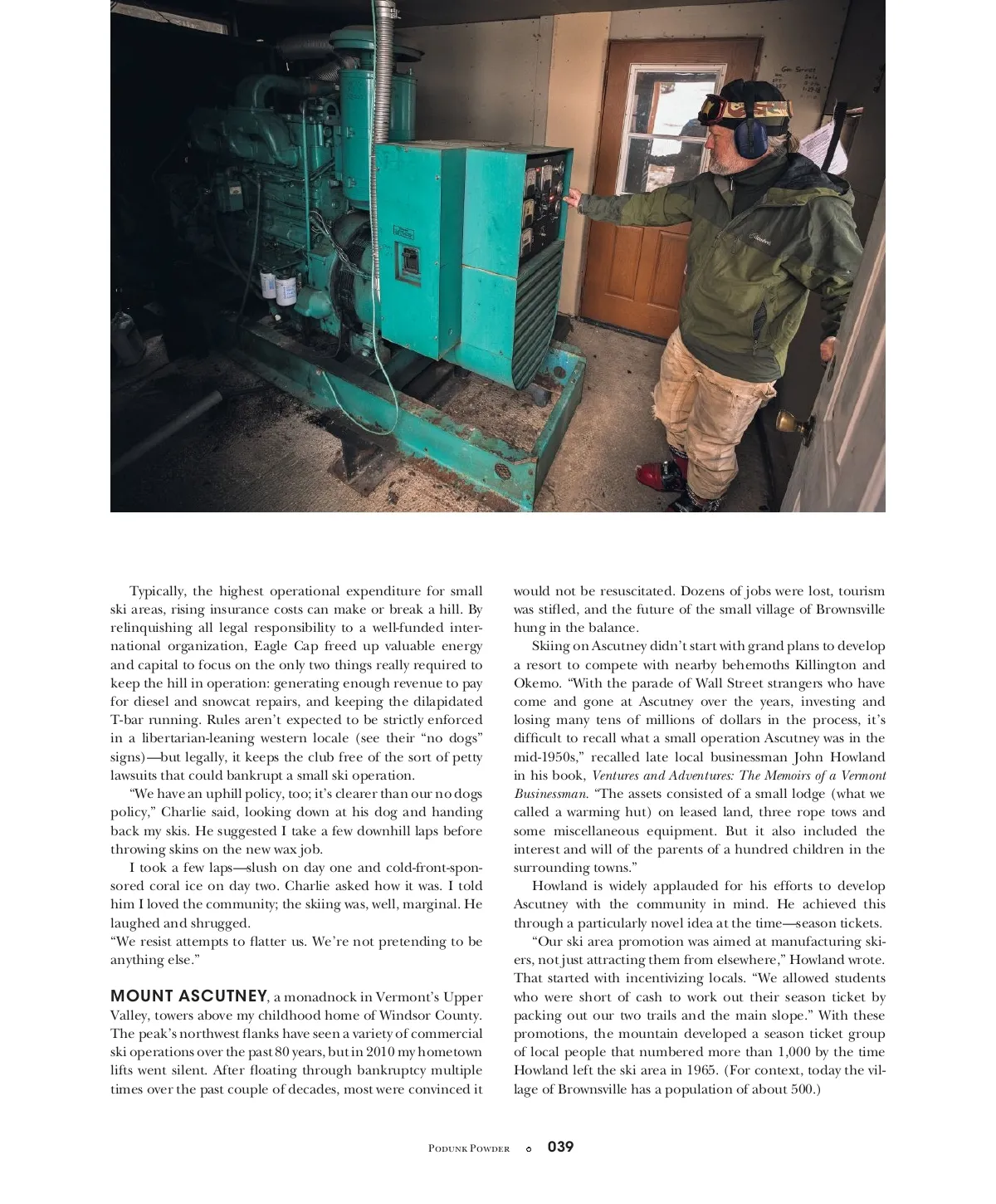
Typically, the highest operational expenditure for small ski areas, rising insurance costs can make or break a hill. By relinquishing all legal responsibility to a well-funded inter-national organization, Eagle Cap freed up valuable energy and capital to focus on the only two things really required to keep the hill in operation: generating enough revenue to pay for diesel and snowcat repairs, and keeping the dilapidated T-bar running. Rules aren’t expected to be strictly enforced in a libertarian-leaning western locale (see their “no dogs” signs)—but legally, it keeps the club free of the sort of petty lawsuits that could bankrupt a small ski operation. “We have an uphill policy, too; it’s clearer than our no dogs policy,” Charlie said, looking down at his dog and handing back my skis. He suggested I take a few downhill laps before throwing skins on the new wax job. I took a few laps—slush on day one and cold-front-spon-sored coral ice on day two. Charlie asked how it was. I told him I loved the community; the skiing was, well, marginal. He laughed and shrugged. “We resist attempts to flatter us. We’re not pretending to be anything else.” MOUNT ASCUTNEY , a monadnock in Vermont’s Upper Valley, towers above my childhood home of Windsor County. The peak’s northwest flanks have seen a variety of commercial ski operations over the past 80 years, but in 2010 my hometown lifts went silent. After floating through bankruptcy multiple times over the past couple of decades, most were convinced it would not be resuscitated. Dozens of jobs were lost, tourism was stifled, and the future of the small village of Brownsville hung in the balance. Skiing on Ascutney didn’t start with grand plans to develop a resort to compete with nearby behemoths Killington and Okemo. “With the parade of Wall Street strangers who have come and gone at Ascutney over the years, investing and losing many tens of millions of dollars in the process, it’s difficult to recall what a small operation Ascutney was in the mid-1950s,” recalled late local businessman John Howland in his book, Ventures and Adventures: The Memoirs of a Vermont Businessman. “The assets consisted of a small lodge (what we called a warming hut) on leased land, three rope tows and some miscellaneous equipment. But it also included the interest and will of the parents of a hundred children in the surrounding towns.” Howland is widely applauded for his efforts to develop Ascutney with the community in mind. He achieved this through a particularly novel idea at the time—season tickets. “Our ski area promotion was aimed at manufacturing ski-ers, not just attracting them from elsewhere,” Howland wrote. That started with incentivizing locals. “We allowed students who were short of cash to work out their season ticket by packing out our two trails and the main slope.” With these promotions, the mountain developed a season ticket group of local people that numbered more than 1,000 by the time Howland left the ski area in 1965. (For context, today the vil-lage of Brownsville has a population of about 500.) Podunk Powder 039
The Ski Journal Volume 14, Issue 3: Page 39