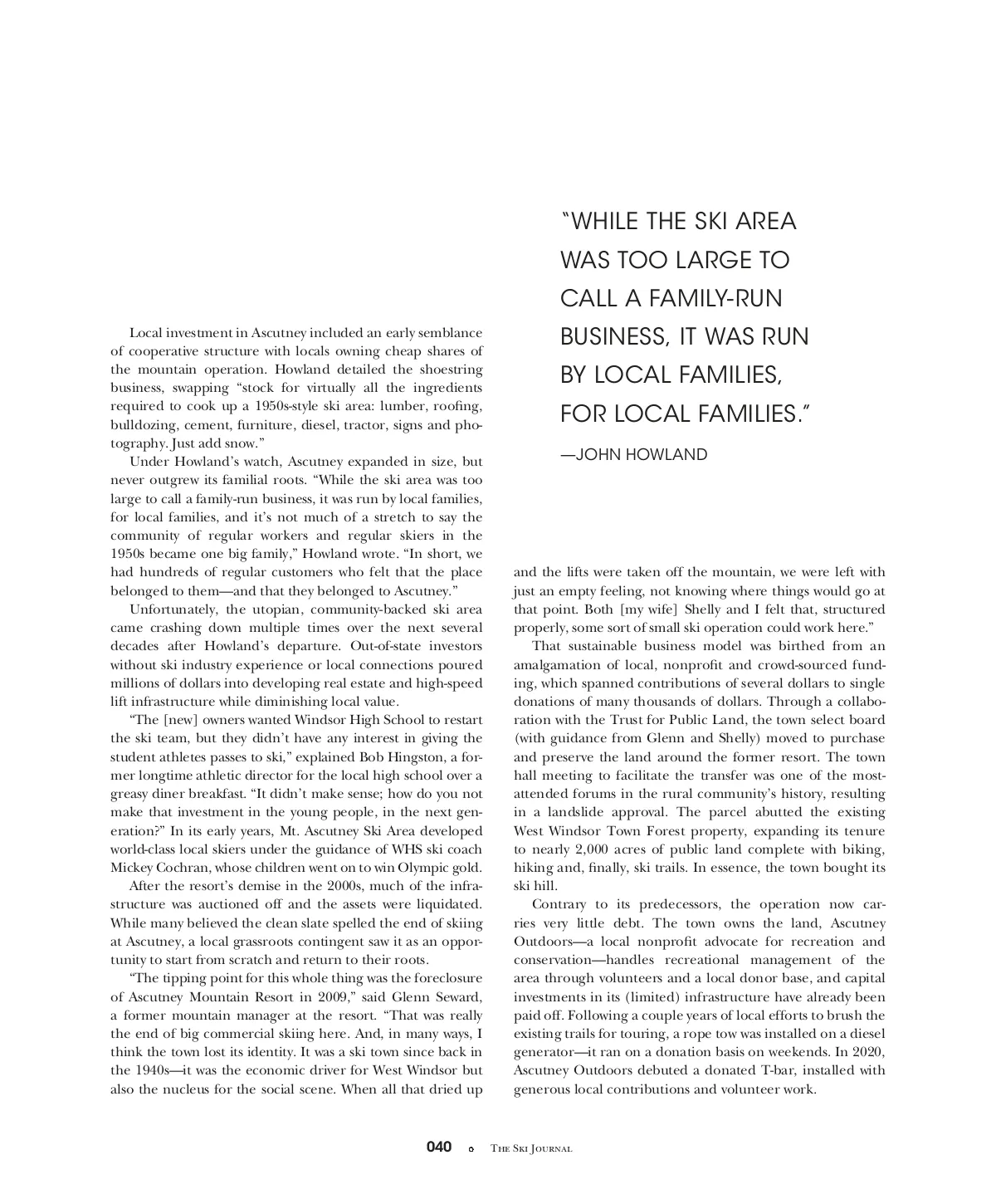
“WHILE THE SKI AREA WAS TOO LARGE TO CALL A FAMILY-RUN Local investment in Ascutney included an early semblance of cooperative structure with locals owning cheap shares of the mountain operation. Howland detailed the shoestring business, swapping “stock for virtually all the ingredients required to cook up a 1950s-style ski area: lumber, roofing, bulldozing, cement, furniture, diesel, tractor, signs and pho-tography. Just add snow.” Under Howland’s watch, Ascutney expanded in size, but never outgrew its familial roots. “While the ski area was too large to call a family-run business, it was run by local families, for local families, and it’s not much of a stretch to say the community of regular workers and regular skiers in the 1950s became one big family,” Howland wrote. “In short, we had hundreds of regular customers who felt that the place belonged to them—and that they belonged to Ascutney.” Unfortunately, the utopian, community-backed ski area came crashing down multiple times over the next several decades after Howland’s departure. Out-of-state investors without ski industry experience or local connections poured millions of dollars into developing real estate and high-speed lift infrastructure while diminishing local value. “The [new] owners wanted Windsor High School to restart the ski team, but they didn’t have any interest in giving the student athletes passes to ski,” explained Bob Hingston, a for-mer longtime athletic director for the local high school over a greasy diner breakfast. “It didn’t make sense; how do you not make that investment in the young people, in the next gen-eration?” In its early years, Mt. Ascutney Ski Area developed world-class local skiers under the guidance of WHS ski coach Mickey Cochran, whose children went on to win Olympic gold. After the resort’s demise in the 2000s, much of the infra-structure was auctioned off and the assets were liquidated. While many believed the clean slate spelled the end of skiing at Ascutney, a local grassroots contingent saw it as an oppor-tunity to start from scratch and return to their roots. “The tipping point for this whole thing was the foreclosure of Ascutney Mountain Resort in 2009,” said Glenn Seward, a former mountain manager at the resort. “That was really the end of big commercial skiing here. And, in many ways, I think the town lost its identity. It was a ski town since back in the 1940s—it was the economic driver for West Windsor but also the nucleus for the social scene. When all that dried up BUSINESS, IT WAS RUN BY LOCAL FAMILIES, FOR LOCAL FAMILIES.” —JOHN HOWLAND and the lifts were taken off the mountain, we were left with just an empty feeling, not knowing where things would go at that point. Both [my wife] Shelly and I felt that, structured properly, some sort of small ski operation could work here.” That sustainable business model was birthed from an amalgamation of local, nonprofit and crowd-sourced fund-ing, which spanned contributions of several dollars to single donations of many thousands of dollars. Through a collabo-ration with the Trust for Public Land, the town select board (with guidance from Glenn and Shelly) moved to purchase and preserve the land around the former resort. The town hall meeting to facilitate the transfer was one of the most-attended forums in the rural community’s history, resulting in a landslide approval. The parcel abutted the existing West Windsor Town Forest property, expanding its tenure to nearly 2,000 acres of public land complete with biking, hiking and, finally, ski trails. In essence, the town bought its ski hill. Contrary to its predecessors, the operation now car-ries very little debt. The town owns the land, Ascutney Outdoors—a local nonprofit advocate for recreation and conservation—handles recreational management of the area through volunteers and a local donor base, and capital investments in its (limited) infrastructure have already been paid off. Following a couple years of local efforts to brush the existing trails for touring, a rope tow was installed on a diesel generator—it ran on a donation basis on weekends. In 2020, Ascutney Outdoors debuted a donated T-bar, installed with generous local contributions and volunteer work. 040 The Ski Journal
The Ski Journal Volume 14, Issue 3: Page 40