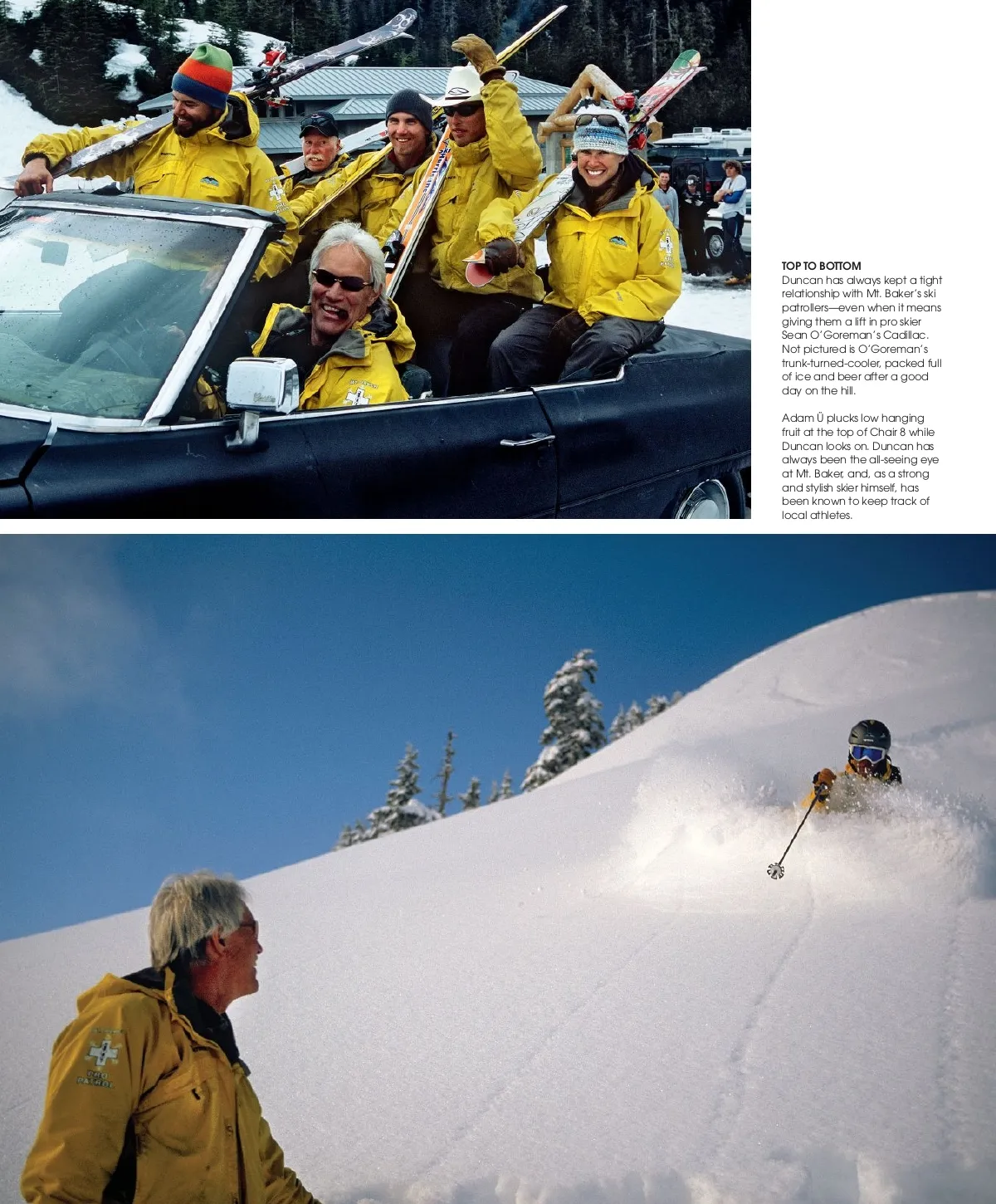
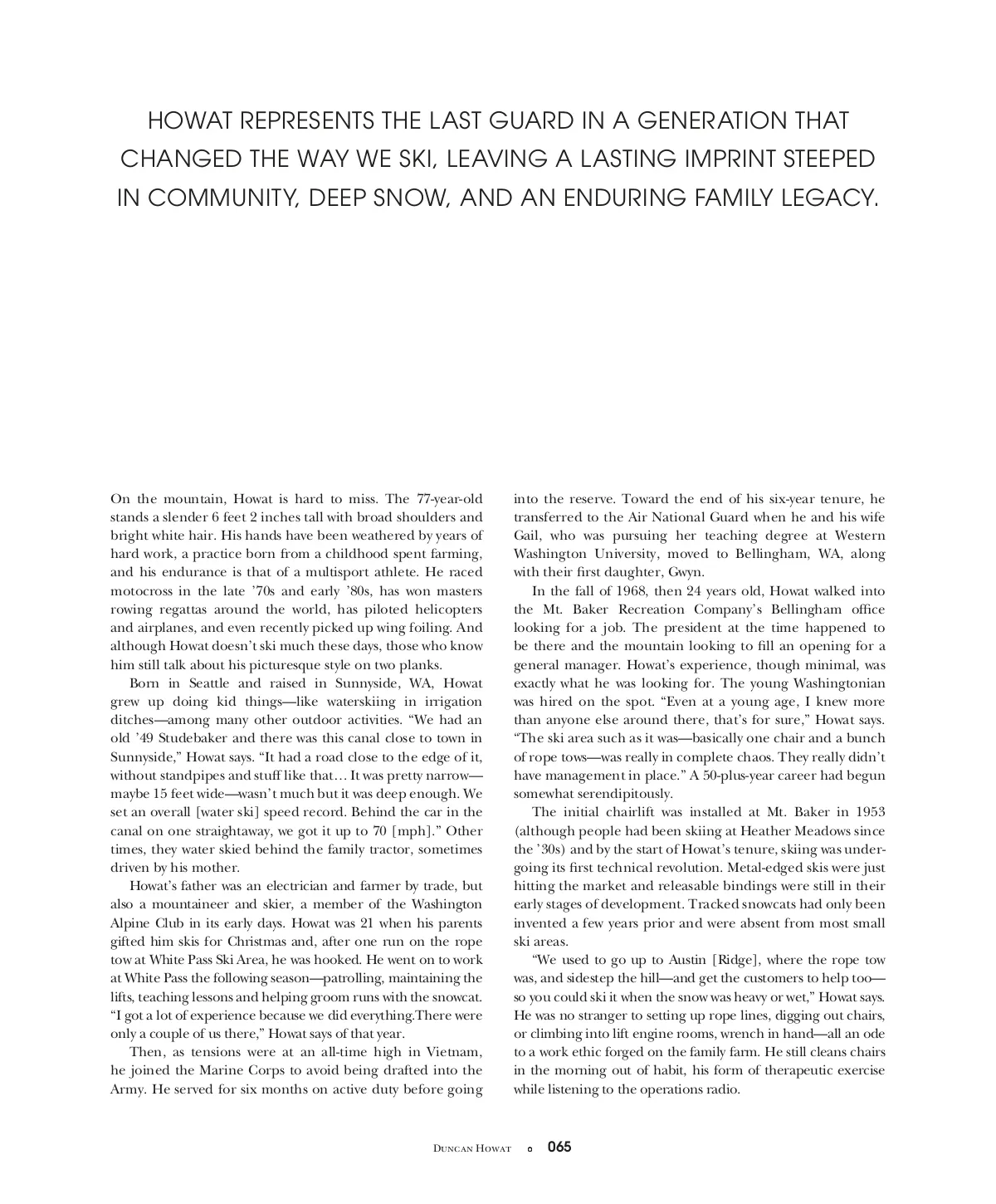
HOWAT REPRESENTS THE LAST GUARD IN A GENERATION THAT CHANGED THE WAY WE SKI, LEAVING A LASTING IMPRINT STEEPED IN COMMUNITY, DEEP SNOW, AND AN ENDURING FAMILY LEGACY. On the mountain, Howat is hard to miss. The 77-year-old stands a slender 6 feet 2 inches tall with broad shoulders and bright white hair. His hands have been weathered by years of hard work, a practice born from a childhood spent farming, and his endurance is that of a multisport athlete. He raced motocross in the late ’70s and early ’80s, has won masters rowing regattas around the world, has piloted helicopters and airplanes, and even recently picked up wing foiling. And although Howat doesn’t ski much these days, those who know him still talk about his picturesque style on two planks. Born in Seattle and raised in Sunnyside, WA, Howat grew up doing kid things—like waterskiing in irrigation ditches—among many other outdoor activities. “We had an old ’49 Studebaker and there was this canal close to town in Sunnyside,” Howat says. “It had a road close to the edge of it, without standpipes and stuff like that… It was pretty narrow— maybe 15 feet wide—wasn’t much but it was deep enough. We set an overall [water ski] speed record. Behind the car in the canal on one straightaway, we got it up to 70 [mph].” Other times, they water skied behind the family tractor, sometimes driven by his mother. Howat’s father was an electrician and farmer by trade, but also a mountaineer and skier, a member of the Washington Alpine Club in its early days. Howat was 21 when his parents gifted him skis for Christmas and, after one run on the rope tow at White Pass Ski Area, he was hooked. He went on to work at White Pass the following season—patrolling, maintaining the lifts, teaching lessons and helping groom runs with the snowcat. “I got a lot of experience because we did everything.There were only a couple of us there,” Howat says of that year. Then, as tensions were at an all-time high in Vietnam, he joined the Marine Corps to avoid being drafted into the Army. He served for six months on active duty before going into the reserve. Toward the end of his six-year tenure, he transferred to the Air National Guard when he and his wife Gail, who was pursuing her teaching degree at Western Washington University, moved to Bellingham, WA, along with their first daughter, Gwyn. In the fall of 1968, then 24 years old, Howat walked into the Mt. Baker Recreation Company’s Bellingham office looking for a job. The president at the time happened to be there and the mountain looking to fill an opening for a general manager. Howat’s experience, though minimal, was exactly what he was looking for. The young Washingtonian was hired on the spot. “Even at a young age, I knew more than anyone else around there, that’s for sure,” Howat says. “The ski area such as it was—basically one chair and a bunch of rope tows—was really in complete chaos. They really didn’t have management in place.” A 50-plus-year career had begun somewhat serendipitously. The initial chairlift was installed at Mt. Baker in 1953 (although people had been skiing at Heather Meadows since the ’30s) and by the start of Howat’s tenure, skiing was under-going its first technical revolution. Metal-edged skis were just hitting the market and releasable bindings were still in their early stages of development. Tracked snowcats had only been invented a few years prior and were absent from most small ski areas. “We used to go up to Austin [Ridge], where the rope tow was, and sidestep the hill—and get the customers to help too— so you could ski it when the snow was heavy or wet,” Howat says. He was no stranger to setting up rope lines, digging out chairs, or climbing into lift engine rooms, wrench in hand—all an ode to a work ethic forged on the family farm. He still cleans chairs in the morning out of habit, his form of therapeutic exercise while listening to the operations radio. Duncan Howat 065
The Ski Journal Volume 15, Issue 4: Page 65