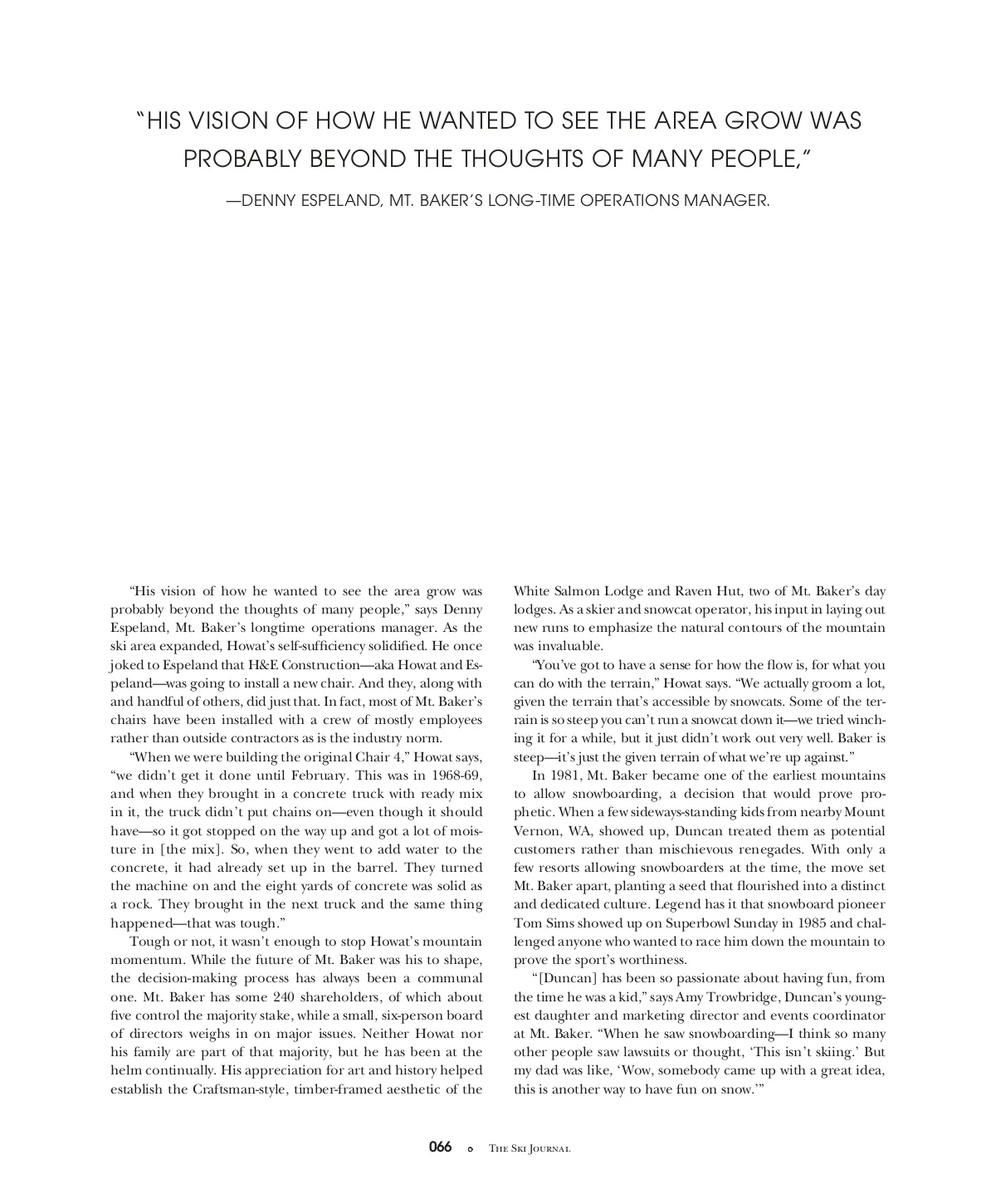
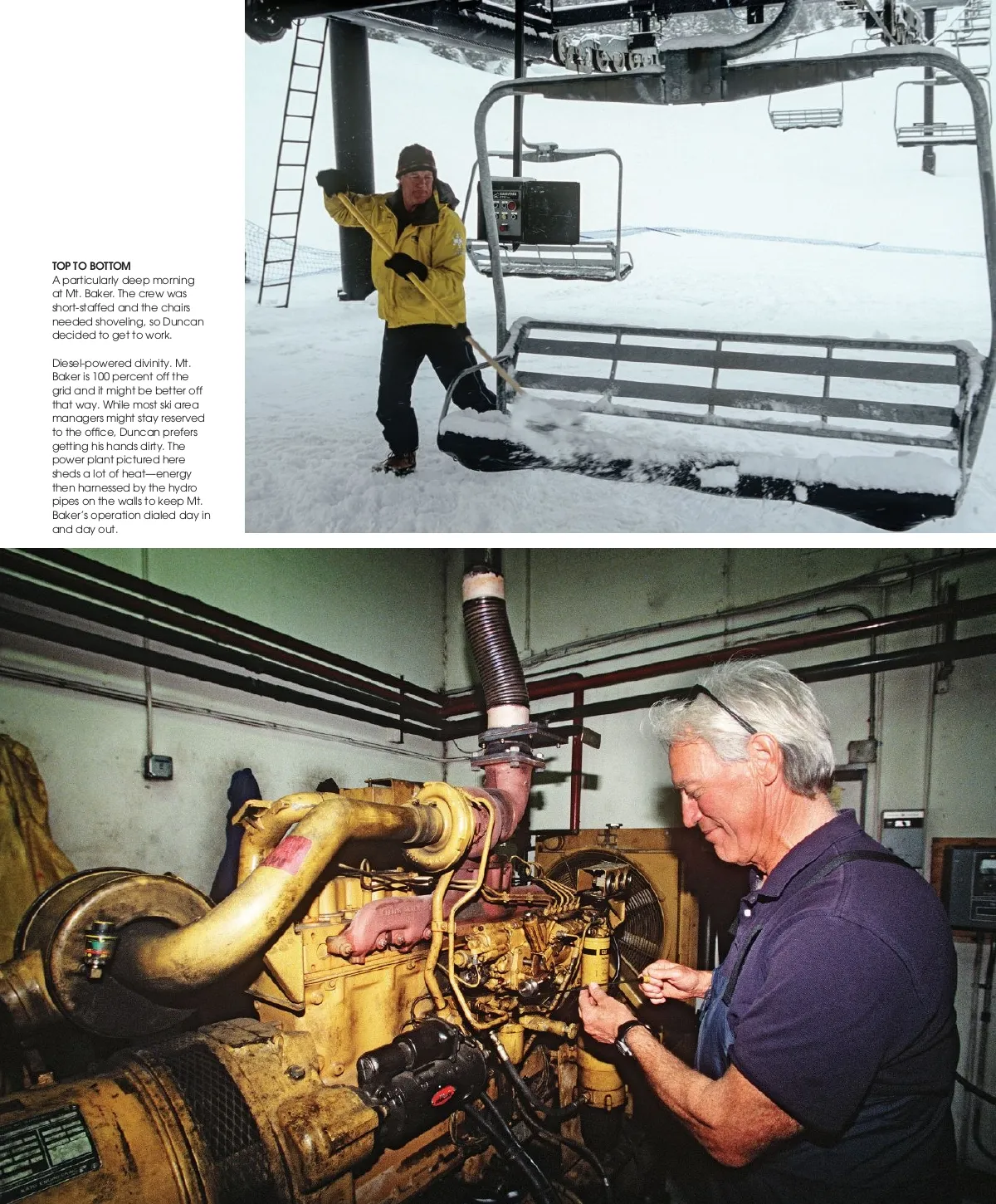
“HIS VISION OF HOW HE WANTED TO SEE THE AREA GROW WAS PROBABLY BEYOND THE THOUGHTS OF MANY PEOPLE,” —DENNY ESPELAND, MT. BAKER’S LONG-TIME OPERATIONS MANAGER. “His vision of how he wanted to see the area grow was probably beyond the thoughts of many people,” says Denny Espeland, Mt. Baker’s longtime operations manager. As the ski area expanded, Howat’s self-sufficiency solidified. He once joked to Espeland that H&E Construction—aka Howat and Es-peland—was going to install a new chair. And they, along with and handful of others, did just that. In fact, most of Mt. Baker’s chairs have been installed with a crew of mostly employees rather than outside contractors as is the industry norm. “When we were building the original Chair 4,” Howat says, “we didn’t get it done until February. This was in 1968-69, and when they brought in a concrete truck with ready mix in it, the truck didn’t put chains on—even though it should have—so it got stopped on the way up and got a lot of mois-ture in [the mix]. So, when they went to add water to the concrete, it had already set up in the barrel. They turned the machine on and the eight yards of concrete was solid as a rock. They brought in the next truck and the same thing happened—that was tough.” Tough or not, it wasn’t enough to stop Howat’s mountain momentum. While the future of Mt. Baker was his to shape, the decision-making process has always been a communal one. Mt. Baker has some 240 shareholders, of which about five control the majority stake, while a small, six-person board of directors weighs in on major issues. Neither Howat nor his family are part of that majority, but he has been at the helm continually. His appreciation for art and history helped establish the Craftsman-style, timber-framed aesthetic of the White Salmon Lodge and Raven Hut, two of Mt. Baker’s day lodges. As a skier and snowcat operator, his input in laying out new runs to emphasize the natural contours of the mountain was invaluable. “You’ve got to have a sense for how the flow is, for what you can do with the terrain,” Howat says. “We actually groom a lot, given the terrain that’s accessible by snowcats. Some of the ter-rain is so steep you can’t run a snowcat down it—we tried winch-ing it for a while, but it just didn’t work out very well. Baker is steep—it’s just the given terrain of what we’re up against.” In 1981, Mt. Baker became one of the earliest mountains to allow snowboarding, a decision that would prove pro-phetic. When a few sideways-standing kids from nearby Mount Vernon, WA, showed up, Duncan treated them as potential customers rather than mischievous renegades. With only a few resorts allowing snowboarders at the time, the move set Mt. Baker apart, planting a seed that flourished into a distinct and dedicated culture. Legend has it that snowboard pioneer Tom Sims showed up on Superbowl Sunday in 1985 and chal-lenged anyone who wanted to race him down the mountain to prove the sport’s worthiness. “[Duncan] has been so passionate about having fun, from the time he was a kid,” says Amy Trowbridge, Duncan’s young-est daughter and marketing director and events coordinator at Mt. Baker. “When he saw snowboarding—I think so many other people saw lawsuits or thought, ‘This isn’t skiing.’ But my dad was like, ‘Wow, somebody came up with a great idea, this is another way to have fun on snow.’” 066 The Ski Journal
The Ski Journal Volume 15, Issue 4: Page 66