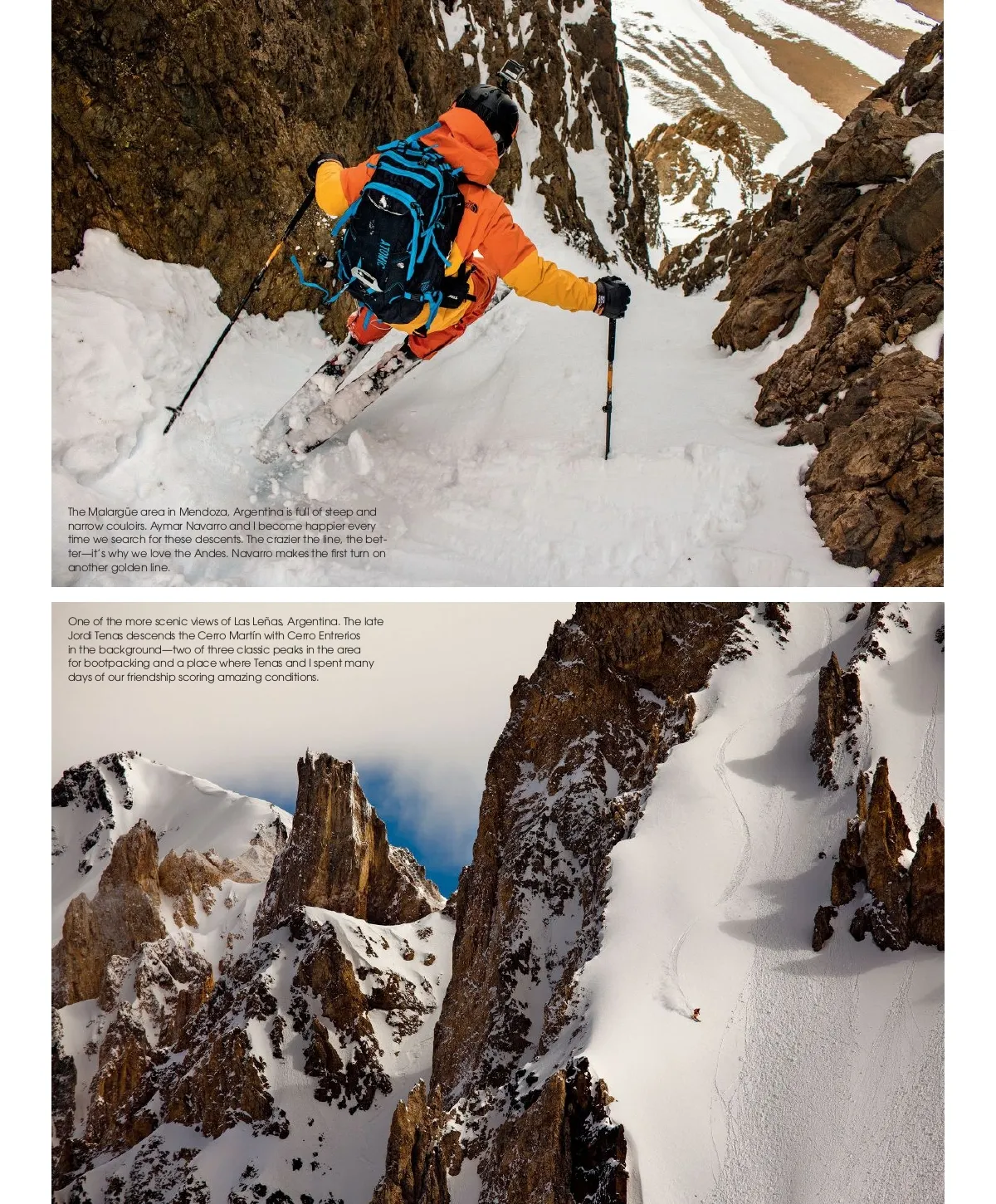
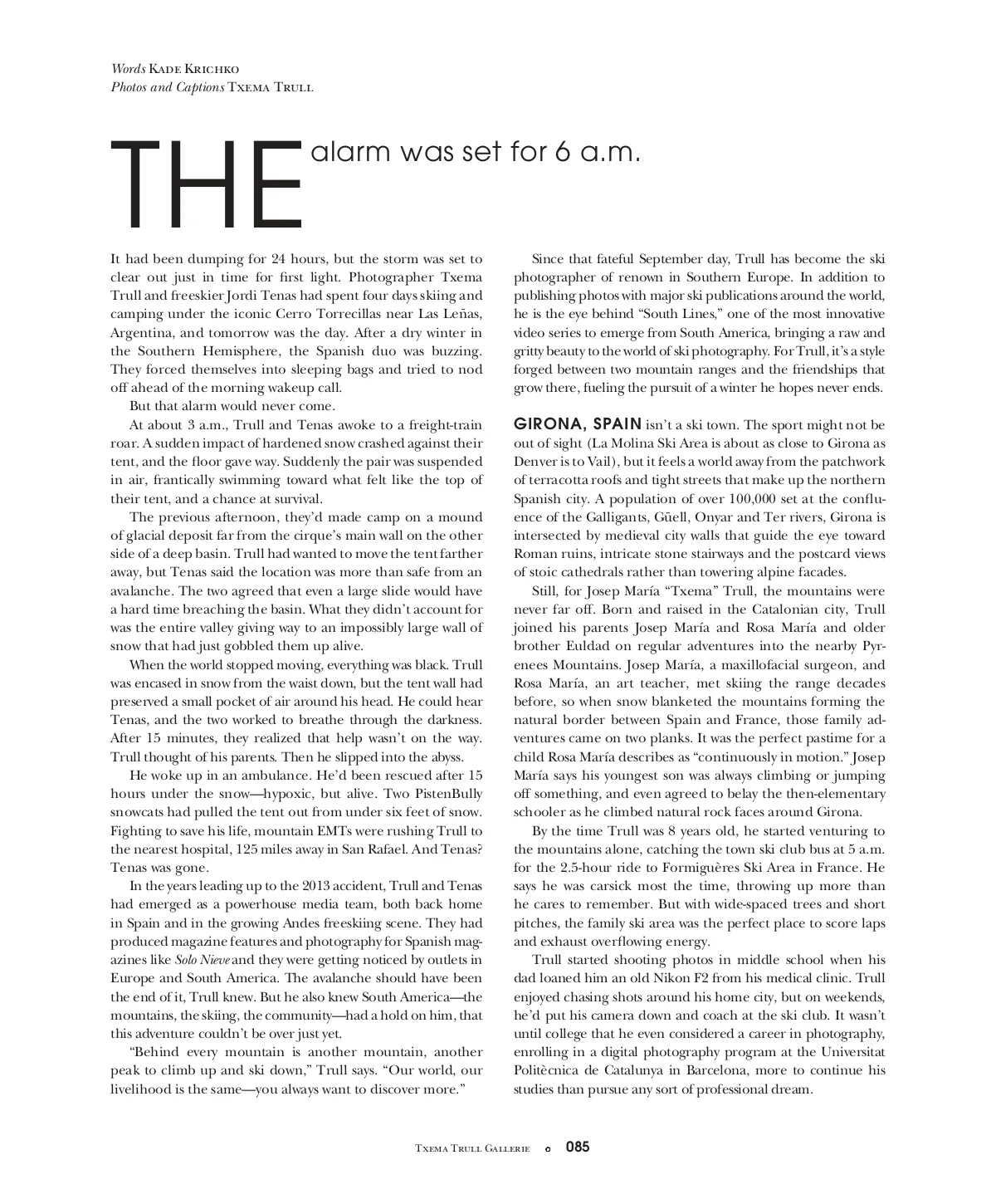
Words Kade Krichko Photos and Captions Txema Trull THE alarm was set for 6 a.m. It had been dumping for 24 hours, but the storm was set to clear out just in time for first light. Photographer Txema Trull and freeskier Jordi Tenas had spent four days skiing and camping under the iconic Cerro Torrecillas near Las Leñas, Argentina, and tomorrow was the day. After a dry winter in the Southern Hemisphere, the Spanish duo was buzzing. They forced themselves into sleeping bags and tried to nod off ahead of the morning wakeup call. But that alarm would never come. At about 3 a.m., Trull and Tenas awoke to a freight-train roar. A sudden impact of hardened snow crashed against their tent, and the floor gave way. Suddenly the pair was suspended in air, frantically swimming toward what felt like the top of their tent, and a chance at survival. The previous afternoon, they’d made camp on a mound of glacial deposit far from the cirque’s main wall on the other side of a deep basin. Trull had wanted to move the tent farther away, but Tenas said the location was more than safe from an avalanche. The two agreed that even a large slide would have a hard time breaching the basin. What they didn’t account for was the entire valley giving way to an impossibly large wall of snow that had just gobbled them up alive. When the world stopped moving, everything was black. Trull was encased in snow from the waist down, but the tent wall had preserved a small pocket of air around his head. He could hear Tenas, and the two worked to breathe through the darkness. After 15 minutes, they realized that help wasn’t on the way. Trull thought of his parents. Then he slipped into the abyss. He woke up in an ambulance. He’d been rescued after 15 hours under the snow—hypoxic, but alive. Two PistenBully snowcats had pulled the tent out from under six feet of snow. Fighting to save his life, mountain EMTs were rushing Trull to the nearest hospital, 125 miles away in San Rafael. And Tenas? Tenas was gone. In the years leading up to the 2013 accident, Trull and Tenas had emerged as a powerhouse media team, both back home in Spain and in the growing Andes freeskiing scene. They had produced magazine features and photography for Spanish mag-azines like Solo Nieve and they were getting noticed by outlets in Europe and South America. The avalanche should have been the end of it, Trull knew. But he also knew South America—the mountains, the skiing, the community—had a hold on him, that this adventure couldn’t be over just yet. “Behind every mountain is another mountain, another peak to climb up and ski down,” Trull says. “Our world, our livelihood is the same—you always want to discover more.” Since that fateful September day, Trull has become the ski photographer of renown in Southern Europe. In addition to publishing photos with major ski publications around the world, he is the eye behind “South Lines,” one of the most innovative video series to emerge from South America, bringing a raw and gritty beauty to the world of ski photography. For Trull, it’s a style forged between two mountain ranges and the friendships that grow there, fueling the pursuit of a winter he hopes never ends. GIRONA, SPAIN isn’t a ski town. The sport might not be out of sight (La Molina Ski Area is about as close to Girona as Denver is to Vail), but it feels a world away from the patchwork of terracotta roofs and tight streets that make up the northern Spanish city. A population of over 100,000 set at the conflu-ence of the Galligants, Güell, Onyar and Ter rivers, Girona is intersected by medieval city walls that guide the eye toward Roman ruins, intricate stone stairways and the postcard views of stoic cathedrals rather than towering alpine facades. Still, for Josep María “Txema” Trull, the mountains were never far off. Born and raised in the Catalonian city, Trull joined his parents Josep María and Rosa María and older brother Euldad on regular adventures into the nearby Pyr-enees Mountains. Josep María, a maxillofacial surgeon, and Rosa María, an art teacher, met skiing the range decades before, so when snow blanketed the mountains forming the natural border between Spain and France, those family ad-ventures came on two planks. It was the perfect pastime for a child Rosa María describes as “continuously in motion.” Josep María says his youngest son was always climbing or jumping off something, and even agreed to belay the then-elementary schooler as he climbed natural rock faces around Girona. By the time Trull was 8 years old, he started venturing to the mountains alone, catching the town ski club bus at 5 a.m. for the 2.5-hour ride to Formiguères Ski Area in France. He says he was carsick most the time, throwing up more than he cares to remember. But with wide-spaced trees and short pitches, the family ski area was the perfect place to score laps and exhaust overflowing energy. Trull started shooting photos in middle school when his dad loaned him an old Nikon F2 from his medical clinic. Trull enjoyed chasing shots around his home city, but on weekends, he’d put his camera down and coach at the ski club. It wasn’t until college that he even considered a career in photography, enrolling in a digital photography program at the Universitat Politècnica de Catalunya in Barcelona, more to continue his studies than pursue any sort of professional dream. Txema Trull Gallerie 085
The Ski Journal Volume 15, Issue 4: Page 85