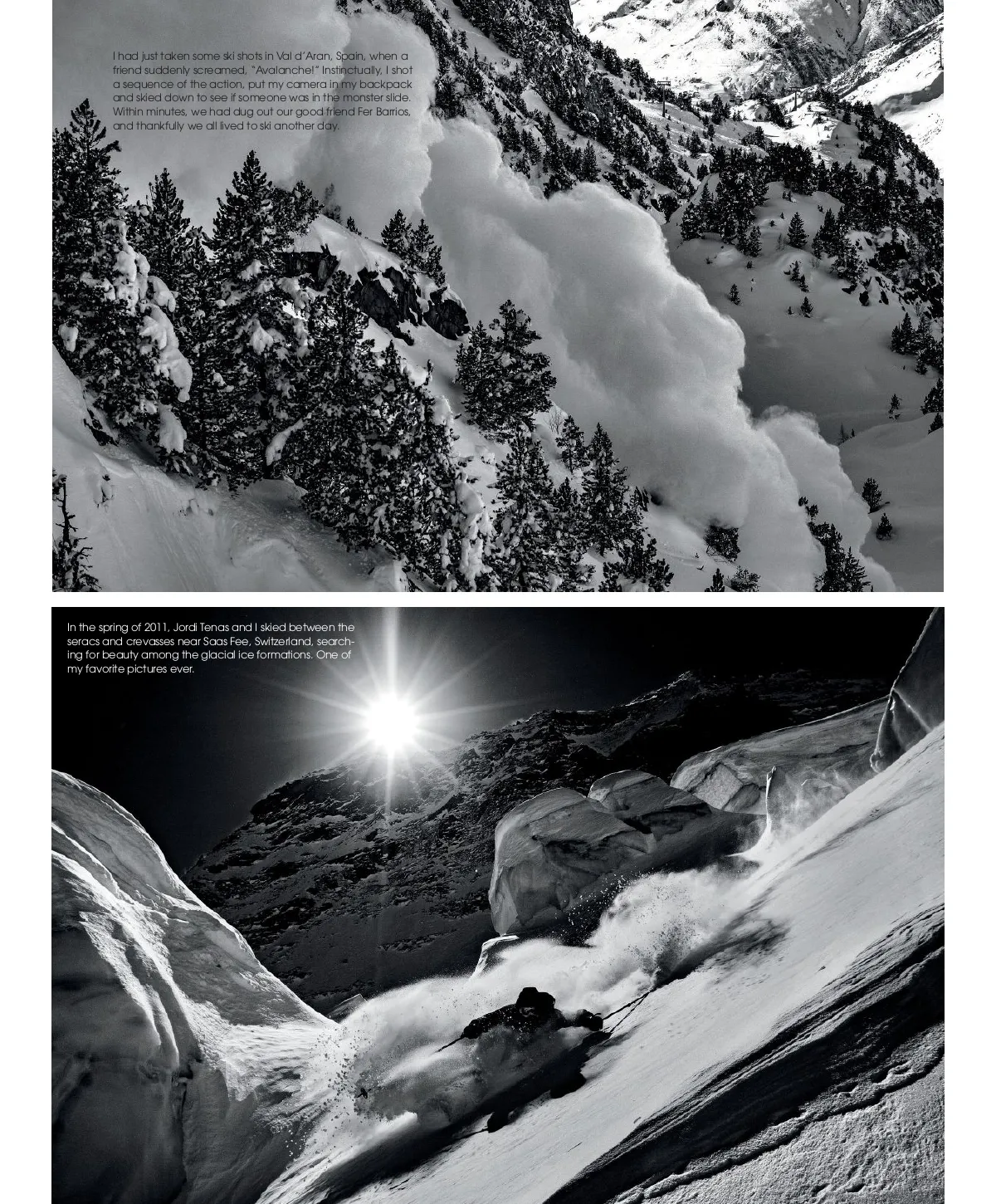
That dream space was reserved for sliding on snow, some-thing he chased right out of college. In 2005, a few months after graduation, Trull turned down a newspaper job in Girona and moved to Baqueira-Beret, the largest ski resort in Spain. He found a job as a bellboy in an area hotel, a gig that earned him enough to cover his share of the rent, but not enough time on snow. That’s when Trull’s two worlds collided. Fototur, a local photo shop, was looking for help shooting tourism photos on-hill that season, and Trull was uniquely qualified for the job. Thus, a professional photography career began, complete with a colorful vest and plenty of photos of amateur racers and Spanish vacationers. But Trull saw his opportunity and ran with it. He already had an eye for picturesque landscapes and, through covering races and freeride events, mastered capturing the decisive turn, huck and slash. Those were the two elements Trull still looks for in his photography today— pivotal split seconds in beautiful places. “I like to talk about visual for the sake of visual,” Trull explains. “I’m not always looking for photos with messages or to tell a story. I’m looking more for spectacular moments both in the mountains and on skis.” Trull was gaining momentum in Baqueira. But seasons end, and with them, seasonal work. He knew he wanted to keep his nascent photo career going, but didn’t know how. When his Chilean boss suggested he chase snow to South America that summer, Trull suddenly had his answer. He landed in Valle Nevado, Chile, that first summer, liv-ing in the freezing basement of a hotel with an assortment of random roommates, working at a local photo shop and skiing as much as possible. It was a rugged baptism into the cult of endless winter, but also the start of a snow-chasing journey that persisted for the next 13 years. “What was supposed to be a season became my life,” he says. TRULL CONSIDERS HIMSELF a winter nomad. But un-like the modern-day definition that chases Instagram sunsets and food pictures around the world at a mile a minute, the Spaniard’s movements are more like the herders and hunters of old—calculated, repetitive and built around sustaining a way of life. In fact, almost all of Trull’s travel has been be-tween the Pyrenees and the Andes, a photographic migration that is by design. “It’s not about spending one week in each place, it’s about going to a place and spending a long time there—learn it, see how it moves, how it changes,” he says. “By finding those places and shooting there over and over again, it gives you a chance to improve upon what you’ve done before, on what’s possible with your photos.” For Trull that meant long scouting days in the mountains and lots of study. Light, contrast conditions, time of year—he examined subtle changes over time, developing an internal shot list before working with any athlete. The work suited Trull well, giving him a chance to ski as much as scout, and to develop a method amid what, to the outside, seemed a constant state of motion. “Sometimes you only have a few days on assignment and it’s like swinging a machete, hacking out a few easy shots to make sure you have your bases covered,” Trull explains. “If it’s more up to me, I want to learn these places that I shoot intimately up front, know where to go and how to get there in order to produce specific kinds of photos.” He has even chosen his travel and ski partners according to this methodology, linking up with other Spaniards chasing win-ter between the two continents. It’s how he began working with Aymar Navarro, a Freeride World Tour competitor and arguably the most well-known freeskier from Iberia, and how he met his best friend, Tenas. Trull had been traveling to Chile for three years by the time he met Tenas, a motivated freeskier from Bar-celona, Spain. He caught the up-and-comer slicing a line down Tuc de Baciver, the mythical peak near Baqueira, snapping a couple of photos before tracking down the athlete in town. The bond was immediate—Tenas a relentless go-getter and Trull an endless supply of energy and enthusiasm with an eye for good skiing in tough-to-get-to places. It was Tenas that convinced Trull to move his South American base to Las Leñas, a freeskier’s paradise with big, consequential lines between impressive rock spires. He and Tenas made it to Las Leñas in 2009, and quickly started picking off lines in the extensive Argentinean back-country. Tenas forced him to push farther into the mountains than ever before, showing Trull that his athletic ability helped him stand out as a photographer. Many of his shots were taken from across the valley, perched on a steep outcropping of rock or blustery ridgeline, but many were taken from a much more intimate point-of-view perspective, bringing the viewer into the heart-gripping crux of a dramatic line. The extra effort abroad started to gain attention at home, with Baqueira-Beret bringing Trull on as a staff photographer and Spanish and European ski magazines plastering his im-ages throughout their pages. “With Jordi, we were skiing these huge 3,000-foot couloirs and we were just so motivated,” Trull says. “He motivated us. I got so much better technically and mentally just by being with him in the mountains.” 086 The Ski Journal
The Ski Journal Volume 15, Issue 4: Page 86