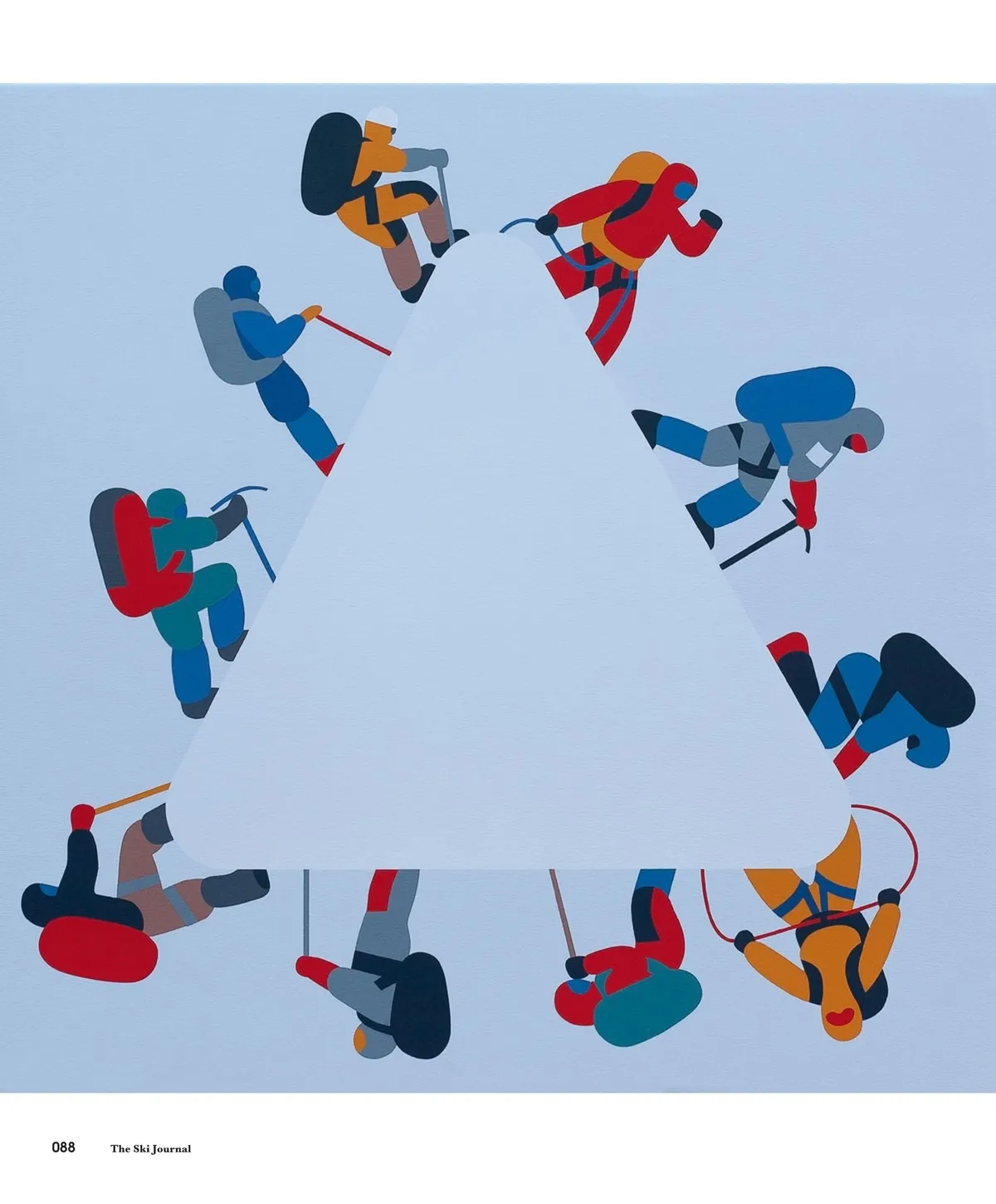
Transcendentalhypoxia, acrylic on canvas (2021) I did a series of paintings with mountaineers because I like how high-alti-tude climbers become these sort of brightly colored Playmobil figures, or Haribo gummy bears from far away, but at the same time they are living in the death zone. The composition is similar to works I have done in the past: figures coming and going—an endless, pointless trudge. DURING DECADES SPENT WORKING as a visual artist, Geoff McFetridge has worked on campaigns for Pepsi and designed shoes for Nike, creating artwork that reveals itself as the shoe breaks in. He’s responsible for the images for Patagonia’s Live Simply campaign—illustrations that show the simplicity of a guitar with a single string or the juxtaposition of a pair of hiking tracks up a mountain beside parallel lines snaking down blue snow. McFetridge is in your literature—producing animations for the New York Times and covers for The Atlantic , and as the first art director for the Beastie Boys’ magazine, Grand Royal . He’s in your music—creating packaging, graphics, logos and limited-edition LPs for the Whitest Boy Alive, Jack Johnson, OK Go and Death Cab for Cutie. He’s in your films—his art shows up in Spike Jonze productions such as Her and the opening animation of Where the Wild Things Are ; Sofia Coppola hired McFetridge to design the title sequence for The Virgin Suicides . The dude is even in your pantry and at your parties—check out the baffling work he did for Oreos, the screen-printed velvet bag for Bushmills’ decanters, or the beautiful and over-peopled label for Beck’s beer. McFetridge’s art is ubiquitous, boiling down a corporate marketing campaign into something simple, memorable, surreal, humorous and evocative all at once. K2 Vice President of Marketing Tim Swart had seen McFe-tridge’s process firsthand, having worked with him on projects for outdoors companies in the past, so when a ski rebrand came around in 2019, he knew the visual artist was their guy. McFetridge agreed to take on the project, but realized quickly that creating graphics for skis and mountains was a step in an unexpectedly different and awkwardly challenging direction. While his work graces everything from buildings to bottles, skis have been one of his most difficult canvases. “It’s the worst shape, the worst thing to make art for,” McFe-tridge says. “It’s super narrow and then there are bindings in the middle of it. So you’re going to mount them and obliterate the graphics in the middle.» “Knowing that [McFetridge] was a skier, and out of the respect I had for him, we wanted to see where his head went and how he would interpret it,” says Brad Walters, design director for K2 Ski-ing and Snowboarding. K2 gave McFetridge free rein. And when the sketchbooks had about a dozen ideas, Walters recalls those first submitted pages. “I vividly remember everyone going, ‘This is going to be cool.’” For the Wayback 96, a touring ski, McFetridge imagined the skis to be two strips of film that told complementary stories. For each ski, he created a dozen-and-a-half slides with abstract, simply drawn images. Just behind the bindings, one ski shows a head locked, the other a head unlocked. Behind that are five repeated images of a child and an adult that fuse together, frame by frame, to form K2’s logo. McFetridge sees skiing as “connecting with your child self.” He still thinks back on childhood days spent charging through bumps when nothing else mattered. But he also remembers when that carefree relationship changed, as a teenager distracted and consumed by constantly becoming better rather than just enjoying the ride. Ultimately, he says, those worries threatened to poison the well. “There’s so many moments of doubt,” McFetridge says of ski-ing, adding that the same holds true for his pursuit of skateboard-ing, surfing and snowboarding. “Thinking, ‘I just completely suck at this.’ But that’s sort of the point. You’re constantly pushing through this deep doubt.” If you can make it to the other side, says McFetridge, you’ll reconnect with that worry-free child spirit once again. As a kid, McFetridge was a self-proclaimed nerd, drawing all the time and playing Dungeons and Dragons. But during middle school he discovered skateboarding and punk music, and says both scenes “hit [me] with a lot of stuff culturally.” With skateboard decks and punk T-shirts, he had canvases. And given the way the sport and music exploded his synapses, suddenly McFetridge had stuff to draw. “The language of these cultures were really art-based.” By high school, he had started a zine that he photocopied in his dad’s office. After college, he left Canada for Los Angeles to attend grad school at California Institute of the Arts. The school had one of the most experimental design programs in the United States at the time. It wasn’t long before the newly landed transplant was combining his past and present, designing snowboard graphics for Burton and Salomon. He started painting skate decks as well, from Krooked to Girl to his own board company, Solitary Arts. By his late 20s, McFetridge’s friend Takuji Masuda, who inter-twined surf and street art culture, introduced the young artist to surfing. During the day, the pair would surf in Malibu, and at night they’d crash at the house Masuda rented from infamous music executive Suge Knight. Surfing helped connect McFetridge with the initial childhood joy he’d experienced on skis. In turn, learning something new later in life ultimately opened a door that led back to the mountains. Soon he was diving into telemark, backcountry and alpine skiing (again) at Mammoth, his adopted home mountain. He says this time around, the story reads differently. Instead of getting caught up in the stress and doubt of his teenage years, McFetridge has a newfound love for his old flame, one rooted in just getting out there and having fun. “My adult version of skiing is way better than my kid version,” he says. Geoff McFetridge Gallerie 089
The Ski Journal Volume 16, Issue 2: Page 89