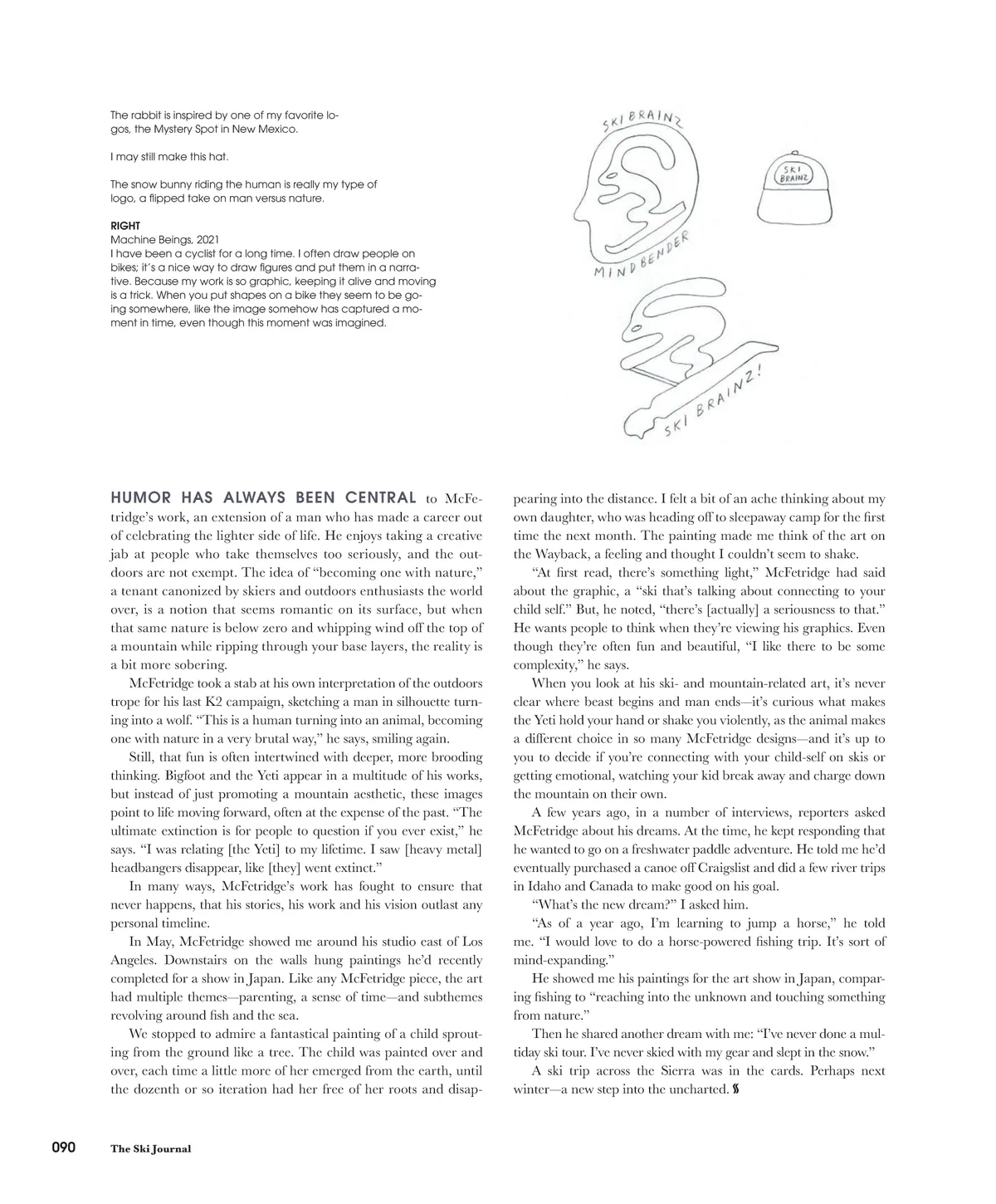
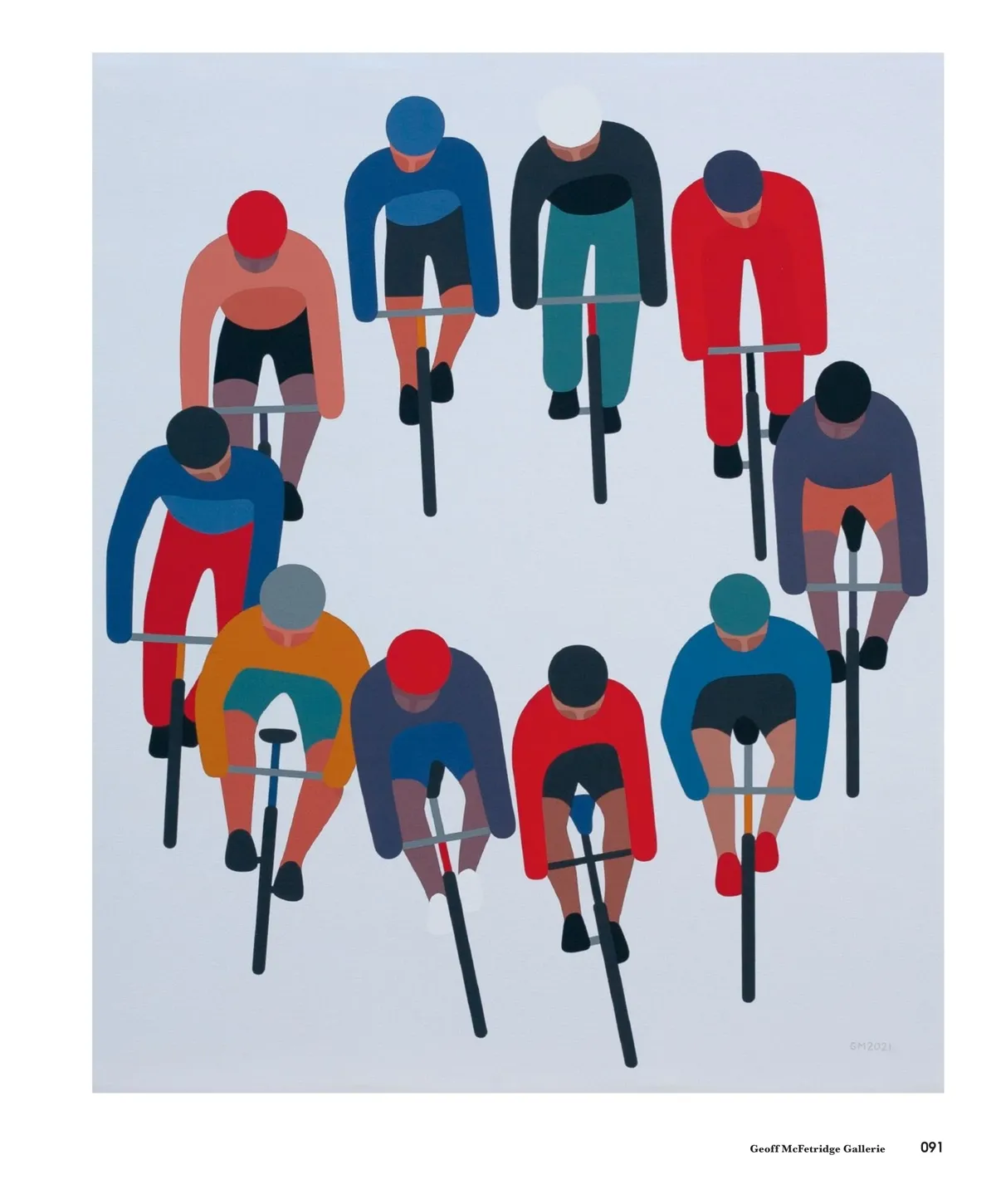
The rabbit is inspired by one of my favorite lo-gos, the Mystery Spot in New Mexico. I may still make this hat. The snow bunny riding the human is really my type of logo, a flipped take on man versus nature. RIGHT Machine Beings, 2021 I have been a cyclist for a long time. I often draw people on bikes; it’s a nice way to draw figures and put them in a narra-tive. Because my work is so graphic, keeping it alive and moving is a trick. When you put shapes on a bike they seem to be go-ing somewhere, like the image somehow has captured a mo-ment in time, even though this moment was imagined. HUMOR HAS ALWAYS BEEN CENTRAL to McFe-tridge’s work, an extension of a man who has made a career out of celebrating the lighter side of life. He enjoys taking a creative jab at people who take themselves too seriously, and the out-doors are not exempt. The idea of “becoming one with nature,” a tenant canonized by skiers and outdoors enthusiasts the world over, is a notion that seems romantic on its surface, but when that same nature is below zero and whipping wind off the top of a mountain while ripping through your base layers, the reality is a bit more sobering. McFetridge took a stab at his own interpretation of the outdoors trope for his last K2 campaign, sketching a man in silhouette turn-ing into a wolf. “This is a human turning into an animal, becoming one with nature in a very brutal way,” he says, smiling again. Still, that fun is often intertwined with deeper, more brooding thinking. Bigfoot and the Yeti appear in a multitude of his works, but instead of just promoting a mountain aesthetic, these images point to life moving forward, often at the expense of the past. “The ultimate extinction is for people to question if you ever exist,” he says. “I was relating [the Yeti] to my lifetime. I saw [heavy metal] headbangers disappear, like [they] went extinct.” In many ways, McFetridge’s work has fought to ensure that never happens, that his stories, his work and his vision outlast any personal timeline. In May, McFetridge showed me around his studio east of Los Angeles. Downstairs on the walls hung paintings he’d recently completed for a show in Japan. Like any McFetridge piece, the art had multiple themes—parenting, a sense of time—and subthemes revolving around fish and the sea. We stopped to admire a fantastical painting of a child sprout-ing from the ground like a tree. The child was painted over and over, each time a little more of her emerged from the earth, until the dozenth or so iteration had her free of her roots and disap-pearing into the distance. I felt a bit of an ache thinking about my own daughter, who was heading off to sleepaway camp for the first time the next month. The painting made me think of the art on the Wayback, a feeling and thought I couldn’t seem to shake. “At first read, there’s something light,” McFetridge had said about the graphic, a “ski that’s talking about connecting to your child self.” But, he noted, “there’s [actually] a seriousness to that.” He wants people to think when they’re viewing his graphics. Even though they’re often fun and beautiful, “I like there to be some complexity,” he says. When you look at his ski-and mountain-related art, it’s never clear where beast begins and man ends—it’s curious what makes the Yeti hold your hand or shake you violently, as the animal makes a different choice in so many McFetridge designs—and it’s up to you to decide if you’re connecting with your child-self on skis or getting emotional, watching your kid break away and charge down the mountain on their own. A few years ago, in a number of interviews, reporters asked McFetridge about his dreams. At the time, he kept responding that he wanted to go on a freshwater paddle adventure. He told me he’d eventually purchased a canoe off Craigslist and did a few river trips in Idaho and Canada to make good on his goal. “What’s the new dream?” I asked him. “As of a year ago, I’m learning to jump a horse,” he told me. “I would love to do a horse-powered fishing trip. It’s sort of mind-expanding.” He showed me his paintings for the art show in Japan, compar-ing fishing to “reaching into the unknown and touching something from nature.” Then he shared another dream with me: “I’ve never done a mul-tiday ski tour. I’ve never skied with my gear and slept in the snow.” A ski trip across the Sierra was in the cards. Perhaps next winter—a new step into the uncharted. 090 The Ski Journal
The Ski Journal Volume 16, Issue 2: Page 90