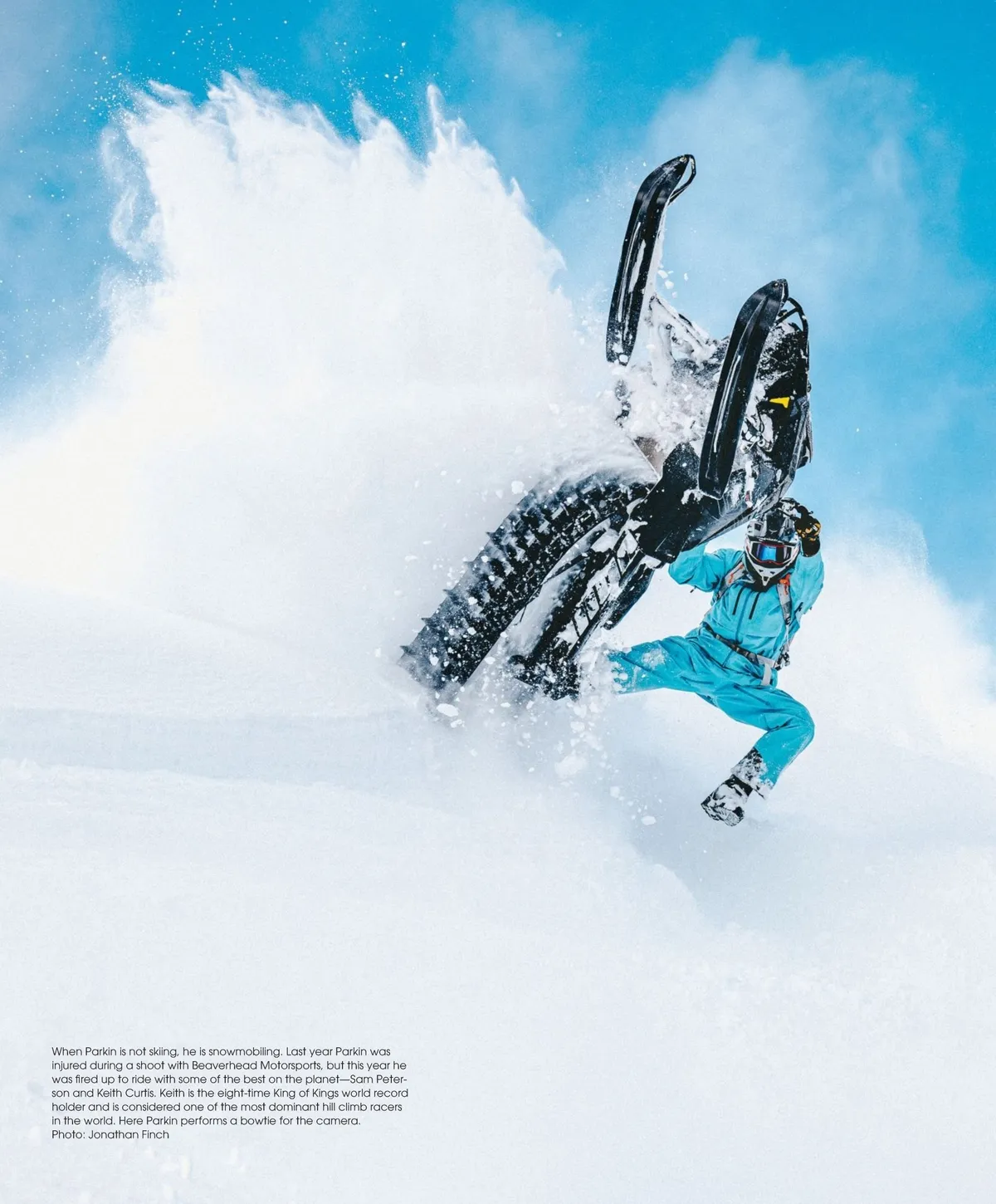
Cleancut with stylish blond hair, Parkin looks more prep than frontier-bred outdoorsman. His friendly, curious, yet calculated demeanor shines through the minute you meet him, and his initial impression makes him seem much older than his 23 years. Even though his skiing shone from a young age, he still approaches the mountains like a student, exploring possibilities and experimenting, while taking in everything he can from those around him. Pete, in his own way, has provided a bit of a reluctant blueprint for his oldest son. Pete never settled for the 9-to-5, finding work not only as a trail-builder but also holding down gigs as a traveling ski journalist, dirt-hauling com-pany owner, gourmet food salesman and nighttime resort groomer. All of it, he says, was to get more time on snow. Much of that time was spent with a young Parkin, and the parallels between them are hard to ignore. In fact, Pete’s drive to ski above all else was ingrained into his son. Parkin’s voice never wavers when he says that by the time he was in middle school he knew he wanted to be a pro skier. Still he recognized the inherent challenges involved, that very few truly “make it” in the sport. He also knew that if he was going to reach the biggest stage in today’s changing ski world, his dad’s recipe was a good start, but he’d need to find his own path. FLYING OUT OF THE BASE of the Knik Glacier near Palmer, at the northern end of Alaska’s Chugach Moun-tains, the TGR team was right in the heart of some of the biggest terrain in North America. Sage, Mac, Parkin and his childhood friend and slopestyle superstar Maggie Voisin spent the first few days scouting from the heli and getting their feet under them on warm-up lines, but an extended unfavorable weather pattern left the mountains inaccessible. Many of the zones they wanted to film featured fluted spines glued precariously to vertical rock slabs, the kind of terrain that requires ideal conditions. Sage knew the scouting process was all about patience, taking in the terrain as his body and mind got used to the game again. It had been five years since his last trip to Alaska, and he admitted that fear and doubt were weighing more heavily than they had during his younger days. Knowing that Alaska’s year had been rough even before they arrived, Parkin was also concerned. “I’m no expert yet, but I can tell you that having clouds in Alaska for two weeks straight is definitely concerning,” he says. He leaned into the combined decades of experience of Sage and Mac, turning a tough situation into a valuable and timely crash course. Whether it was the mechanics of glacier travel, getting in and out of helicopters performing full-power toe-in landings atop a 60-degree face, or the art of slough management, the rookies learned on the fly. “You get inspired to ski like Sage and Ian just watching them drop into the most exposed stuff you can imagine,” Parkin says. “But after spending nearly a month with them on that trip, the key takeaway was learning that I didn’t have to send it every second of every day—sometimes it’s worth waiting a storm or even two.” On TGR’s exploratory Alaska trips, it’s ultimately up to the athletes to choose the terrain they want to ride. It’s on them to make sure it’s in the right light at the right time. Sage and Mac recognized quickly that Parkin had the mountain skills he needed to succeed in this terrain, but they saw an op-portunity to push Parkin toward a more measured approach. They passed along filming knowledge, like predicting when and where the light would hit to ensure a once-in-a-career line would shoot to TGR’s filming standards, and reminded him to always be certain the line has a safe exit. “To me, the scariest part of skiing in Alaska is that the mountains tend to roll over and the lines get steeper near the middle, so you often can’t see where your line ends,” Parkin says. “Is it the apron, or is it the 200-foot cliff your slough is spilling over?” In the back of his mind, he knew that getting cliffed-out in the Chugach wasn’t quite the same as at Big Sky. In these mountains, consequences multiply. “Parkin really took to Sage and Ian’s process,” Maggie says. “It was really cool to watch him observe two legends. On the flip side, it was amazing to have him share his vision about how to ski stuff—lines he saw that even Sage and Ian couldn’t visualize.” But Parkin doesn’t stop at visualization—he backs it up with the skills it takes to ride these video-game lines. Those skills are what paved Parkin’s road to Alaska. Parkin won TGR’s Grom Contest at age 15 and has numerous IFSA freeride competition victories to his name. With his dad behind the video camera, Parkin even scored the top spot at the 2017 Quiksilver Young Guns video contest with the only big mountain edit in a sea of park videos, beating out future Olympians Finn Bilous and Birk Ruud. In 2018, thanks in part to the recognition he received from the Grom Contest, the then-18-year-old Parkin was invited to film a segment with TGR for their annual film Far Out , his first as an athlete. “Mom was definitely strongly reminding me that I should finish my education. But she never held me back,” Parkin says. “Dad was stoked to see it come together, and when I got the TGR invite, I figured it was time to focus on that.” Parkin Costain 047
The Ski Journal Volume 17, Issue 1: Page 47