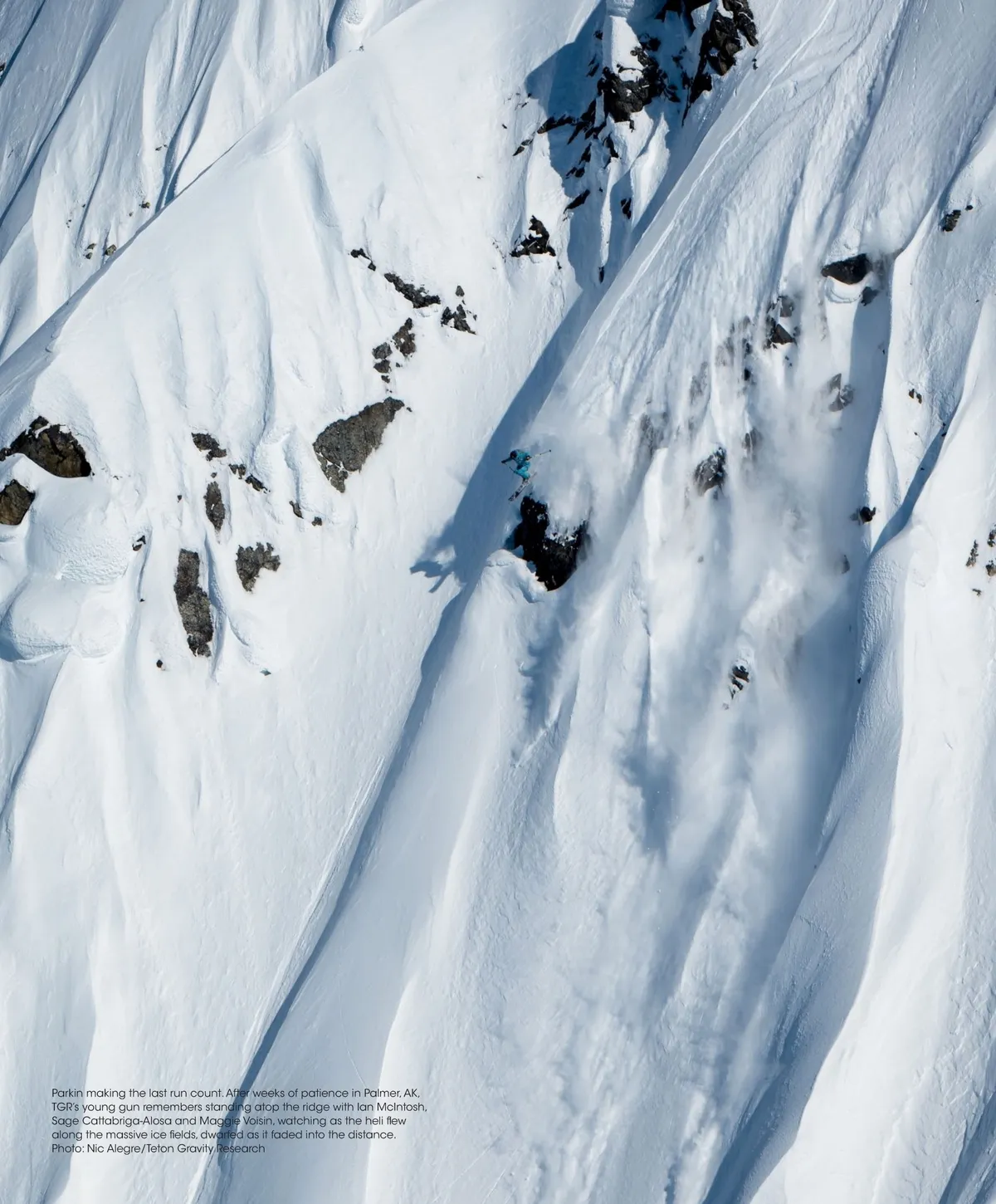
That year, he received a $3,000 travel budget from his sponsors for trips to British Columbia and Haines, AK. TGR covered some expenses once he was on location, but he dug into savings earned from operating excavators for Pete’s trail-building company, Terraflow Trails, to film his first major segment. Anything to stay on snow. It was a path Pete had taken years earlier and one Parkin found himself walking as a teenager. Still, Parkin realized that paying his own way to get into ski films wasn’t sustainable. If he was going to give professional skiing a go, he would need to make a statement. Parkin made that statement in 2020 by winning Jackson Hole’s Kings & Queens of Corbet’s with a massive double backflip. He hadn’t been invited the first two years after the competition. Forever the analyst, he had watched the competition explode, and concluded that a high finish could give him the industry recognition he needed. He and friend Jake Hopfinger decided to take matters into their own hands, building a bigger lip atop Corbet’s, which allowed for just enough pop for Parkin to pull off his comp-winning maneuver. “It ended up being some of the biggest airs we’d ever done,” Parkin says. The victory put him in the company of previous winners Travis Rice and Karl Fostvedt—both giants in snowboard-ing and skiing, respectively. Industry heavyweights like TGR couldn’t really ignore the win (and the viral double flip) and soon sponsors came calling. Suddenly Parkin had taken a step his father never did. Now he makes a living sliding on snow thanks to big contracts from Scott Sports, Polaris and Backcountry, among others. PARKIN SAYS THAT DESPITE the obvious gnar fac-tor, Alaska is where he feels the most comfortable skiing. The huge terrain gives him room to ski fast, and there are endless features to trick and showcase his style. For years, Parkin had followed his dad through backcountry zones around Big Sky, Cooke City and Whitefish, seeking out big, rocky faces and exposed spine lines—miniature versions of what he now looks for in Alaska. “I’m inspired by what a young eye can see and do in the mountains,” Sage says. “[Parkin’s] appetite for risk is that of a hungry 23-year-old. Where my years of experience have me look at a zone with a degree of temperance, he sees opportunities.” Sage, along with Mac, saw Parkin and Maggie as wild cards. They’d never skied with the duo before and, despite the young skiers’ impressive resumes, they knew Alaskan skiing required a specialized skill set. It’s one thing to ski these mountains, but it’s an entirely different game to piece together a movie segment in Alaska. While the act of riding Alaskan spines may look like com-mitting to a semi-controlled fall, the rookies were quickly introduced to its layers of nuance. During their many trips to the Chugach, Sage and Mac had developed a systematic approach to searching out the exact place they wanted to ride, which had ultimately resulted in decades of successful round trips. But on this mission, they discovered that even though they were ostensibly the teachers in this terrain, their pupils offered up a few lessons of their own. “This year, I was definitely the expert at figuring out where to go, but Parkin was the expert at figuring out what he was going to do once we were there,” Sage says. “Once we found a face, it was all about, ‘What’s Parkin going to do?’” Parkin, for his part, joined in the planning and scout-ing process happily, learning from Sage and Mac in real time. Just as he’d learned from Pete throughout his child-hood, Parkin was now taking cues from some of the best in the big mountain game. Within days of a good weather window, Parkin turned his learnings into action, executing the whole process—from light, to angle, to his own and the crew’s safety—and laying down film-worthy lines. “The thing about mentorship in the mountains is that it’s informal, there’s no lesson plans or anything, but Parkin was able to absorb those skills by just being along for the ride,” Sage says. “He went from being a passenger to being part of the process.” When, after nearly two weeks, the skies finally went blue, Parkin dialed in. Those fluted spines were beckoning, and with newfound wisdom imparted by the best in the game, he knew he was up to bat. With cameras rolling, Parkin dropped—and showed his teachers what he’d learned. 048 The Ski Journal
The Ski Journal Volume 17, Issue 1: Page 48