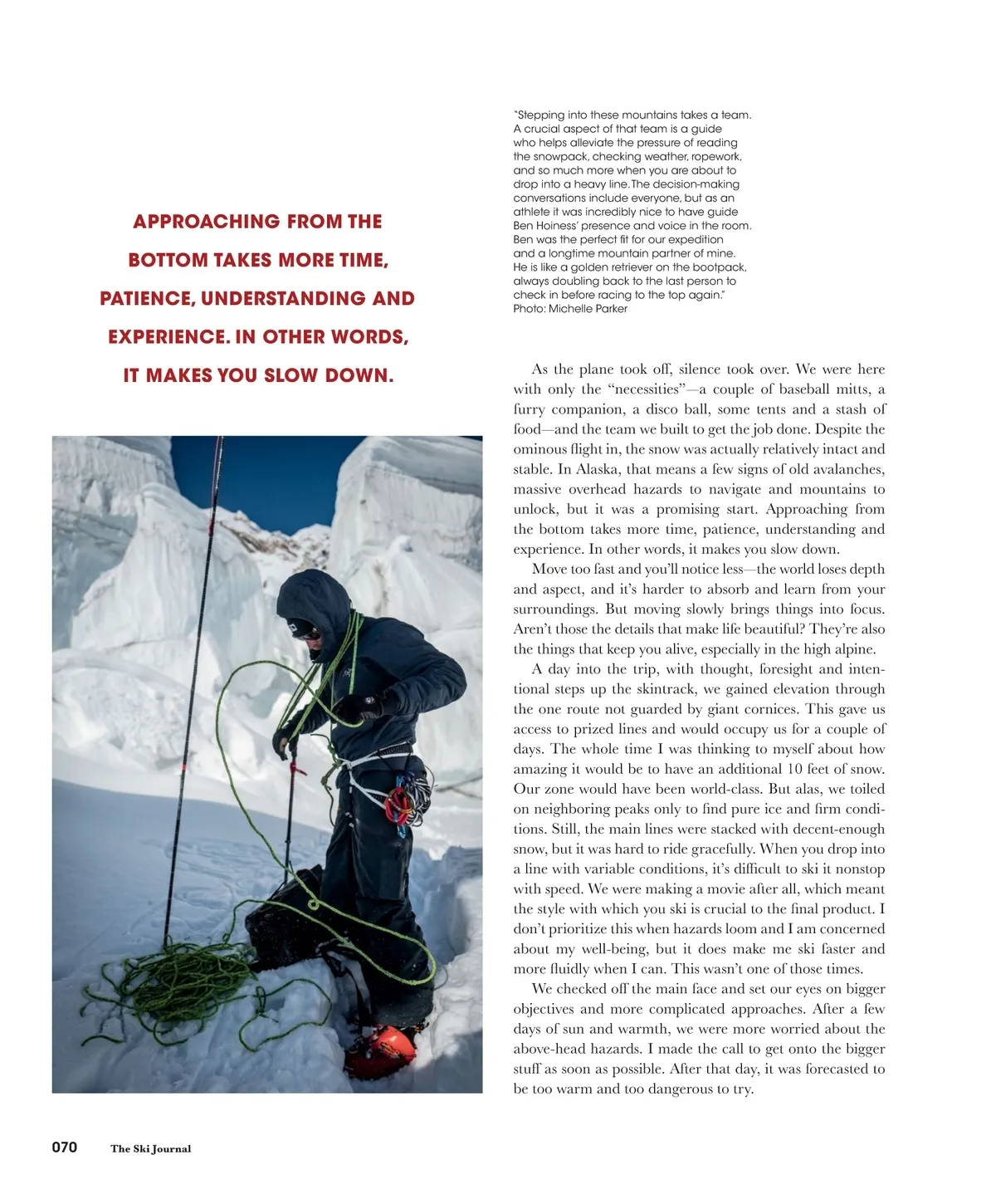
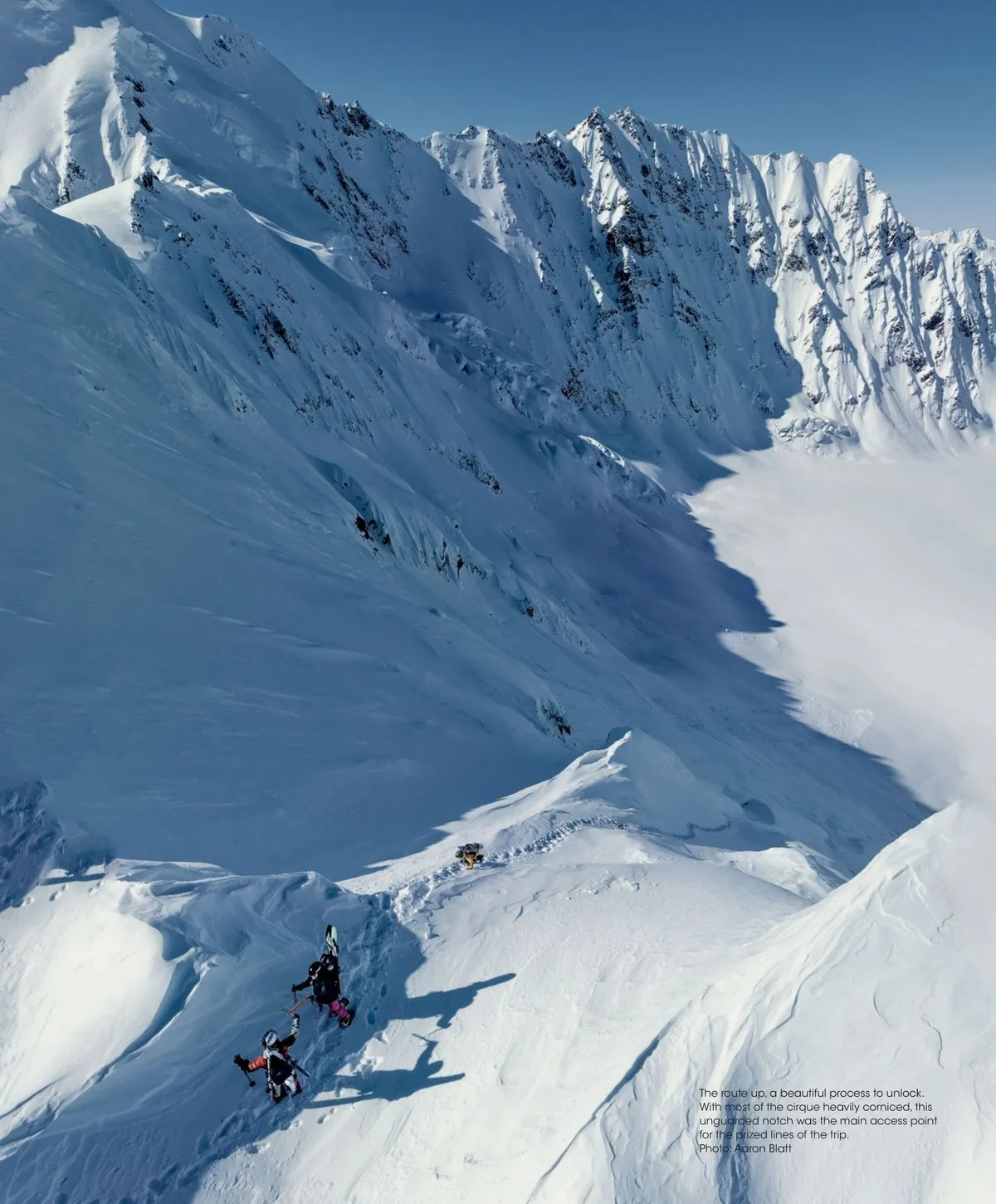
APPROACHING FROM THE BOTTOM TAKES MORE TIME, PATIENCE, UNDERSTANDING AND EXPERIENCE. IN OTHER WORDS, IT MAKES YOU SLOW DOWN. “Stepping into these mountains takes a team. A crucial aspect of that team is a guide who helps alleviate the pressure of reading the snowpack, checking weather, ropework, and so much more when you are about to drop into a heavy line. The decision-making conversations include everyone, but as an athlete it was incredibly nice to have guide Ben Hoiness’ presence and voice in the room. Ben was the perfect fit for our expedition and a longtime mountain partner of mine. He is like a golden retriever on the bootpack, always doubling back to the last person to check in before racing to the top again.” Photo: Michelle Parker As the plane took off, silence took over. We were here with only the “necessities”—a couple of baseball mitts, a furry companion, a disco ball, some tents and a stash of food—and the team we built to get the job done. Despite the ominous flight in, the snow was actually relatively intact and stable. In Alaska, that means a few signs of old avalanches, massive overhead hazards to navigate and mountains to unlock, but it was a promising start. Approaching from the bottom takes more time, patience, understanding and experience. In other words, it makes you slow down. Move too fast and you’ll notice less—the world loses depth and aspect, and it’s harder to absorb and learn from your surroundings. But moving slowly brings things into focus. Aren’t those the details that make life beautiful? They’re also the things that keep you alive, especially in the high alpine. A day into the trip, with thought, foresight and inten-tional steps up the skintrack, we gained elevation through the one route not guarded by giant cornices. This gave us access to prized lines and would occupy us for a couple of days. The whole time I was thinking to myself about how amazing it would be to have an additional 10 feet of snow. Our zone would have been world-class. But alas, we toiled on neighboring peaks only to find pure ice and firm condi-tions. Still, the main lines were stacked with decent-enough snow, but it was hard to ride gracefully. When you drop into a line with variable conditions, it’s difficult to ski it nonstop with speed. We were making a movie after all, which meant the style with which you ski is crucial to the final product. I don’t prioritize this when hazards loom and I am concerned about my well-being, but it does make me ski faster and more fluidly when I can. This wasn’t one of those times. We checked off the main face and set our eyes on bigger objectives and more complicated approaches. After a few days of sun and warmth, we were more worried about the above-head hazards. I made the call to get onto the bigger stuff as soon as possible. After that day, it was forecasted to be too warm and too dangerous to try. 070 The Ski Journal
The Ski Journal Volume 17, Issue 2: Page 70