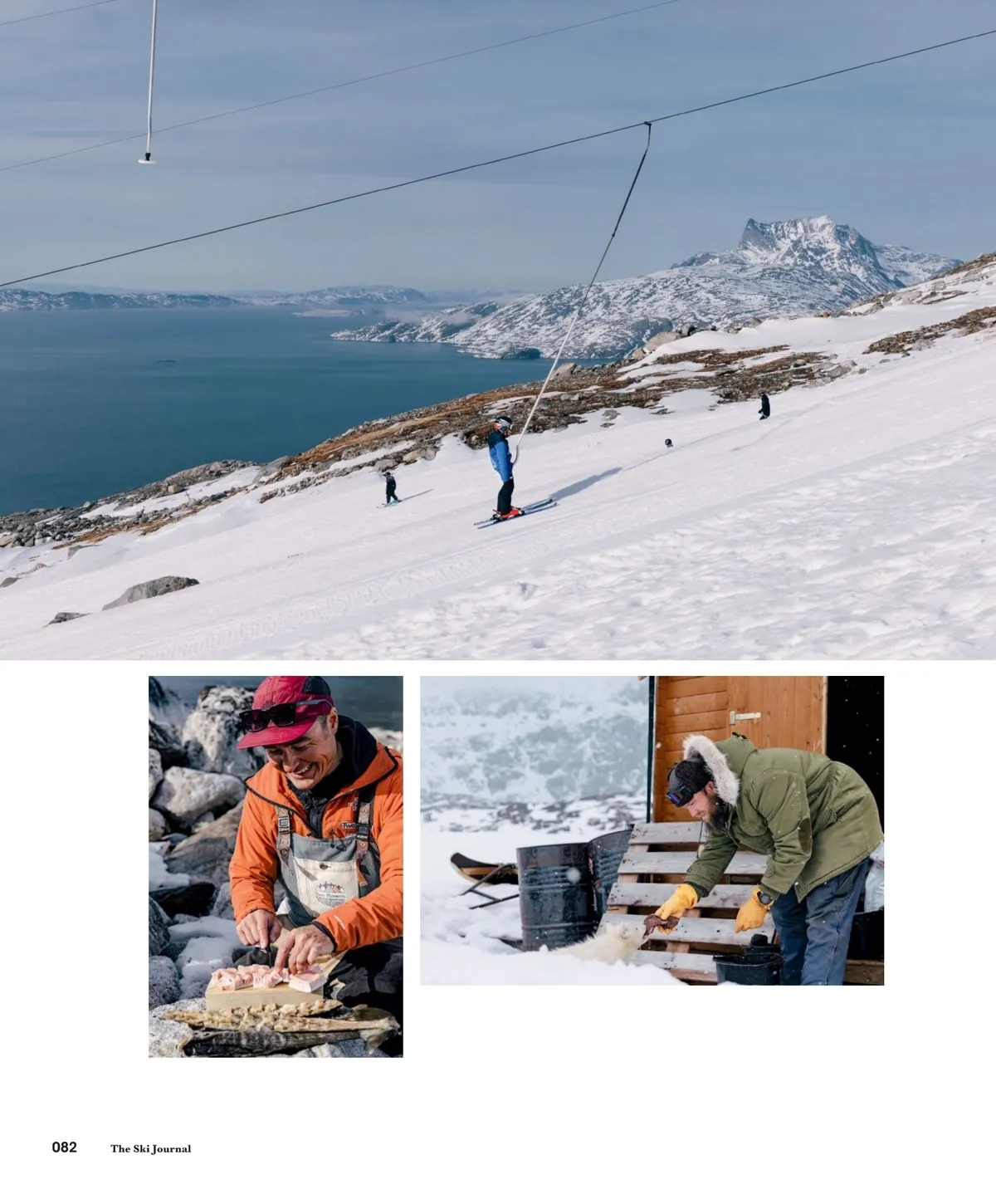
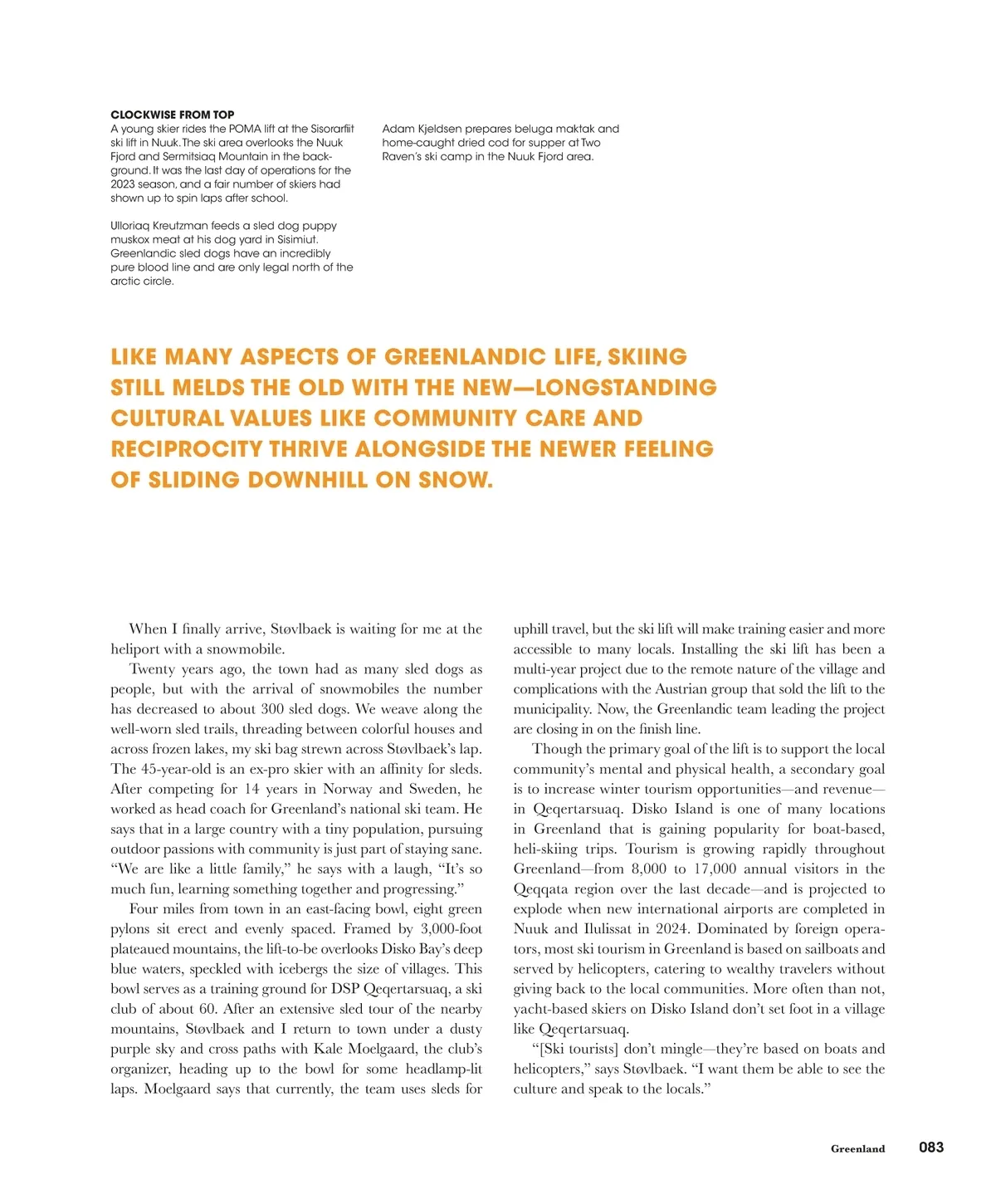
CLOCKWISE FROM TOP A young skier rides the POMA lift at the Sisorarfiit ski lift in Nuuk. The ski area overlooks the Nuuk Fjord and Sermitsiaq Mountain in the back-ground. It was the last day of operations for the 2023 season, and a fair number of skiers had shown up to spin laps after school. Ulloriaq Kreutzman feeds a sled dog puppy muskox meat at his dog yard in Sisimiut. Greenlandic sled dogs have an incredibly pure blood line and are only legal north of the arctic circle. Adam Kjeldsen prepares beluga maktak and home-caught dried cod for supper at Two Raven’s ski camp in the Nuuk Fjord area. LIKE MANY ASPECTS OF GREENLANDIC LIFE, SKIING STILL MELDS THE OLD WITH THE NEW—LONGSTANDING CULTURAL VALUES LIKE COMMUNITY CARE AND RECIPROCITY THRIVE ALONGSIDE THE NEWER FEELING OF SLIDING DOWNHILL ON SNOW. When I finally arrive, Støvlbaek is waiting for me at the heliport with a snowmobile. Twenty years ago, the town had as many sled dogs as people, but with the arrival of snowmobiles the number has decreased to about 300 sled dogs. We weave along the well-worn sled trails, threading between colorful houses and across frozen lakes, my ski bag strewn across Støvlbaek’s lap. The 45-year-old is an ex-pro skier with an affinity for sleds. After competing for 14 years in Norway and Sweden, he worked as head coach for Greenland’s national ski team. He says that in a large country with a tiny population, pursuing outdoor passions with community is just part of staying sane. “We are like a little family,” he says with a laugh, “It’s so much fun, learning something together and progressing.” Four miles from town in an east-facing bowl, eight green pylons sit erect and evenly spaced. Framed by 3,000-foot plateaued mountains, the lift-to-be overlooks Disko Bay’s deep blue waters, speckled with icebergs the size of villages. This bowl serves as a training ground for DSP Qeqertarsuaq, a ski club of about 60. After an extensive sled tour of the nearby mountains, Støvlbaek and I return to town under a dusty purple sky and cross paths with Kale Moelgaard, the club’s organizer, heading up to the bowl for some headlamp-lit laps. Moelgaard says that currently, the team uses sleds for uphill travel, but the ski lift will make training easier and more accessible to many locals. Installing the ski lift has been a multi-year project due to the remote nature of the village and complications with the Austrian group that sold the lift to the municipality. Now, the Greenlandic team leading the project are closing in on the finish line. Though the primary goal of the lift is to support the local community’s mental and physical health, a secondary goal is to increase winter tourism opportunities—and revenue— in Qeqertarsuaq. Disko Island is one of many locations in Greenland that is gaining popularity for boat-based, heli-skiing trips. Tourism is growing rapidly throughout Greenland—from 8,000 to 17,000 annual visitors in the Qeqqata region over the last decade—and is projected to explode when new international airports are completed in Nuuk and Ilulissat in 2024. Dominated by foreign opera-tors, most ski tourism in Greenland is based on sailboats and served by helicopters, catering to wealthy travelers without giving back to the local communities. More often than not, yacht-based skiers on Disko Island don’t set foot in a village like Qeqertarsuaq. “[Ski tourists] don’t mingle—they’re based on boats and helicopters,” says Støvlbaek. “I want them be able to see the culture and speak to the locals.” Greenland 083
The Ski Journal Volume 17, Issue 3: Page 83